

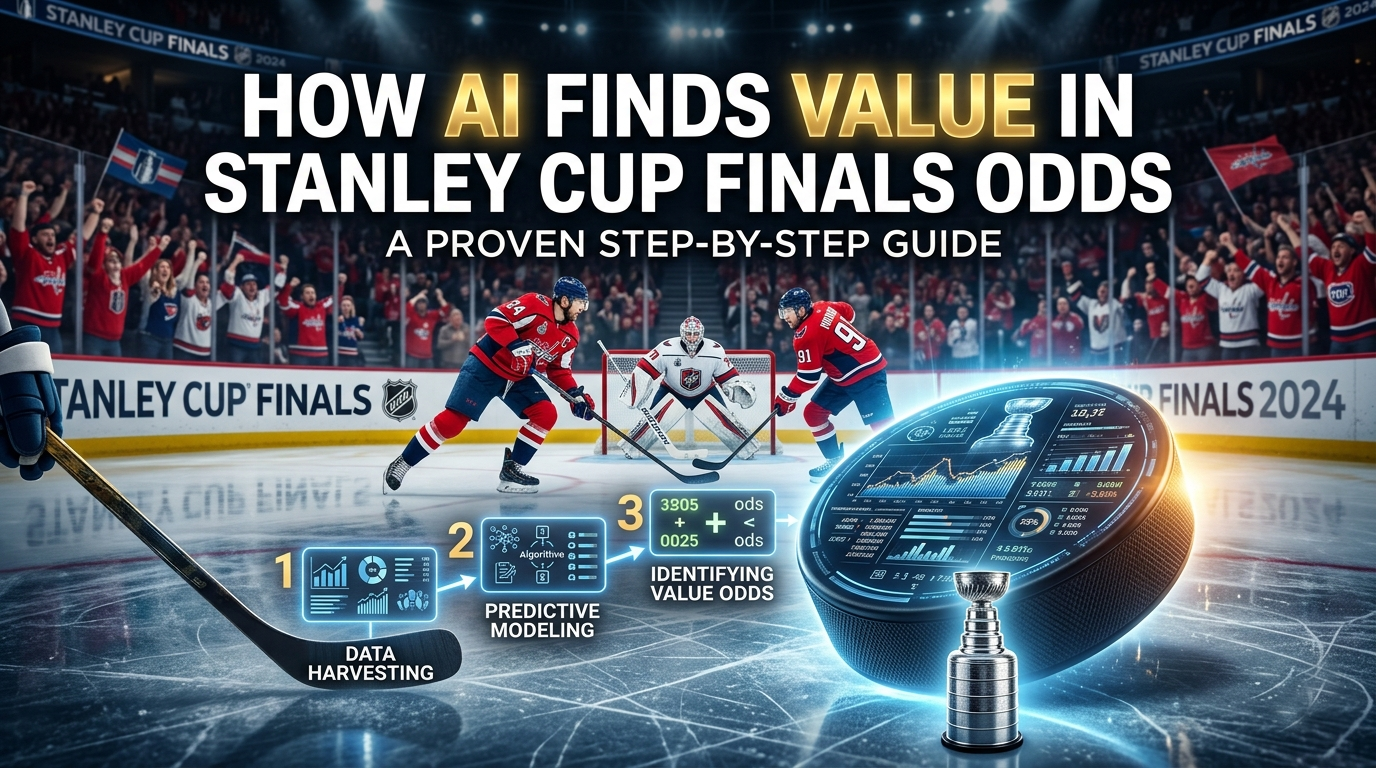
Stanley Cup Finals odds swing fast, and I build my edges with AI models that translate on-ice data into clear probabilities. We are going to cut through the noise of goalie news, public bias, and travel, and I will show you exactly how to price moneylines, totals, and series. Expect plain talk, step-by-step methods, and actionable examples you can use well before the market moves.
Market mechanics and mispricing in Stanley Cup Finals odds
The Stanley Cup Final is a totally different market. Limits go up, handle spikes, and public money is incredibly loud. But those same traits create mispricing windows that you just do not get in January. AI can help you isolate those specific windows instead of just guessing.
Finals markets are not truly thin, but they are narrower than the entire regular-season slate, and they get overexposed to public narratives. Public bias is huge here. Star players and high-profile markets like Original Six teams or Canadian markets draw way more tickets than they deserve relative to their actual strength. Bettors tend to overreact to highlight-reel goals, fights, and goalie controversy, and the number shifts are rarely proportional to the actual change in win probability.
Media narratives also play a massive role. Team of destiny angles and coaching legacy talk inflate prices constantly. A single blowout causes a fashionable narrative on momentum, even if the five-on-five underlying play did not change at all. Meanwhile, books tend to shade toward likely public sides to balance their risk, especially early in the series. Liquidity swells near puck drop, which is when price discovery finally sharpens. If you model well, you will often like your entries either early before limits rise, assuming your edge is news-based and you can get down, or late once your data stabilizes after lineups are confirmed.
A simple way to exploit this with AI is to quantify where the closing line tends to settle relative to early moves. Track your model’s fair prices at open, twenty-four hours out, and right before puck drop, then measure closing line value. If your process consistently beats the close in the Finals, your edge is real. If not, you need to adjust your inputs.
Goaltending announcements and travel quirks can move Finals lines more than in the regular season. A Vezina-caliber starter scratched in Game Five can swing twenty to forty cents on the moneyline, sometimes more if the backup has sketchy playoff exposure. In June, every bit of information like injuries, back spasms, or illness hits a more efficient tape, but it also creates massive overreactions. Finals lines often overshoot on short-sample goalie trends, such as a week-long heater or slump. AI allows you to anchor to rolling goal saved above average and rebound-control metrics while shrinking to a rest-of-season prior. That stabilizes the swing versus just reading headlines.
The impact of last change also grows with coaching precision. Home coaches can hard-match top lines, and that is way more valuable in evenly matched series. Altitude or long travel legs get priced in differently in June, when off days are scripted and fatigue is cumulative. One top-pair minute-eater or penalty kill ace missing eighteen to twenty-two minutes matters much more in a tight series. Market headlines catch it, but the line-by-line impact is usually under-modeled by the public.
To convert odds to implied probabilities, do not just eyeball it. Convert, compare, then act. First, convert American odds to implied probability. For favorites like minus one-fifty, the probability is one-fifty divided by the sum of one-fifty and one hundred, which is sixty percent. For underdogs like plus one-forty, the probability is one hundred divided by the sum of one-forty and one hundred, which is about forty-one point sixty-seven percent. Adjust for hold by normalizing across both teams if you want the true fair market average.
Second, compare that implied to your model’s win percentage. If the market’s implied is sixty percent and you are at fifty-seven point eight percent, you likely pass or consider the other side. If you are at sixty-two point five percent while the market says sixty percent, you have found an edge, assuming your calibration is sound. Third, repeat for totals and series prices. For totals, translate expected goals from your Poisson or Skellam model to over or under probabilities and compare to total prices. For series, convert to match win probabilities and simulate series trees. Small game-by-game edges compound significantly.
Data that actually moves the needle in June hockey
Earlier searches do not show a secret Finals-only metric, and that is fine. Lean on well-known, proven inputs, then adjust how you weight them for the high-stakes playoff environment.
Five-on-five expected goals and shot quality are foundational. Use team-level and on-ice line-level expected goal rates from reliable sources. Weight high-danger chances and pre-shot movement, because shots after east-west passes are much more dangerous. Rush chances often decide tight playoff games, so model their frequency and conversion rates. Tag passes across the slot line if you can.
On-ice matchups and last-change effects are crucial. Encode typical head-to-heads such as top line versus checking line or top defensive pair versus top six. On home ice, last change magnifies these patterns. Goalie form and rebound control are also vital. Use rolling goal saved above average with game-by-game exponential smoothing, rebound suppression, and lateral movement efficiency. Avoid raw save percentage without context.
Special teams volatility is inevitable because playoff whistle rates fluctuate. Price the power play and penalty kill talent, then apply a variance premium. Do not double count if your even-strength expected goals already bake in team quality. Rest and travel quirks matter too. Back-to-back games do not happen in the Final, but recovery windows, cross-continent flights, and altitude change fatigue levels. Track minutes for stars late in games.
Score effects and empty-net tendencies are specific to coaches. Teams chasing will pull the goalie earlier or later depending on coach tendencies, and that matters for totals and puckline tails. Encode team-specific pull times and trailing shot surges. Keep your feature set organized. Create game state splits for five-on-five, five-on-four, four-on-five, and four-on-four rates per sixty minutes. Separate tied, leading, and trailing states to capture score effects. Use a minutes-weighted prior at the player and line level because more minutes equals more trust. Apply ridge or hierarchical shrinkage so noisy series do not swing your rates wildly.
Maintain a rolling view of line combinations by minutes played together in the last ten to fifteen games, decayed more slowly in playoffs to reflect intentional stability. Encode injury impact via replacement-level deltas, for example, removing a top-pair defenseman reduces team expected goal share and penalty kill strength by specific basis points observed historically. Stabilize goalie inputs using rolling goal saved above average with exponential decay, such as an eighty-five percent weekly factor. Venue impacts tempo, and certain officiating crews correlate with power play time variance, so include a mild league-average prior for officiating if you are unsure of the data quality.
Modeling stack that finds value
Your stack does not have to be exotic. It just has to be honest, calibrated, and free of leakage. For win probability, start with logistic regression as a strong baseline that is transparent and easy to calibrate. Include interactions like expected goal differential times last change or goalie goal saved above average times rush chance rate allowed. Add gradient boosted trees, like XGBoost or LightGBM, for non-linear lift, which can capture threshold effects such as when a matchup crosses a danger level. Always watch for overfitting by capping tree depth, tuning the learning rate, and applying early stopping.
Calibration is critical. Use isotonic regression on out-of-fold predictions and verify with reliability curves and Brier scores. If your sixty percent bins win sixty to sixty-one percent over multiple seasons, you are on the right track. For totals and goal lines, model team goals as Poisson processes with rates derived from expected goals and finishing talent adjustments. Adjust for correlation between teams regarding game tempo and penalty frequency. If you do not, totals variance can be mispriced. Use the Skellam distribution for goal difference, which is the puckline, with correlation correction via a copula or heuristic covariance term grounded in historical co-movement.
Cross-validation and backtesting must be done the right way. Use time-aware folds, meaning cross-validate by season-weeks or series blocks, not random shuffles. This prevents leakage and simulates real deployment. Hold out at least two Cup runs for a true out-of-sample test. You want to see how the model behaves when pressure and coaching adjustments rise. Guard against leakage by not including post-game stats or news timestamps that occur after lines would have been bet. Keep line combos and injury flags aligned to the time of bet, such as morning skate versus game-time.
Quantify uncertainty so you do not overbet. Bootstrap confidence intervals by resampling games and re-estimating the model to get a distribution around your probabilities. If your fifty-eight percent projection has a wide fifty-four to sixty-two percent interval, size down accordingly. Separate goalie uncertainty from team play uncertainty. Goalie variance runs hot in short series, so reduce bet size if net uncertainty spikes. Test stress scenarios, like a starter being scratched or reduced power play opportunities, to see how the edge shifts, and pre-plan what you will do.
Converting model edges into smart positions
Turning probabilities into profits is just arithmetic and discipline. Nothing fancy is needed, just a system. To compute your fair price, edge percentage, and expected value, you need a workflow. First, convert book odds to implied probability, adjusting for hold if you want a cleaner comparison. Second, compute your model probability. Third, calculate the fair American price. If your model probability is greater than fifty percent, the fair odds equal negative one hundred times your probability divided by one minus your probability. If the model probability is less than fifty percent, the fair odds equal positive one hundred times one minus your probability divided by your probability.
Fourth, calculate the edge and expected value. The process starts by understanding sports betting expected value explained in a way that emphasizes the math over the narrative. When you look at expected value betting for beginners, the core principle remains consistent: you must identify when the probability of an outcome occurring is greater than what the bookmaker’s odds imply. Once you learn how to calculate expected value in sports betting, you realize that finding a small, repeatable mathematical advantage is far more sustainable than chasing massive long-shot parlays. For example, if the market has a team at minus one-thirty-five, which is an implied fifty-seven point four percent, and your model says sixty point five percent, your fair price is roughly minus one-fifty-three. That is an eighteen-cent edge. That equates to about a five point three percent expected value. Consider it, but still check liquidity and news windows.
For totals, translate your model expected goals to over or under probabilities at the posted line and price. If your over five point five probability is fifty-seven percent and the book is minus one-hundred-five, which is an implied fifty-one point two percent, you have room, but verify your correlation assumptions and late goalie status. For series prices, simulate outcomes using your game-by-game win probability tree with home and away adjustments and last-change toggles. Compare the series fair price to the market, and if you prefer game-by-game, ensure your series exposure is not duplicating the same edge, which is correlated risk.
Entry and exit rules around news windows are how you win. Edges come from information and timing. Be intentional. Pre-skate openers have smaller limits and softer numbers. If your edge is matchup-based and steady, you can enter here with modest size. Between the morning skate and coach availability, injury and goalie confirmation windows occur. Prices move fast. If the market overreacts to a goalie switch and your model deems the delta smaller, consider the buyback. Sixty to ten minutes to puck drop is when liquidity spikes and sharper money sets the closing price. If you still show edge here after calibrating, that is a high-confidence signal.
In the Final, hedging gets attention but can destroy expected value if done reflexively. Only hedge when your new posterior odds and prices justify it. Track your closing line value religiously. If you beat the close consistently, your process is working even if the puck bounces the wrong way in the short term. For position sizing, use fractional Kelly. The Kelly fraction equals the edge divided by the odds payout. Use half or quarter Kelly to reduce drawdowns. Set max exposure per game, such as two to three percent of your bankroll, and per series, such as five to seven percent, to avoid blowups. Minimum bet thresholds avoid nickel-and-diming tiny edges that get crushed by the vig.
Do not load a moneyline, team total over, and two player goal props on the same game if they all hinge on the same tempo thesis. Use a portfolio view to look at the expected covariance between legs and a cap for a single-game cluster. In heavily juiced props, your edge must clear a higher bar, so skip the zero point eight percent edges. Log every bet, model snapshot, and market price, and review them weekly. Compare outcomes to closing lines to ensure your edges show up as closing line value, not just results variance.
Workflow, tools, and reporting
You do not need a giant team. You need clean data, reproducible runs, and honest feedback loops. Pipe raw National Hockey League play-by-play into features. Data ingestion should pull play-by-play and shift data and enhance it with expected goals from reliable models. Feature engineering should build per-sixty and on-ice pair features with game state splits. Maintain rolling windows with minutes-weighted priors and exponential decay, keeping in mind that playoffs decay slower than the regular season.
Model training can use Python and scikit-learn for logistic baselines, isotonic calibration, and reliability curves. For Poisson or Skellam models, implement custom likelihood fits and calibrate totals with historical dispersion. Automation is key, so use daily or event-driven pipelines where new data comes in, features are updated, models are trained, and outputs are written. Create alerts to flag large deltas in predicted edges versus yesterday, which often surface data issues or new injuries.
Sanity-check everything with domain heuristics. Numbers guide the bets, but hockey knowledge keeps you out of trouble. If a coach shortens the bench, does your player-level weighting reflect it yet? Are you double counting a star’s impact both in team advanced impact metrics and on-ice expected goals without shrinkage? Is a goalie’s recent heater anchored to low shot quality against? Do not pay twice for the same perceived value. Set soft blocks when uncertainty is extreme, such as goalie illness the morning of the game, and cap position sizes when your bootstrap intervals exceed predefined error bands.
Stakeholders need to trust the outputs, especially when a model likes an ugly under. Use SHAP values on your tree models to show which features moved a projection. Highlight matchup keys like home defensive pair one versus away line one suppressing slot chances, or goalie rebound control trends favoring the under. After each game, compare actual game flow to expected flow. Did the team generate fewer rush chances than projected? Did special teams minutes deviate from the expected band? Update process rules if you see repeat misses, such as underestimating late pull times for a specific coach.
Communicate results simply. Investors and bettors do not want a statistics lecture right before puck drop. Provide a standard game brief including the fair moneyline price, edge percentage, suggested size, three key model drivers, and risk flags. A quick chart of predicted probability versus the market over the last twenty-four hours is very helpful. Provide a portfolio snapshot showing exposure by team, series, and bet type, and clearly mark correlated clusters and caps. Finally, keep a historical calibration card that shows realized outcomes in the last two playoff runs for each probability bin. Keep it small, readable, and honest.
Data that ATSwins uses to sharpen Stanley Cup positions
ATSwins’ National Hockey League process brings together public metrics and platform-specific signals that align with what actually moves the market in June. Core performance is measured through even-strength expected goal share, high-danger shot quality, and rush and cycle chance rates. We use adjusted impact metrics to remove teammate and opponent noise.
For goaltending, we use rolling goal saved above average with decay, rebound control proxies, and lateral movement context where available. We also account for back-to-back or heavy workload fatigue indicators from shift and time-on-ice patterns. Regarding matchups and last change, we use projected lines with time-decayed priors and matchup matrices on home ice for coach preferences, along with on-ice suppression rates by defensive pair against an opponent’s top six.
Special teams analysis includes power play shot quality and puck recovery rates, along with penalty kill denial rates and exit efficiency. We apply a variance premium on penalty minutes because playoffs can whipsaw power play time. Regarding market and splits, betting splits can reveal crowded sides. We do not fade the public blindly, but when public tickets surge and our fair price diverges, that is a flag to inspect news versus narrative. We track closing line value to validate whether our opinions age well into the close.
Practical how-to: from inputs to bets on a Finals game
A short, repeatable checklist you can run on every game day will save you time and keep you disciplined. In the morning, about ten hours before the game, update your data by ingesting the prior game’s play-by-play and shift data. Recompute features with rolling windows and decay. Run your win-probability and totals models, then output fair prices and error bars. Flag any material differences of fifteen cents or more versus market openers.
Midday, around six hours before the game, scan for news as goalie confirmations likely begin. Adjust projections only after verifying source reliability. Check betting splits, and if public pressure pushes one side while your fair price moves the other way, plan your entry. In the afternoon, three hours out, re-run models after skate updates and expected lineups. Publish your internal brief, which should contain your fair moneyline or total, the edge percentage, your suggested fractional Kelly stake, and any risk notes.
Pre-game, from sixty to ten minutes before puck drop, perform your final sweep. Verify lineups and goalies and compute the last change effect for the home team. Place or top-up your positions if the edge persists and liquidity improves. Log your price and stake, noting your rationale tags like goalie delta, matchup suppression, or power play versus penalty kill edge. Post-game, update your closing line value log and result, and add it to your calibration bins. Run a quick postmortem to see if game state or officiating broke your assumptions, and tag it accordingly.
Totals and props in the Final: where AI adds or trims risk
Totals get tight in June. Teams close ranks, and coaches shorten benches. You can still find value if you are precise about game scripts. For unders with matchup suppression, if both teams’ first pairs suppress slot chances and both goalies have strong rebound control, your Poisson rates should drop more than a market that keys mostly on season-long expected goal averages.
Overs from pace pockets are also possible. Tactical adjustments, such as stretching the neutral zone for rush looks, can pop after a coach calls it out. If you detect a real shift in data like more stretch passes and faster controlled entries, you can project a higher rush expected goal share and tilt the total. For player props, use line-level expected goal share, on-ice shot rates, and power play time projections. Watch for correlated exposure. If you like the under and still take multiple shots-on-goal overs on the same line, make sure you are not contradicting your core script. Empty-net tails are also important. Coach pull tendencies matter more in Finals when teams will not quit early. A coach who pulls at two minutes aggressively can create a fatter tail on pucklines and late overs.
Calibration, reality checks, and humility
Even the cleanest model needs grounding in real game dynamics. Use reliability curves to plot predicted versus realized probabilities in bins. Expect slight miscalibration early in a series as coaches adjust, and recalibrate slowly to avoid chasing small samples. Regarding finishing talent and luck, shooting percentage spikes happen. Avoid the trap of overfitting to three or four games, and let finishing talent regress toward multi-season baselines unless there is a clear tactical change.
Accept that elite goalies can swing single-game outcomes beyond what expected goals imply. That is normal, and it does not mean your expected goal model is broken. It means you should size bets with uncertainty in mind. The Finals invite both underreaction and overreaction. Media can overreact to a blowout, while models can underreact to tactical change. Track shot locations, pre-shot movement, and rush or cycle balance next game to decide which it was.
Templates and quick tools to speed up Finals work
You should have an odds-to-probability template, which is a small spreadsheet containing American odds to implied probability conversion with an optional hold adjustment, model probability to fair odds conversion, edge calculation in cents, expected value per dollar, and fractional Kelly sizing with bankroll input and cap rules. You also need a game script matrix, which is a three-by-three template with expected pace on one axis and special teams minutes on the other, where you pre-fill edge direction for moneyline, total, and common props.
A line matchup sheet is also necessary. This should cover top-six versus top-four pairs, projected minutes, historical expected goal suppression, rush allowance, and faceoff zone starts, color-coded for last-change advantage at home. Finally, keep a closing line value and calibration dashboard. Track your bet price versus close, plus reliability by probability bin. A weekly snapshot will tell you whether to push, pull, or pause your efforts.
Using external sources the right way
A few external resources help but should be harmonized, not swallowed whole. MoneyPuck is great for expected goal models, goalie metrics, and game probability baselines, making it excellent for grounding assumptions. NHL Edge offers speed and tracking-style context to inform rush versus cycle expectations. Hockey-Reference provides historical splits and team trends, which are handy for sanity checks and long-run rates. Evolving-Hockey offers advanced impact metrics and adjusted rates that help separate player impact from context. Finally, scikit-learn provides practical modeling and calibration tools. Use their isotonic and cross-validation utilities to keep your predictions honest.
Final notes on ATSwins process for the Cup
In terms of what moves the market, we focus on public bias, star focus, goalie news, and last change. We map all four directly into features and pre and post-line checks. For what moves the result, we look at five-on-five chance quality, pre-shot movement, rush creation, goalie rebound control, and tactical matchups. We price these higher than momentum.
We act using time-aware validation, proper calibration, bootstrap uncertainty, fractional Kelly, and closing line value tracking. We would much rather bet three high-quality edges than ten coin flips, even during the Final. We keep it simple for users with clean cards showing fair price, edge, suggested size, three drivers, and risk flags. Profit tracking and closing-line comparison are baked in so you can tell if we are beating the market even when variance bites.
Conclusion
We have covered how to price Stanley Cup Finals odds with AI, turn news into fair lines, and then act with timing and bankroll control. The biggest levers remain goalie form, five-on-five shot quality, and tactical matchups. Always convert to implied probabilities, size with fractional Kelly, and track closing line value. For help, ATSwins is an AI-powered sports prediction platform offering picks, player props, betting splits, and profit tracking across the National Football League, National Basketball Association, Major League Baseball, National Hockey League, and National Collegiate Athletic Association. Free and paid plans help you decide smarter.
Frequently Asked Questions (FAQs)
What do Stanley Cup Finals odds actually mean?
Stanley Cup Finals odds show the market’s view of each team’s chance to win games or the series. American odds like negative one-thirty or plus one-fifteen translate to implied probabilities, roughly fifty-six point five percent and forty-six point five percent before the hold. When you see Stanley Cup Finals odds move, it usually reflects new info like goalie updates, injuries, or rest, and sometimes just money hitting one side. Knowing this helps you judge price versus true chance.
How do I turn Stanley Cup Finals odds into implied probabilities?
To convert American Stanley Cup Finals odds to implied probabilities, use the following math. For negative odds like minus one-thirty, the probability is one-thirty divided by the sum of one-thirty and one hundred, which is fifty-six point fifty-two percent. For positive odds like plus one-fifty, the probability is one hundred divided by the sum of one-fifty and one hundred, which is forty percent. Do this for both sides of the Stanley Cup Finals odds, then note the gap, which is the vig. If your own estimate is higher than the implied probability, you may have an edge, which is small but real.
Which factors move Stanley Cup Finals odds the most during a series?
Several things push Stanley Cup Finals odds around. Goalie status and form, such as hot streaks, goal saved above average trends, and back-to-back fatigue are primary movers. Special teams swings and matchup quirks with last change are also massive factors. We also look at five-on-five shot quality, rush chances, and pre-shot movement. Travel and rest days, especially after overtime, and score effects or empty-net patterns late in games also play a role. Books and bettors react fast, so Stanley Cup Finals odds can jump on morning skate news and again at lineups.
How does ATSwins.ai help me read Stanley Cup Finals odds with more confidence?
ATSwins.ai is an AI-powered sports prediction platform offering data-driven picks, player props, betting splits, and profit tracking across the National Football League, National Basketball Association, Major League Baseball, National Hockey League, and National Collegiate Athletic Association. For Stanley Cup Finals odds, ATSwins.ai combines market data and on-ice metrics to surface value spots on moneylines and totals. You will see probabilities, edges, and performance tracking so you do not fly blind. Free and paid plans give you actionable signals plus simple dashboards that make fast decisions easier, especially when prices move on late goalie news.
What’s a smart way to size bets when dealing with Stanley Cup Finals odds volatility?
Stanley Cup Finals odds can be sharp and swingy, so keep it simple. Set a fixed bankroll for the series and cap your risk per play between zero point five percent and one point five percent. Scale your stake with your edge size, so a smaller edge means a smaller bet. Avoid stacking correlated bets in the same game. Track your closing line value to see if you are beating the market. This keeps you alive through variance while the Stanley Cup Finals odds bounce around. A little discipline goes a long way.