

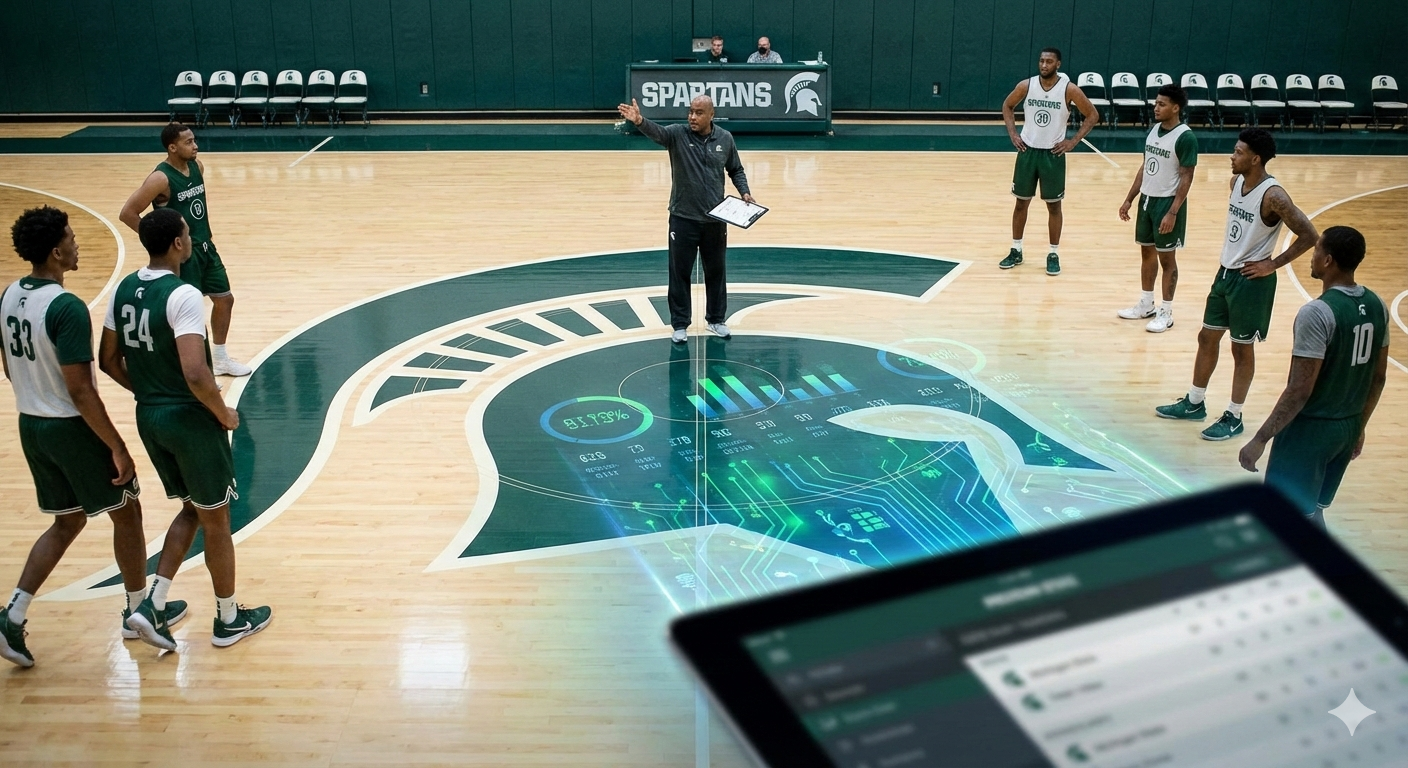
Michigan State basketball continues to draw attention for a reason beyond Tom Izzo’s legendary grit-and-glass style. The Spartans consistently combine disciplined defense, aggressive rebounding, and smart shot selection to create an identity that travels well in the Big Ten and in March.
Understanding MSU requires blending on-court scouting, advanced analytics, and AI-driven models to project matchups, shot quality, and tempo swings. Translating these insights into practical analysis reveals what matters most, why it carries across venues, and how it impacts outcomes for spreads and totals.
Table Of Contents
- Program Snapshot & Identity
- Roster and Player Development
- Coaching Philosophy & Tactics
- Big Ten Landscape and Schedule
- Analytics and AI Workflow
- What to Watch in Shot Quality and Foul Discipline
- How to Prepare Game-By-Game with a Spartan Checklist
- Late-Game ATOs and One-Score Scenarios
- Templates and Tools for Repeatable Bets
- Using ATSWins with MSU-Specific Angles
- What to Watch as the Season Matures
- Matchup Archetypes and How MSU Fares
- Turning Film into Numbers—Quick How-To
- ATO Scoring and the Late-Possession Economy
- Home vs Road Profile Cues for MSU
- Notes on Totals and Possession Expectations
- Quick Reference Workflow Before You Bet
- What Makes MSU a Consistent Modeling Target
- Small Edges That Add Up
- Practice for Analysts: Build Your MSU “Edge Ledger”
- Conclusion
- Frequently Asked Questions (FAQs)
Key Takeaways
Michigan State under Tom Izzo has built a program around three pillars: defensive rebounding, disciplined defense, and opportunistic transition offense.
The Breslin Center and the Izzone student section provide tangible energy advantages that show up in close games. The metrics that consistently drive outcomes include defensive rebounding percentage, turnover rate, free throw rate, and shot quality, particularly rim attempts and catch-and-shoot threes.
When modeling the Spartans, per-possession stats offer more insight than raw totals, and their simple but effective action sets, including Horns formations, baseline out-of-bounds wrinkles, and re-screens, create repeatable advantages. Big Ten play is physically demanding, and travel, rest, and pace windows can influence outcomes.
ATSWins offers a platform to track projections, player stats, and matchup-based insights to guide smarter decisions with these factors in mind.
Program Snapshot & Identity
Tom Izzo took the Michigan State job in the mid-1990s and turned the Spartans into a consistently competitive program known for defense, rebounding, and disciplined shot selection. The national title in 2000 set a high standard, and a string of Final Four appearances cemented MSU as a March presence regardless of roster turnover.
The Spartans’ defensive rebounding and transition readiness form the backbone of the team’s identity. Offensive rebounding, contested 50-50 balls, and physical screening translate effectively even on neutral floors in tournament settings. The program’s NBA pipeline, including players like Draymond Green, Jaren Jackson Jr., Miles Bridges, Gary Harris, Denzel Valentine, and Cassius Winston, reinforces recruiting and demonstrates the staff’s comfort developing length and switchable defenders.
The Breslin Center and the Izzone amplify MSU’s defensive pressure and transition game with energetic, organized support. Home games show better communication on switches, slightly more aggressive rebounding, and improved shot confidence from role players. When forecasting games, defensive rebounding and turnover pressure are usually stronger at home, while foul frequency can be slightly lower due to officiating tendencies.
MSU’s defensive DNA emphasizes strong perimeter pressure, helping funnel drivers into controlled help rather than gambling for steals. Help-and-recover schemes limit rhythm threes, and first-hit positioning on box outs ensures the defensive rebounding engine operates effectively. Offensively, players read shots and game state, committing to the glass selectively. Effective field goal defense stabilizes by midseason, while rebounding indicators settle earlier, offering a reliable foundation for projections.
March consistency comes from players’ ability to defend multiple positions, execute ball screens against various coverages, and finish as rollers or cutters. Guards develop early-passing instincts and two-read decisions. These habits appear in close games where half-court execution is critical, giving MSU reliable scoring opportunities without unnecessary risk.
Roster and Player Development
MSU rosters fluctuate with portal moves, redshirts, and injuries, so analyzing the team by role rather than names provides consistent insights. Guards handle on-ball creation, point-of-attack defense, and tempo control. Wings offer size, switchability, secondary rebounding, and spacing. Bigs contribute rim protection, post touches, and defensive rebounding. Tagging players by usage role, defensive responsibilities, and transition duties produces data that moves modeling results more than individual names.
Rotation tiers matter for projecting game flow. Tier one players carry heavy minutes and influence both ends. Tier two contributors provide matchup advantages or secondary scoring. Tier three players supply energy and specialist minutes, while tier four is situational for specific packages or press breaks. Weekly tracking of minutes, foul trends, defensive rebounding, and matchups against top scorers reveals staff trust and player impact.
Freshman wings often develop in Tier three and move into Tier two after the first half of the season, impacting totals and transition pace. Redshirts and portal additions fill specific roles, such as spacing or defensive stopping. Injuries to primary bigs influence rim defense, foul exposure, and opponent layup frequency, creating opportunities to adjust totals.
Coaching Philosophy & Tactics
MSU relies on a controlled and repeatable offensive system with Horns entries, floppy screen variations, baseline out-of-bounds packages, and secondary break options. Re-screening and elevator doors create late-clock efficiency, while the secondary break takes advantage of trailing players and drag screens. Defensive rebounding and offensive rebounding adjust pace and scoring volume depending on opponent strength.
Ball-screen coverages shift between drop, hedge, show, or switch based on opponent tendencies. End-of-game switches reduce open pick-and-pop threes, while pre-switch rotations involve wing defenders. Tempo is managed via defensive rebounding success rather than forcing the pace, and foul discipline is emphasized to avoid early-game foul trouble that compromises rim protection. Early fouls on starting bigs can change total projections by one or two points depending on bench depth.
Big Ten Landscape and Schedule
The Big Ten is one of the most physically demanding conferences in college basketball. Teams hit hard in the post, close out aggressively on shooters, and often slow the game down to grind out possessions.
For Michigan State, this environment plays to their strengths. The Spartans’ identity—strong defensive rebounding, versatile wings, and efficient half-court execution—matches up well against the league’s physical style. When MSU travels to arenas in Madison, Champaign, or Piscataway, pace often drops slightly due to travel fatigue and the physicality of opposing rosters. Rivalries, particularly against Michigan, can amplify volatility. Intensity spikes in these games often result in higher turnover counts and wider swings in score distributions, making modeling and projections trickier but also providing sharp opportunities for those tracking edges.
Key matchups against top-heavy teams like Purdue require careful attention to turnovers and defensive rebounding, while Q1 road wins carry major bracket implications and can shape perceptions of the Spartans’ tournament readiness. Nonconference tests, typically scheduled in November and December against high-major opponents, serve as early calibration points.
These games help analysts establish baseline metrics for turnover creation, transition efficiency, and the pace at which MSU can push the ball against elite athletic teams. Understanding these schedule nuances is critical for projecting spreads, totals, and lineup-specific performance throughout the season.
Analytics and AI Workflow
Modeling Michigan State requires a layered approach that blends team fundamentals, lineup data, opponent tendencies, and contextual variables. At the team level, key factors include effective field goal percentage, turnover rate, offensive and defensive rebounding, and free throw rate. Lineup-level metrics track on/off splits, defensive rebounding swings, and turnover pressure with specific guard and wing combinations. Opponent-specific tags focus on tendencies such as ball-screen frequency, post-up volume, and spot-up shooting efficiency.
Analysts also incorporate context variables such as rest days, travel miles, altitude changes, referee tendencies, and rivalry indicators, all of which can subtly shift expected outcomes. Feature engineering goes further, adjusting shooting stats for pace, tracking rolling three-game rebounding rates with opponent strength adjustments, flagging potential travel fatigue, and calculating shot profile deltas to capture mismatches or defensive weaknesses. Turnover creation is tagged by coverage type, while foul sensitivity measures how early infractions on bigs can influence bench rotations and scoring opportunities.
Machine learning models—tree ensembles like LightGBM, logistic regression for ATS probability, and stacked models combining pace and spread predictions—help capture nonlinear interactions between these inputs. Calibration ensures that predicted probabilities align with historical performance, while rolling 20–30 game windows and time-based cross-validation catch shifts in performance trends and blind spots. Analysts monitor defensive rebounding edges, opponent spacing, turnover control, and whistle environments to refine predictions. Live-bet opportunities emerge when MSU dominates early defensive rebounding, generates clean outlets, or suppresses corner threes, giving actionable in-game angles for total adjustments or spread tweaks.
Shot Quality and Foul Discipline
Michigan State prioritizes high-value shot opportunities that align with their identity. The ideal offensive map includes rim attempts generated through slips, cuts, and secondary screens, alongside catch-and-shoot threes from wing positions. Midrange shots are generally reserved for late-clock situations as a fallback option, rather than a primary scoring plan. Poor shot quality often emerges when contested twos dominate possessions, or when isolation plays replace team-oriented scoring actions. On the defensive end, foul discipline is emphasized across the roster, but the physical nature of Big Ten basketball sometimes results in tight whistle games, particularly on the road. Early fouls can force bench bigs into extended minutes, impacting rim protection and potentially prompting slight in-game total adjustments. Tracking first-five-minute foul patterns offers predictive insight into the likely pace and efficiency of the early portion of the game.
Game-by-Game Preparation
Analysts preparing for individual matchups start by confirming starters, minute tiers, and player availability from official sources. Opponents are tagged by playing style, such as post-heavy lineups, pick-and-roll oriented schemes, or switch-all defensive approaches. Estimating offensive and defensive rebounding advantages, alongside pace adjustments based on road travel and rest, helps contextualize performance expectations.
Comparing projected spreads and totals to market figures provides insight into edges, while ATSWins splits and prop data offer additional guidance on value areas. Early-game performance indicators—such as successful defensive rebounding cycles, foul patterns on primary bigs, or suppression of opponent corner threes—can inform real-time adjustments and create opportunities for more precise modeling during the game.
Late-Game ATOs and One-Score Scenarios
In tight games decided by a possession or two, Michigan State leans on highly rehearsed late-game actions. Cross screens into post seals, floppy misdirection entries into middle pick-and-rolls, elevator doors for wing threes, and decoy baseline drift actions form the backbone of their execution.
Assigning an execution boost to these scenarios can increase the probability of covering small spreads, while also supporting unders in games where longer, higher-quality possessions limit scoring variance.
Understanding which ball handlers are on the floor and how veteran players execute under pressure is crucial for projecting late-clock efficiency.
Templates and Tools
Pregame templates allow analysts to score offensive and defensive factors on scales such as rim pressure, shooting gravity, turnover risk, ball-screen containment, rebounding security, and foul risk. Contextual variables, including rest, travel, rivalry intensity, and officiating tendencies, help refine these projections. Lineup tracking sheets capture minutes played, offensive and defensive rebounding, turnovers, shot efficiency, coverage assignments, and game outcomes. Film shorthand codes assist in quickly tagging and evaluating specific on-court actions, streamlining feature creation for modeling. Collectively, these tools create a repeatable workflow that keeps analysis structured and actionable throughout the season.
Using ATSWins with MSU Angles
ATSWins provides a centralized platform to evaluate splits, player props, and ROI tracking specifically for Michigan State. Analysts can observe shifts in public money versus model projections, validate rebounding props against opponent tendencies, and tag plays like “MSU Glass Edge” or “MSU ATO Bump” for structured review. Live betting triggers include defensive stands that generate clean transition opportunities, coverage adjustments that suppress specific shot types, and foul-related bench substitutions, all of which can create actionable in-game insights. By integrating ATSWins outputs with internal models, analysts can identify which edges are sustainable versus those influenced by public perception or market inefficiencies.
Season Maturation
By mid-January, rotation tiers stabilize as Tier one and two players cement their roles. Shot profiles settle into predictable patterns, and travel or officiating effects normalize, giving models more confidence in per-possession metrics. By late February, opponents are familiar with MSU’s set plays and counters, necessitating adjustments such as slips, ghost screens, and subtle spacing changes. Player fatigue becomes a factor, influencing late-clock decision-making, turnover rates, and shot quality. These dynamics directly affect both totals and spreads, requiring ongoing recalibration of predictive models as the season approaches its final stretch.
Matchup Archetypes
Michigan State navigates different opponent types with specific approaches. Against post-centric teams, the Spartans emphasize post defense, timely help rotations, and securing the glass to limit second-chance points. Switch-heavy, athletic wing teams challenge spacing, forcing MSU to rely on slips, ghost screens, and strategic short-roll passing. High ball-screen usage tests the team’s coverage flexibility, with the effectiveness of hedge or drop tactics determining defensive efficiency. In-game adjustments often create live opportunities for unders or MSU covers, depending on early success and rotation usage. Understanding these archetypes is key to anticipating performance against varying styles within the Big Ten.
Film-to-Numbers Process
Turning film into actionable metrics requires tagging every made field goal and allowed shooting foul with action type, help source, and result location. Analysts compare opponent shot profiles against season averages to detect deviations from typical patterns. Calculating deltas for rim attempts and three-point attempts helps project rematch outcomes and informs tournament line adjustments. This process provides a data-backed bridge between qualitative scouting and quantitative modeling.
ATO Scoring
In close Big Ten contests, set-piece baskets from timeouts or dead-ball situations can swing ATS outcomes. Analysts track points per possession for ATOs and the late-clock bailout rate, with lower bailout rates indicating cleaner execution. Strong ATO PPP combined with efficient late-clock decision-making can justify a half-point cushion when projecting home spreads, providing a subtle but repeatable edge.
Home vs Road Cues
Home games offer tangible advantages, including improved communication, enhanced rebounding, and slightly higher offensive efficiency. Role players often shoot more confidently from designated spots, further stabilizing scoring. On the road, coverage is initially more conservative, but live-bet windows emerge after early-game adjustments. Foul patterns, particularly in the first eight minutes, indicate the defensive tone for each half and can inform tempo and total projections.
Totals and Possessions
Projecting totals involves considering multiple interacting factors. Opponent paint packing, MSU shooting variance, transition constraints, screening craft, and opponents’ ability to finish through contact all influence expected point totals. Analysts adjust for these elements when evaluating alternate lines or refining projections, ensuring totals reflect both style of play and situational dynamics.
Quick Reference Workflow
When preparing for a Michigan State game, efficiency starts with organized information. The first step is updating rosters, minutes, and role assignments using official MSU sources. Checking the NCAA team page and MSU Athletics ensures accurate status updates, whether it’s a starter returning from injury, a freshman stepping into a larger role, or a bench big approaching foul trouble. Next, compare your model outputs with ATSWins splits and props. This helps you see where market lines align—or deviate—from your expectations. It’s not just about confirming a number; it’s about spotting subtle value in spreads, totals, and player-based props.
Once the foundational data is in place, set specific in-game triggers. For example, if MSU wins the first few defensive rebounding cycles, it can indicate the team will run clean transition possessions, nudging pace projections upward. Early foul trouble on a starter or bench big signals potential shifts in rim protection, which can adjust expected totals or create short-term edges for team-based props. If the opponent’s corner threes are drying up after MSU adjusts help angles, it’s a cue to project lower scoring in those spots. This workflow creates a repeatable, structured approach that keeps analysts proactive rather than reactive, turning live game observations into actionable data in real time.
Consistent Modeling Target
Michigan State is one of those programs where identity and habits rarely fluctuate, making them a consistent target for modeling spreads and totals. The core pillars—rebounding, disciplined defense, and efficient half-court execution—don’t change regardless of personnel shifts. Adjustments are predictable: whether it’s defensive coverage tweaks, offensive rebounding prioritization, or late-game ATO packages, the staff has a clear template for responding to opponent styles. Rotation clarity by midseason adds another layer of predictability. Tier one and two players settle into their roles, so on/off data becomes meaningful and less prone to surprises.
Even market perception plays a role. MSU’s reputation as a tough, well-coached team sometimes creates shaded lines in spreads or totals, which may not fully reflect in-game execution. By tracking how performance translates into ATSWins outputs versus public lines, analysts can distinguish genuine edges from brand-influenced market noise. All these factors—identity stability, predictable adjustments, rotation clarity, and market-awareness—combine to make Michigan State a reliable, high-confidence modeling target week after week.
Small Edges
Big wins often come from small, repeatable advantages. With MSU, micro edges accumulate in ways that aren’t obvious on the surface but have real consequences late in games. Guard-level defensive rebounding is one example: when MSU plays two bigger wings, guards can crash the glass more effectively without sacrificing spacing. This triggers clean transition opportunities, reduces live-ball turnovers, and subtly nudges totals downward by stretching possessions efficiently.
Slip timing on ball screens is another small edge. If switches are late or defenders miscommunicate, MSU’s short-roll passing unlocks high-value two-point opportunities, often in one-on-one scenarios where the defense is caught flat-footed. Baseline inbound variety is a third micro edge. Teams that struggle to defend BLOB or SLOB entries can give up easy baskets or late-clock possessions, flipping end-of-half or end-of-game outcomes. Individually, these edges may seem minor, but over multiple possessions, they accumulate and can influence both spreads and totals in meaningful ways.
Building an Edge Ledger
To make small advantages actionable, analysts create an edge ledger, a structured way to track and quantify the factors that consistently influence outcomes. Each edge is recorded with a label, a clear definition, measurable indicators, a threshold for activation, the expected effect on the game, and the real-world ROI. For example, one edge—known as the Spartan Glass Advantage—identifies situations where MSU’s defensive and offensive rebounding percentages provide a net edge over the opponent, such as securing three to five extra rebounds that translate into additional transition possessions. Coverage Flex tracks how MSU’s pick-and-roll coverage interacts with opponent tendencies, reducing opponent points per possession after adjustments, while the ATO Bump captures late-game execution out of timeouts where points per possession exceed season averages, offering a small but meaningful cushion for tight spreads. Another edge, Wings Switch Win, monitors matchups where MSU’s wings gain size or strength advantages, which lowers foul rates, reduces opponent corner three attempts, and sometimes nudges totals downward. Analysts update the ledger monthly, keeping only edges that consistently deliver positive ROI after accounting for variance. Over time, this ledger becomes a practical playbook of high-confidence edges specific to Michigan State’s system, helping analysts focus on what truly moves outcomes instead of relying on intuition or guesswork.
Conclusion
Michigan State’s success isn’t a mystery—it comes from a combination of tough rebounding, disciplined defense, and efficient offensive sets. These core pillars create predictable performance in both the Big Ten and March, even as rosters shift. Tracking shot quality, turnovers, pace, and lineup roles uncovers actionable edges that can be exploited consistently. Film notes complement quantitative models, giving context to the numbers and providing a complete picture of team tendencies. Tools like ATSWins add a further layer of insight, translating complex data into clear, actionable decisions. For analysts or bettors looking to be methodical rather than reactive, this combination of stable identity, structured tracking, and high-quality data empowers smarter, more confident decisions game after game.
Frequently Asked Questions
What makes Michigan State Spartans men's basketball consistent every March?
Defense, rebounding, and pace control form the foundation, with player development, switchable wings, and disciplined sets maintaining high floors and tournament readiness.
Which stats matter most during Big Ten play?
The four factors—effective field goal percentage, turnover rate, offensive rebound rate, and free throw rate—are crucial, with defensive rebounding percentage and turnover rate swinging games most.
How does the Breslin Center affect performance?
Home energy and communication boost defense and transition, while foul patterns are slightly favorable. On the road, half-court execution becomes more critical.
What should I watch in rotations and tactics during close games?
Observe who anchors the glass, late-clock ball handlers, Horns entries, baseline out-of-bounds wrinkles, and ATO execution.
How can ATSWins help analyze MSU?
ATSWins provides model outputs, matchup notes, and trend context for spreads, totals, and player props, helping align decisions with data rather than guesswork.
Related Posts
AI For Sports Prediction - Bet Smarter and Win More
AI Football Betting Tools - How They Make Winning Easier
Bet Like a Pro in 2025 with Sports AI Prediction Tools
Sources
The Game Changer: How AI Is Transforming The World Of Sports Gambling
AI and the Bookie: How Artificial Intelligence is Helping Transform Sports Betting
How to Use AI for Sports Betting
Keywords:
MLB AI predictions atswins
AI MLB predictions atswins
NBA AI predictions atswins
basketball ai prediction atswins
NFL ai prediction atswins