

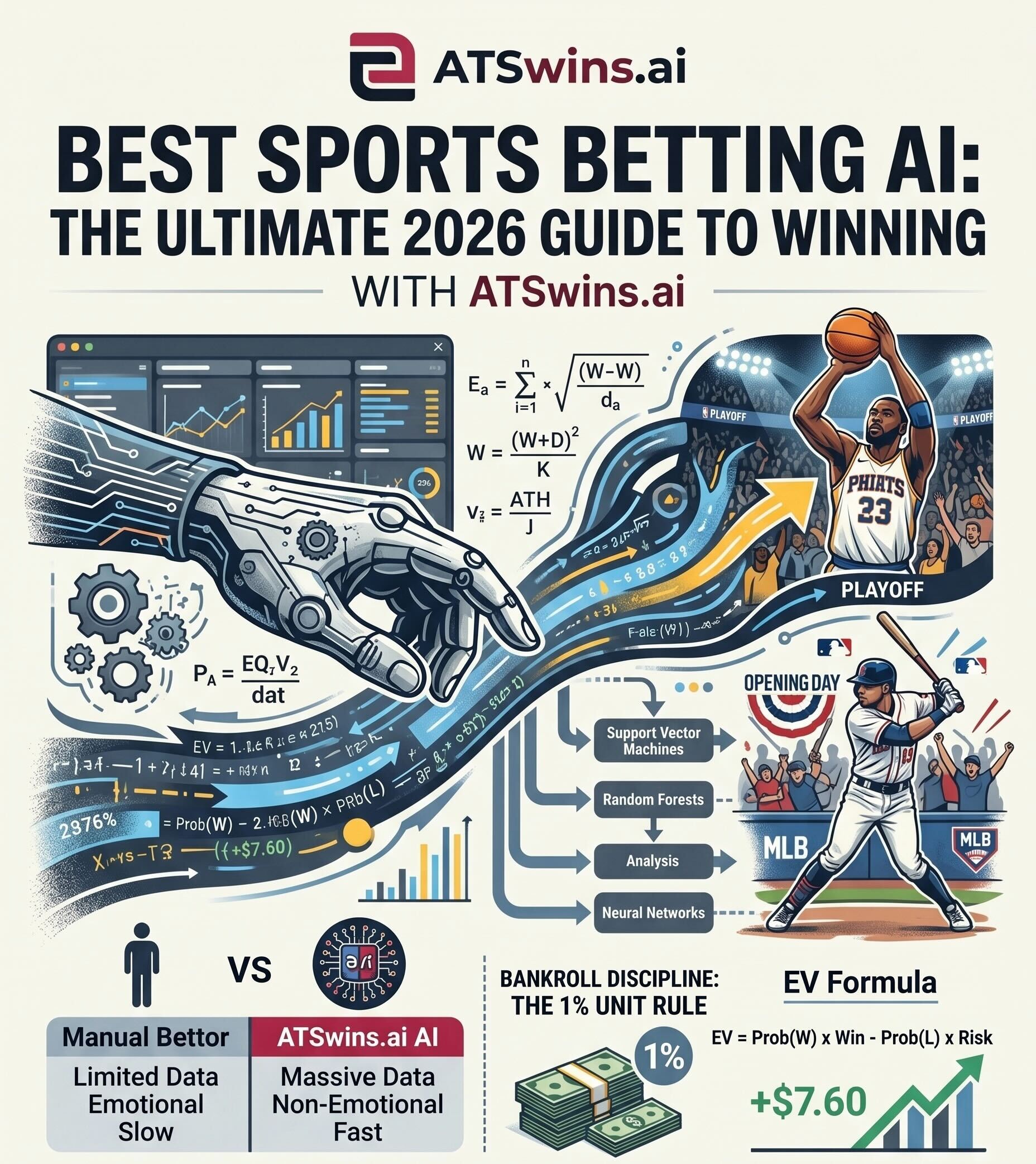
If you are searching for the best sports betting ai in April 2026, you are not really looking for another hot pick service. You are looking for a system that can process more information than any human, react faster than any human, and stay more disciplined than any human. That matters right now because the sports calendar is packed: the first round of the 2026 NBA Playoffs tipped off on April 18, and the 2026 MLB regular season is already underway after Opening Day on March 26–27, with all 30 teams active by March 28. In other words, we are in a part of the year where the volume is high, the narratives are loud, and the number of betting markets explodes every single day.
That is exactly why manual handicapping is losing ground.
The old model of sports betting was built around opinion. A bettor would watch highlights, read a few injury blurbs, remember what happened last week, and make a “sharp” pick based on instinct dressed up as analysis. In 2026, that approach is obsolete. Not because intuition has zero value, but because intuition cannot compete with machine learning systems that can ingest huge volumes of structured and semi-structured data, update probabilities continuously, and surface edges across moneylines, spreads, totals, and props faster than a person scrolling three apps on their phone.
The best sports betting ai is not the one that screams “lock of the night.” It is the one that helps you make hundreds or thousands of mathematically sound decisions over time. It is the one that thinks in probabilities, not predictions. It is the one that helps you pursue positive expected value (+EV), protect your bankroll, and survive the emotional chaos that destroys casual bettors.
That is where ATSwins.ai separates itself.
ATSwins.ai is not built around selling certainty. It is built around helping users identify edge, understand risk, and apply discipline. If your goal is long-term profitability instead of dopamine hits, then the path is simple: stop guessing, start calculating.
Best Sports Betting AI in 2026: Why Manual Handicapping Is Dead
To understand why ATSwins.ai matters, you first need to understand why the old way is breaking down.
A human bettor can only process a tiny slice of the available information before placing a bet. Even a smart, experienced bettor is still limited by time, bias, memory, and emotion. They overweight recent games. They fall in love with teams they watch often. They confuse being “right about a matchup” with being right about a price. They chase losses. They increase stake size when tilted. They talk themselves into bad numbers because a star player is “due.”
The market does not care.
The modern betting environment rewards speed, calibration, and repetition. Research reviewing machine learning in sports betting has highlighted exactly the model families that dominate this kind of work, including Support Vector Machines, Random Forests, and Neural Networks, and other work on betting-specific modeling has emphasized a point sharp bettors should never ignore: calibration matters more than raw accuracy if your goal is profitability.
That is a huge distinction.
A casual bettor asks, “Who wins tonight?”
A serious bettor asks, “What is the true probability of this outcome, what is the market implying, and is the difference large enough to justify risking capital?”
That second question is where the best sports betting ai lives.
What Actually Defines the Best Sports Betting AI?
The phrase gets thrown around constantly, but the real definition is pretty simple. The best sports betting ai must do five things well:
- Handle data at scale
- Update fast when conditions change
- Model probabilities instead of hype
- Stay calibrated across large sample sizes
- Translate output into usable betting decisions
Here is the cleanest way to think about it:
Trait | Manual Bettor | Best Sports Betting AI |
| Data volume | Limited | Massive |
| Speed | Slow, reactive | Fast, continuous |
| Emotional control | Inconsistent | Non-emotional |
| Probability modeling | Usually weak | Core function |
| Scalability | Low | High |
| Long-term repeatability | Rare | Possible with discipline |
In 2026, the AI conversation has also shifted. Large language models are becoming better at forecasting-related tasks and better at orchestrating tools, data retrieval, and multi-step workflows. But the lesson from recent research is not that a chatbot alone should replace a predictive engine. It is that LLM-style systems are increasingly useful as an interface and orchestration layer, while reliable forecasting still depends on calibrated models, external data, and verifiable pipelines.
That is why the smartest approach is not “LLM instead of modeling.”
It is LLM-integrated workflows on top of real predictive modeling.
That is the lane ATSwins.ai fits perfectly.
Inside the ATSwins.ai Engine: Why This Is the Best Sports Betting AI for Serious Bettors
ATSwins.ai is built for bettors who want process over noise.
At the core, the platform operates like a probability engine, not a pick-selling machine. That distinction matters because the real edge in sports betting does not come from identifying a team you “like.” It comes from identifying where your estimated probability is meaningfully different from the market price.
To do that well, the engine needs layers.
1. Random Forests for Pattern Discovery
Random Forest models are useful because sports are messy. Outcomes are rarely driven by one variable. They are driven by interacting clusters of variables: rest, shot quality, pace environment, bullpen fatigue, matchup history, weather, usage shifts, coaching tendencies, and line movement context.
Random Forests help surface nonlinear relationships that a spreadsheet bettor would miss. A team might look strong in a basic stats model, but when you layer in short rest, travel, and a bad stylistic matchup, the win probability can shift in a way that does not show up in surface-level numbers.
2. Support Vector Machines for Clean Separation
Support Vector Machines are valuable when the objective is classifying outcomes in high-dimensional spaces. Sports betting data is rarely neat. The edge often lives in the margins between similar teams, similar prices, and similar game environments.
SVM-style logic helps distinguish those borderline setups where public perception says one thing but the underlying structure says another. That matters most in games where the narrative is obvious and the true probability is not.
3. Neural Networks for Complex Interactions
Neural Networks are built for high-volume pattern recognition across complex inputs. In sports, that can mean relationships between player availability, recent performance clusters, pace or tempo environments, scoring distributions, market movement, and other contextual features that interact in ways humans cannot reliably weight on the fly.
The point is not to sound technical for the sake of it. The point is that the best sports betting ai should not rely on a single model family. It should combine multiple modeling approaches to reduce blind spots.
That is exactly the right way to think about ATSwins.ai.
The Invisible Variables Humans Miss
This is where the real separation happens.
Most losing bettors still handicap the obvious: star power, record, last game result, broad offensive ranking, broad defensive ranking. The problem is that the market already sees that stuff.
The edge comes from what I call the invisible variables:
- travel compression
- back-to-back fatigue
- time-zone effects
- bullpen or bench depletion
- lineup fragility
- late scratch volatility
- micro-weather changes
- usage redistribution after injuries
- officiating environments
- pace distortion created by opponent style
In April 2026, this matters everywhere.
In the NBA Playoffs, the market is hyper-focused on stars, rotations, and headline matchups. But the true edge can come from smaller variables: how a short rotation responds to travel, how a role player’s minutes change after a minor injury, how late lineup news impacts a total more than a side, or how a team’s halfcourt profile changes against a specific defensive shell. In MLB, the same principle applies. Casual bettors see starting pitchers. Strong models see bullpen availability, umpire tendencies, weather, travel, platoon changes, and hidden fatigue from recent game scripts.
Humans can notice some of this. Machines can weigh all of it simultaneously.
That is why ATSwins.ai is not just useful. It is necessary for anyone trying to bet like an investor instead of a fan.
The Profitability Blueprint: How to Use the Best Sports Betting AI Without Blowing Up Your Bankroll
Here is the truth nobody wants to hear:
Even if you have the best sports betting ai, you can still lose money if your staking is terrible.
The model is only half the game.
The bankroll strategy is the other half.
The 1% Unit Rule
If you take one thing from this article, let it be this:
Never risk more than 1% of your bankroll on a single ATSwins.ai pick.
If your bankroll is $1,000, your standard bet is $10.
If your bankroll is $5,000, your standard bet is $50.
If your bankroll is $20,000, your standard bet is $200.
That is not conservative because you are scared.
It is rational because variance is real.
Here is a simple table:
Bankroll | 1% Unit Size |
| $500 | $5 |
| $1,000 | $10 |
| $2,500 | $25 |
| $5,000 | $50 |
| $10,000 | $100 |
Why does this matter so much?
Because even strong models lose plenty. A profitable bettor can still go 4–8 over a 12-bet stretch. A great month can still contain a brutal week. If your bet sizing is too aggressive, variance kills you before edge can compound.
Volume Over Luck
This is where serious bettors are separated from people hunting screenshots.
A bettor who hits 56% to 58% over a large sample is not “barely winning.” That bettor is dangerous. Over hundreds and then thousands of wagers, that kind of edge can create meaningful bankroll growth.
A bettor who chases “locks” and swings from 1 unit to 5 units to 10 units based on emotion is basically volunteering to donate to variance.
The math is not glamorous, but it is powerful.
Let’s use a simple example with standard -110 pricing.
If you risk $110 to win $100, your break-even rate is about 52.38%.
If ATSwins.ai helps you consistently find spots where your true edge pushes you to 55%, 56%, or better over time, that gap is where bankroll growth starts.
Here is the expected value formula in plain English:
EV = (Probability of Win × Amount Won) – (Probability of Loss × Amount Risked)
Example:
- Bet risk: $110
- Win amount: $100
- Estimated win probability: 56%
- Loss probability: 44%
EV = (0.56 × 100) – (0.44 × 110)
EV = 56 – 48.4
EV = +$7.60
That means every time you place that same type of wager with the same edge, your long-run expected profit is $7.60 per bet.
One bet means nothing.
Five hundred bets means everything.
Why Chasing Creates Poverty
Chasing losses is not just emotionally bad. It is mathematically stupid.
When bettors lose three plays in a row and double their next stake, they are no longer following the edge. They are changing the entire risk profile of their system based on recent pain.
That is how good models get blamed for bad bankroll behavior.
The proper approach with ATSwins.ai is boring on purpose:
- choose a bankroll
- define 1 unit as 1%
- trust volume
- review performance over large samples
- never escalate stake size because of emotion
That is what sustainable growth looks like.
Navigating the ATSwins.ai Dashboard
The best sports betting ai is only useful if the output is readable. ATSwins.ai works because it does not just throw a pick at you. It gives you a framework for interpreting the opportunity.
Confidence Ratings
Think of confidence ratings as probability-backed conviction, not emotional certainty.
If a play grades out stronger than the rest of the board, that does not mean “guaranteed winner.” It means the model sees a larger gap between its estimated true probability and the market price.
That is an important mindset shift.
A higher confidence rating should lead to:
- more attention
- more verification
- better prioritization
It should not lead to:
- reckless bet sizing
- all-in behavior
- abandoning your unit system
The right way to use confidence is as a sorting tool.
Model Discrepancies
This is where the best stuff usually lives.
A model discrepancy is the distance between the market’s implied view and the model’s view. If the market says a team should be -2.5 and the model says the fair number is -5, that discrepancy matters. If the market is hanging a total at 231.5 and the model sees 226.0, that discrepancy matters too.
Discrepancies are not automatic bets. They are invitations to investigate.
When you see a big discrepancy, ask:
- Is this a stale number?
- Is there injury news the market has not fully absorbed?
- Is the discrepancy supported by matchup data?
- Is the edge strongest on side, total, or derivative market?
- Has the number already started moving toward the model?
That last question is huge. If the market begins converging toward the model’s number, that is often useful confirmation that your edge was real and time-sensitive.
Using Data Visualizations the Right Way
Data visualization should help you do one thing: slow down and verify.
Before placing a wager, use ATSwins.ai visual tools to check:
- recent performance context
- matchup splits
- pricing relationship
- trend direction
- whether the market is drifting toward or away from the model
This is especially valuable when the raw pick feels uncomfortable. Often the best bets are the ones that do not line up with public instinct. Visual context can help you separate “this feels weird” from “this is actually flawed.”
Advanced Strategies for 2026: Player Props
If you want to know where some of the most attractive modern edges live, it is here.
Player Props
Props are valuable because the market is often thinner and more fragmented than main sides and totals. That does not mean easy money. It means more potential for modeling advantage if you understand role, usage, minutes, matchup, and volatility.
ATSwins.ai can be especially useful here because player props are rarely about one stat in isolation. They are about distribution.
To bet props well in 2026, you need to think in terms of:
- expected minutes
- usage share
- rebound chances
- assist environment
- opponent scheme
- teammate availability
- game pace
- foul risk
- blowout risk
That is a lot for a person to process manually, especially on a busy playoff slate or a full MLB card.
Adapting to Late-Breaking News in the NBA Playoffs
This is one of the biggest reasons AI matters right now.
Playoff series create rapid information loops. One game changes the next game’s rotation assumptions. A questionable tag becomes a minutes cap. A bench player suddenly matters. A coach shortens the rotation. A role shift changes usage, which changes props, which changes side and total assumptions too.
The market reacts fast. Good AI workflows react faster and more consistently.
That is where ATSwins.ai becomes more than a prediction page. It becomes a decision-support system.
A 2026 Example: What a Disciplined Month Can Look Like
Let’s say a user starts May 2026 with a $5,000 bankroll.
They commit to the ATSwins.ai approach:
- 1% flat staking
- $50 per unit
- no chasing
- focus on model discrepancies
- prioritize higher-confidence spots
- mix main markets with selective props
Over one month, they place 120 bets.
Assume the record is 67–53 on mostly standard pricing.
That is a 55.8% hit rate.
Approximate outcome:
- Wins: 67 × $45.45 = $3,045.15
- Losses: 53 × $50 = $2,650
- Net profit: $395.15
That is not fantasy-land nonsense. That is the power of small edge plus repetition.
Now imagine the opposite bettor:
- same bankroll
- same model access
- same slate quality
- but they vary from $50 to $300 per play
- double stakes after losses
- fire on “revenge” spots with no edge
- tilt bet live markets after bad beats
That bettor can turn a profitable model into a losing month.
The point is simple:
ATSwins.ai can help identify edge.
Only discipline can convert edge into growth.
Why ATSwins.ai Is the Best Sports Betting AI
By now, the answer should be clear.
The best sports betting ai is not defined by flash. It is defined by whether it helps users operate like professionals.
ATSwins.ai checks the boxes that matter:
- it is built around probability, not hype
- it supports disciplined +EV thinking
- it helps users evaluate discrepancies between model and market
- it turns overwhelming sports data into actionable signal
- it fits the modern reality of playoff basketball, full MLB slates, live markets, and props
- it supports repeatable bankroll strategy instead of emotional chaos
And maybe most importantly, it encourages the right mindset.
Serious bettors do not ask, “What is the lock?”
They ask, “Where is the edge, how big is it, and how should I size it?”
That is the mindset ATSwins.ai supports.
Final Take: Stop Guessing, Start Calculating
In 2026, sports betting is no longer a game of who has the hottest take. It is a game of who can model reality more accurately, price risk more rationally, and stay disciplined long enough for the numbers to matter.
That is why manual handicapping keeps losing.
That is why emotional betting keeps failing.
That is why the search for the best sports betting ai ends with ATSwins.ai.
Use the platform the right way:
trust probability over opinion,
trust volume over luck,
trust bankroll discipline over ego.
That is how sustainable growth happens.
Stop guessing. Start calculating. Start using ATSwins.ai like a serious bettor.
Related Articles:
The Quant’s Edge: Mastering Sports Betting with ATSwins.ai in 2026
Sources:
The Game Changer: How AI Is Transforming The World Of Sports Gambling
AI and the Bookie: How Artificial Intelligence is Helping Transform Sports Betting
How to Use AI for Sports Betting
Keywords:
MLB AI predictions atswins
AI MLB predictions atswins
AI NFL predictions atswins
NBA AI predictions atswins