

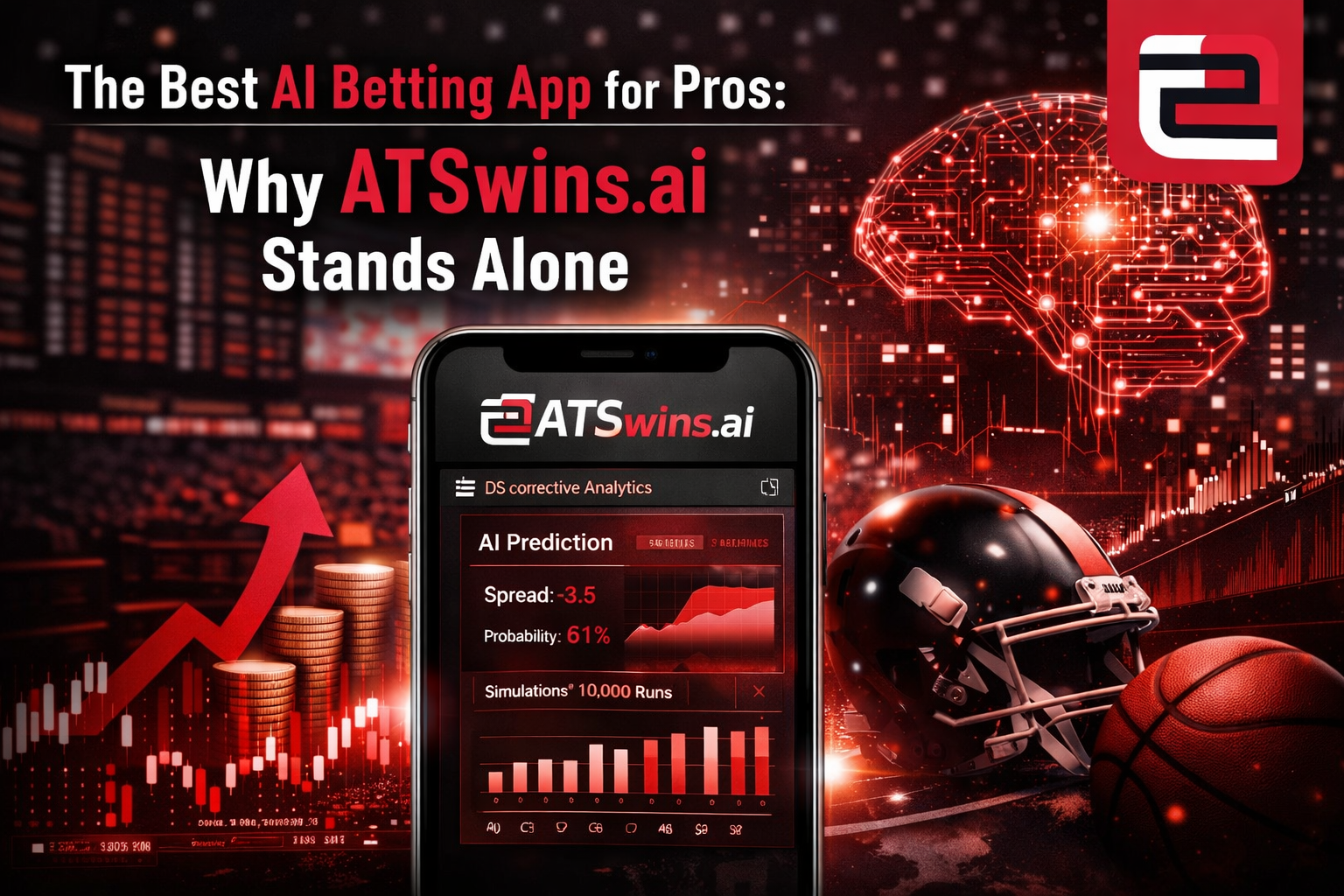
In 2026 most people still talk about sports wagering as if it is a bar-stool hobby built on hot streaks, vibes, and last night’s box score. That framing is obsolete. The market has been industrialized. Sportsbooks now use automated pricing logic, constant data ingestion, and AI-assisted risk management to move lines faster than any old-school handicapper with a spreadsheet ever could. William Mabra has described it as an AI-driven arms race between books trying to manage every game and bettors trying to isolate only the few spots where the market is actually wrong.
That shift matters because the Old Way of betting was never built for a machine-speed market. The old approach was descriptive: basic stats, recent scores, maybe an injury note, then a gut-level conclusion. ATSwins.ai’s public methodology frames its edge differently. Its model is predictive, not descriptive. Instead of telling you what happened yesterday, it evaluates thousands of variables, runs large-scale simulations, and gives users projections, player props, betting splits, grading, and tracking tools designed to make the decision process faster and more disciplined.
That is the real reason ATSwins.ai belongs at the top of any serious discussion around the best ai betting apps. It was built specifically to counter the house’s algorithmic advantage, not to entertain casuals with generic picks. The platform’s own language is blunt: it is designed to help users beat the books by turning raw data into actionable insights, running thousands of simulations every day across major sports, and surfacing value before the market fully reacts.
For the serious bettor, that distinction is everything. Amateur betting asks, “Who do I like?” Professional betting asks, “Where is the price wrong?” ATSwins.ai is built around the second question. It is not trying to make you feel smart for one night. It is trying to give you a repeatable process for positive expected value betting, machine-assisted decision-making, and better long-run sports betting ROI 2026 and beyond.
The Industrialization of Sports Betting
The best way to understand the current market is to stop thinking about it as “picks” and start thinking about it as pricing. Sportsbooks are not in the prediction business in the same way bettors are. They are in the risk-management business. They use AI to set odds, balance exposure, and keep the market efficient. Bettors who still rely on instinct are effectively bringing a pocket knife to a data-center fight.
That is why the serious search for the best ai betting apps should not be about which platform looks the flashiest or screams the loudest. It should be about which platform actually helps a bettor build a professional workflow. ATSwins.ai does that by combining AI sports predictions, game simulations, player props, public betting splits, grades, results pages, and a bet tracker inside one operating environment. The point is not just to hand you a side. The point is to let you measure edge, manage exposure, and audit outcomes.
There is a reason that matters more in 2026 than it did even two years ago. William Mabra said ATSwins launched in early 2024 to remove human bias from betting predictions and to give bettors a statistical edge without relying on affiliate deals or human handicapper theatrics. That is exactly the right product philosophy for an algorithmic market: if the books are industrial, your process has to be industrial too.
The Founder’s Vision
The clearest way to understand ATSwins is to start with the original pain point. On the ATSwins about page, Mabra’s founding motivation is straightforward: he could not find one place that combined value-bet discovery, statistical discrepancies, and a consistent AI model strong enough to clear the professional threshold of roughly 53% or better. After getting tired of juggling multiple subscriptions, he built the product himself.
That matters because the founding logic shapes the product logic. ATSwins.ai was not built as a content funnel. It was built as a decision-support system. Mabra later described the mission the same way in public: help bettors find a statistical edge, remove human bias, and avoid being pushed toward affiliate offers or performative capping.
The ethical foundation is even more important than the technical one. ATSwins.ai’s public materials repeatedly emphasize independence. The platform says it is not a sportsbook affiliate, does not profit from user losses, and measures success by the accuracy and usefulness of its insights. Analytics Insight likewise described ATSwins as relying on subscription revenue rather than sportsbook commissions or ads.
That independent subscription model is not a minor business detail. It is the entire alignment mechanism. In betting, incentives decide credibility. If a platform makes money when users lose, the user is the product. If a platform makes money from subscriptions, the platform has to keep earning trust through transparency, interpretability, and process. ATSwins.ai leans directly into that by publishing results pages, exposing grades and splits, and giving users a tracker to monitor their own performance rather than hiding behind opaque “locks” language.
Deep Dive: The ATSwins.ai Engine Room
ATSwins.ai does not publish a full institutional model card, so the most accurate public description is this: it is an ensemble-style, simulation-driven prediction engine built on supervised-learning concepts, neural-network logic, advanced AI algorithms, and large-scale game simulation. ATSwins publicly says it runs thousands of simulations every day, and its user guide states that individual game pages simulate outcomes 10,000 times to produce an average simulated score.
From a quantitative standpoint, that is exactly what a serious betting platform should be doing. In practical terms, a modern machine-learning stack for this kind of problem usually blends multiple model families because no single model handles every edge case well. Tree-based learners such as Random Forests are useful for non-linear interaction discovery. Support Vector Machines (SVMs) are strong in high-dimensional classification problems. Deep Neural Networks are powerful when the feature space is large, dynamic, and layered. ATSwins’ public materials explicitly reference supervised learning, neural networks, and advanced AI algorithms, while other ATSwins educational materials discuss Random Forests and SVMs as part of the broader sports-AI toolbox. The most grounded way to describe the engine, then, is as a professional machine learning betting picks framework consistent with that multi-model, ensemble mindset.
What goes into the model?
ATSwins’ public pages and guide make clear that the input layer goes far beyond headline stats. The platform references player stats, injuries, weather conditions, historical trends, public betting splits, rest-day effects, season trends, team trends, home/away performance, and travel or schedule context. Its published examples even describe adjusting for 15+ mph winds, stadium orientation, and fatigue effects on player efficiency.
That gives the system a richer feature set than the average bettor can process manually. A serious AI betting model needs to account for several categories at once:
- Long-horizon historical structure: how teams, coaches, and game states have performed over large samples.
- Short-horizon recency: ATSwins highlights rolling windows such as L3, L5, and L8 to detect acceleration or slippage faster than market consensus.
- Environmental context: weather, venue, travel, rest, and schedule density.
- Market intelligence: public ticket percentages, money splits, and reverse line movement.
- Player-level granularity: injuries, role changes, matchup-specific impact, and props-level inefficiencies.
In a mature quant shop, that layer can also extend to officiating tendencies and hyper-local weather granularity when data is available. The main point is not whether one variable sounds clever. The point is that ATSwins is built to synthesize many small edges at once, because that is how real pricing advantages are found in 2026.
The ensemble method and true probability
Here is where most casual bettors get it wrong: the goal of AI is not merely to “pick winners.” It is to estimate true probability more accurately than the market is currently pricing. ATSwins’ own educational content says profitable betting is about mispriced odds, not simply choosing the team most likely to win. If the market price implies 52.4% but the model believes the real probability is 60%, that gap is the trade.
That is why the simulation layer matters so much. Running a game 10,000 times forces the model to think probabilistically instead of narratively. It is not asking, “Who is better?” It is asking, “Across thousands of plausible game paths, what range of outcomes appears most often, and how does that compare to the line on the board?” That is the difference between fan logic and quant logic. ATSwins turns that quant logic into something usable on a daily basis through projections, grades, props, splits, and results archives.
Mastering the Platform: A Professional Strategy Guide
A serious user should treat ATSwins.ai less like a tip sheet and more like a workflow.
Phase 1: Finding the Edge (+EV)
Start in the Predictions section. ATSwins tells users to filter by sport, view AI-generated projections for spread, moneyline, and totals, and prioritize by confidence ratings from A to D, with A representing the strongest value. The core task is simple: identify mismatches between the AI projection and the sportsbook line.
This is where the language of professional betting matters. The “difference” is not just a disagreement. It is a pricing spread between market-implied probability and model-implied probability. That spread is your potential edge. A disciplined bettor is not trying to fire on every game. He is scanning for the handful of spots where ATSwins says the market is still soft enough to exploit. That is the essence of positive expected value betting.
ATSwins also improves this phase by adding context. The guide instructs users to check public betting splits, sharp-versus-public dynamics, and reverse line movement. If most tickets are on one side but the money or the line behaves differently, you may be looking at professional action rather than public enthusiasm. That matters because the best number often disappears before the average bettor understands why it was good in the first place.
Phase 2: Bankroll Management
No platform can rescue a reckless bettor from bad sizing. ATSwins’ user guide is refreshingly clear on this. It emphasizes bankroll protection, warns against emotional betting and chasing losses, and recommends breaking bankroll into units rather than going all-in. The guide gives a broad range of 1% to 5% per bet; for a serious bettor trying to dampen volatility, the professional operating sweet spot is usually tighter at 1% to 3% per wager, with sizing adjusted by confidence and liquidity.
That 1% to 3% rule matters because edge realization is noisy. Even a very good model will lose plenty of bets. The point of a professional staking framework is survival. Your bankroll is inventory. You are not supposed to prove courage with it. You are supposed to deploy it rationally.
ATSwins gives users the tools to support that discipline. Paid plans include access to the Bet Tracker, and the guide says users can log stake, odds, ROI, wins, losses, and trend data to refine strategy over time. That moves the process from memory-based self-deception into measurable performance management.
Phase 3: Beating Closing Line Value (CLV)
This is where serious bettors separate themselves from tourists. Closing Line Value is the best real-time audit of whether your process is identifying true edge before the market fully prices it in. ATSwins’ Oddsmaker Pro materials say the product flags meaningful gaps between its AI number and the market opener, and its CLV page lets users see whether those early positions actually beat the closing number by game time.
The example is simple. If ATSwins likes a team at -120 and the game closes -140, you captured positive CLV. You may still lose that bet. That is irrelevant to the process. The important thing is that your entry price beat the terminal market. Over a large enough sample, that is one of the strongest signals that your method is working. ATSwins says as much directly: consistently beating the close is a key predictor of long-term profitability.
This is also why speed matters. In 2026, edges decay quickly. The bettor who waits for consensus is usually donating value back to the market. ATSwins.ai is useful because it compresses scan time, surfaces discrepancies early, and turns model disagreement into actionable timing. That is how you move from having opinions to having an execution edge.
Case Studies and Theoretical ROI
Let’s strip the emotion out and talk math. At standard -110 pricing, the break-even win rate is 52.38%. A bettor hitting 55% is not “a little better.” He is operating with a real edge. On a 1-unit-to-win-0.909 structure, a 55% hit rate produces roughly 5.0% ROI per bet. At 57%, the number rises to about 8.8%. At 60%, it climbs to roughly 14.5%.
Now layer that onto a disciplined ATSwins workflow. Suppose a bettor risks 1.5% of bankroll per play, stays selective, captures positive CLV, and compounds bankroll gradually rather than swinging for parlays. The difference between 52% guessing and 55% to 60% model-assisted execution becomes enormous over hundreds of wagers. That is the entire professional case for ATSwins.ai. You are not seeking entertainment variance. You are seeking compounding edge.
This is exactly why ATSwins frames itself around data, discipline, and process rather than promises. The pricing page explicitly warns that no service can guarantee a long-run winning percentage and that anything can happen in sports on a given day. That kind of transparency is not a weakness. It is what a serious bettor should want from a serious platform.
The Psychology of Winning
One of AI’s most underrated benefits is not computational. It is psychological. Humans tilt. Humans chase. Humans fall in love with narratives. ATSwins’ educational content directly calls out the bettor’s biggest cognitive traps: overreacting to variance, seeing patterns where none exist, succumbing to gambler’s fallacy, and letting confirmation bias override the numbers. Its AI “has no favorites; it only has variables.”
That matters because the cleanest path to profitability is often subtractive. Remove ego. Remove revenge betting. Remove the need to have action on everything. ATSwins.ai gives structure to that restraint through grades, filters, simulations, market context, and bankroll guidance. In other words, it does not just improve your picks. It improves your behavior.
Conclusion
If you are casually browsing for the best ai betting apps, you may think this is a category decision. It is not. For the serious bettor, it is an alignment decision. Do you want noise, or do you want process? Do you want marketing, or do you want measurement? Do you want affiliate incentives, or do you want a subscription platform whose job is to help you think more clearly than the market?
That is why ATSwins.ai stands alone. William Mabra built it to remove human bias, centralize the tools serious bettors actually need, and give users a repeatable path toward better execution. In a market now dominated by machine-speed pricing, the only rational response is machine-assisted discipline. Join ATSwins.ai, build your workflow, and start treating sports betting like the high-frequency alternative asset class it has become.
FAQ
Is ATSwins.ai legal?
ATSwins.ai presents itself as a research and analytics platform, not a sportsbook. Using an analytics tool is generally different from placing a wager, but whether you can actually bet depends on your local laws and access to licensed operators in your jurisdiction. ATSwins’ own FAQ describes the product as an insights platform rather than the place where wagers are placed.
How many picks do you get per day?
It depends on your plan and the slate. ATSwins’ free plan includes 2 predictions and 2 simulations per day, while paid plans include unlimited predictions and unlimited simulations plus the bet tracker, grades, and public betting splits.
Why the subscription model?
Because incentives matter. ATSwins publicly emphasizes that it is not a sportsbook affiliate and does not profit from user losses. Public reporting has also described the business as driven by subscription revenue rather than sportsbook commissions. That means the platform wins by being useful, transparent, and accurate enough to keep subscribers renewing.
What makes ATSwins.ai different from a typical picks service?
The platform combines AI sports predictions, 10,000-run game simulation on matchup pages, player prop projections, public betting splits, results archives, A-to-D confidence grading, and a bet tracker in one workflow. That is a process stack, not just a picks feed.
Can ATSwins.ai guarantee profits?
No, and that is one reason to take it more seriously. ATSwins explicitly says it cannot guarantee any long-term winning percentage and that anything can happen in sports. What it can do is improve your process, help you find mispriced numbers, and give you the tools to measure whether your strategy is actually improving over time.
Related Articles:
The Quant’s Edge: Mastering Sports Betting with ATSwins.ai in 2026
Sources:
The Game Changer: How AI Is Transforming The World Of Sports Gambling
AI and the Bookie: How Artificial Intelligence is Helping Transform Sports Betting
How to Use AI for Sports Betting
Keywords:
MLB AI predictions atswins
AI MLB predictions atswins
NBA AI predictions atswins