

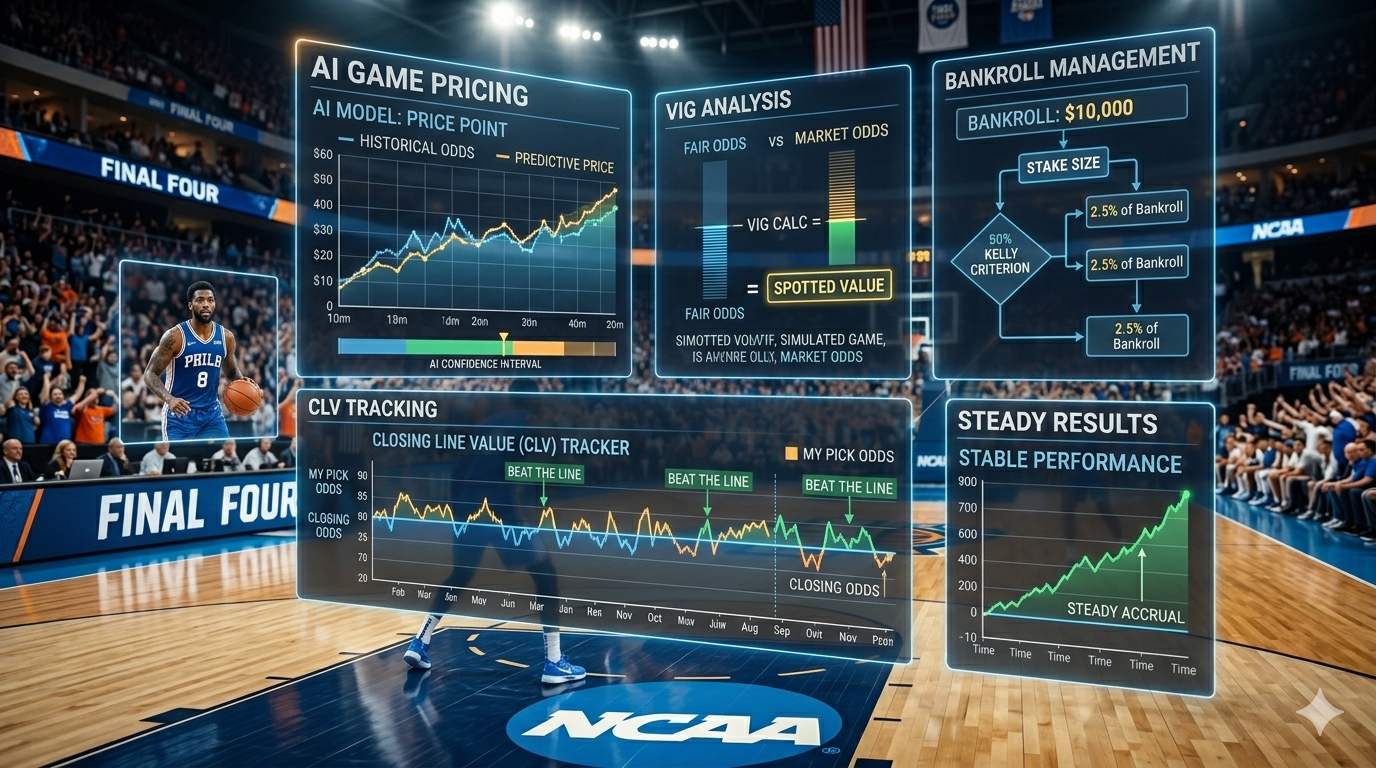
AI is changing the way serious bettors approach the market. Instead of guessing or chasing hot streaks, bettors can now use structured data and machine learning models to evaluate games and make smarter betting decisions. The goal is not to get lucky for one weekend. The goal is to build a repeatable system that can produce consistent long term results.
In this guide I’m walking through the real workflow behind modern ai sports betting to beat sportsbooks. This is not theory or hype. It is about practical steps that turn raw sports data into betting decisions you can actually trust. We will talk about how models are built, how probabilities are evaluated, how bankroll is protected, and how platforms like ATSwins fit into the process.
If you want to understand how serious bettors approach the market using ai sports betting expected value strategy, this article will break it down step by step.
Table Of Contents
- Strategy and expectations for long term profit
- Data and modeling workflow that survives out of sample
- Risk and bankroll management during cold streaks
- Operations and workflow like a professional betting desk
- Continuous improvement that compounds your edge
- Step by step workflow from raw data to bet placement
- Practical templates and examples
- Simple comparisons that help guide betting choices
- How ATSwins fits into a modern AI betting workflow
- Common mistakes and quick fixes
- Measurement metrics that matter more than ROI
- Conclusion
- Frequently Asked Questions (FAQs)
Strategy And Expectations For Long Term Profit
The first thing to understand about AI betting is that the goal is not winning every week. Anyone promising that is selling fantasy.
Successful betting is about building small statistical edges and applying them consistently. Over thousands of wagers, those small advantages compound.
When people talk about ai sports betting prediction accuracy, they often imagine models that are magically correct all the time. That is not how it works. Even the best betting models in the world might only have a slight edge over the market. The key difference is that the edge is consistent.
A bettor running a disciplined ai betting systems for consistent roi might aim for something like five to ten percent ROI over the long term. That might sound small, but when bankroll management is done correctly and volume is high enough, that edge becomes very powerful.
Variance is part of the process. Losing weeks happen. Losing months happen. Even professional bettors experience large drawdowns during normal variance cycles. What matters is whether the underlying model continues to beat market pricing over large samples.
Understanding sportsbook pricing is critical here. Most standard betting markets include built in margin called the vig. If both sides of a bet are priced at minus one hundred ten odds, the sportsbook already has an advantage. Your model must produce probabilities that beat that margin consistently in order to profit.
This is where ai betting model vs vegas lines becomes important. The model produces its own probability estimate. That probability is compared to the sportsbook price. If the model probability is better than the implied market probability, the bet may have positive expected value.
Professional bettors focus on expected value rather than short term results. Even a great bet can lose. What matters is whether the bet had positive expected value at the time it was placed.
Another important concept is closing line value. If your bet consistently beats the final market line before the game starts, it is a strong signal that your model is identifying real edges. Over time, beating the closing line usually correlates with long term profitability.
This approach forms the foundation of modern ai sports betting to beat sportsbooks. It is not about predicting winners with perfect accuracy. It is about consistently identifying probabilities that are slightly better than what the sportsbook is offering.
Data And Modeling Workflow That Survives Out Of Sample
The biggest mistake beginner model builders make is building systems that only work on historical data. A model that looks great in backtests but fails in real betting is useless.
A strong modeling workflow starts with clean historical data. That includes past odds, game results, player statistics, schedules, injuries, and other contextual information that affects performance.
Data quality matters more than model complexity. A simple model with reliable data will usually outperform a complicated model built on messy data.
Once the data is collected, the next step is feature engineering. Features are variables that help the model understand the game environment. Examples include pace of play, offensive efficiency, defensive efficiency, rest days, travel distance, and player availability.
The key is building features that remain stable across multiple seasons. If a feature works only in one season or one small sample, it will likely fail when conditions change.
Most bettors start modeling with logistic regression or other simple models. These models are transparent and easier to debug. If the model begins producing useful predictions, more advanced algorithms such as gradient boosting can be introduced later.
The real test of any betting model is out of sample performance. This means evaluating the model on data that was not used during training.
A common approach is walk forward testing. The model trains on earlier seasons and then predicts the next season. After evaluation, the training window moves forward and the process repeats.
This approach mimics real betting conditions where the future is unknown. It prevents the model from accidentally learning information that would not have been available at betting time.
Probability calibration is also extremely important. Many machine learning models produce scores that do not directly represent real world probabilities. Calibration techniques adjust those scores so that predicted probabilities match actual outcomes more closely.
Once probabilities are calibrated, they can be converted into fair betting odds. At that point the model output can be compared directly to sportsbook prices.
This comparison is the heart of ai sports betting expected value strategy. If the model probability is significantly higher than the sportsbook implied probability, the bet may have value.
Platforms like ATSwins provide model driven insights and market comparisons that help speed up this process. Instead of manually analyzing hundreds of games, bettors can focus their research on markets where the model and sportsbook lines differ.
Risk And Bankroll Management During Cold Streaks
Even the best models experience losing streaks. That is why bankroll management is essential.
One of the most widely used staking strategies is the Kelly criterion. This formula calculates the optimal bet size based on the edge and the odds. However, most professional bettors use fractional Kelly rather than full Kelly because it reduces volatility.
A common approach is betting twenty five percent or fifty percent of the Kelly recommendation. This keeps drawdowns manageable while still allowing bankroll growth over time.
Exposure limits are also important. Many bettors cap daily exposure at around two to four percent of their bankroll. Individual bets may be limited to less than one percent.
Correlation between bets must also be considered. Betting multiple props from the same game can create hidden exposure if those outcomes are related.
Simulation can help estimate worst case drawdowns. By running thousands of simulated seasons using historical probabilities, bettors can estimate how large losing streaks might become.
This analysis helps determine whether the bankroll is large enough to survive variance.
The goal of ai betting systems for consistent roi is not just identifying good bets. It is making sure the bettor survives long enough for the edge to play out.
Operations And Workflow Like A Professional Betting Desk
Running an AI betting strategy requires organized operations. Think of it more like managing a small analytics company than placing casual wagers.
Data pipelines should update automatically with the latest odds, injuries, and game information. If a data source fails or produces unexpected values, the system should flag the issue immediately.
Models should also be version controlled. Every model release should include documentation describing the data used, the features included, and the evaluation results.
Retraining schedules should be consistent. During active sports seasons, models may be updated weekly or biweekly to incorporate new data.
Performance monitoring is equally important. Metrics such as calibration error, expected value, and closing line value should be tracked continuously.
If performance begins to drift, the cause must be investigated quickly. Data errors, lineup changes, rule changes, or market adjustments can all affect model accuracy.
Professional bettors also maintain detailed betting logs. Every wager should include timestamp, sportsbook, odds, model probability, expected value, and final closing line.
Tools like ATSwins help streamline this process by providing tracking dashboards that organize results across different leagues and bet types.
Continuous Improvement That Compounds Edge
Edges in sports betting rarely stay static. Markets evolve and sportsbooks adjust their pricing models over time.
Successful bettors treat their betting models as living systems that require constant improvement.
One effective approach is reviewing the largest prediction errors. These are situations where the model strongly favored one outcome but the market moved in the opposite direction or the result was dramatically different.
These cases often reveal missing variables or flawed assumptions.
Calibration plots are also useful for diagnosing model behavior. If predicted probabilities consistently overestimate or underestimate actual outcomes, recalibration may be needed.
Explainability tools can reveal which features influence predictions the most. If unexpected variables begin dominating the model, it may indicate data leakage or changing market dynamics.
Staking strategies can also be tested using controlled experiments. Some bettors run multiple staking rules in parallel on paper to compare drawdowns and long term growth.
Over time, this continuous improvement process strengthens the overall betting system.
Step By Step Workflow From Raw Data To Bet Placement
A typical AI betting workflow begins with collecting several seasons of historical data. This includes game results, odds histories, player statistics, and contextual variables such as injuries and travel schedules.
After cleaning the data, features are created to capture team performance trends. Rolling averages, efficiency metrics, and availability indicators are common examples.
The model is then trained on historical seasons and validated using walk forward testing. Evaluation focuses on probability calibration and predictive stability rather than just raw accuracy.
Once the model produces reliable probabilities, those probabilities are compared with sportsbook prices.
If the model probability exceeds the market implied probability by a sufficient margin, the bet qualifies as positive expected value.
Stake size is determined using fractional Kelly or another bankroll management rule. Exposure limits ensure that no single game or day risks too large a portion of the bankroll.
The bet is then placed at the sportsbook offering the best price.
After placement, the wager is logged with full context including time, price, and model probability. When the game closes, closing line value is recorded for later analysis.
This full workflow represents the core process behind ai sports betting to beat sportsbooks.
Practical Templates And Examples
Every betting operation benefits from standardized workflows. Templates ensure that decisions remain consistent even during busy sports schedules.
A simple bet evaluation template might include fields for model probability, sportsbook probability, expected value, stake size, and exposure limits.
Model release templates help document changes to features or training data so that performance shifts can be explained later.
Responsible gambling practices should also be built into the system. Scheduled breaks, exposure limits, and predefined stop loss triggers help prevent emotional decision making.
Simple Comparisons That Help Guide Betting Choices
Choosing between different staking methods often depends on risk tolerance.
Flat staking offers simplicity but ignores differences in edge quality. Percentage based staking adjusts bet size based on bankroll size but still does not account for expected value.
Fractional Kelly staking balances growth potential with drawdown control. Many professional bettors consider it the most practical option when probabilities are reliable.
Model selection also involves tradeoffs. Simpler models provide transparency and stability while more complex algorithms may capture subtle patterns in large datasets.
The best approach usually begins with simple models and gradually introduces complexity only when it clearly improves predictive performance.
How ATSwins Fits Into A Modern AI Betting Workflow
Modern bettors often combine their own models with external data sources to gain additional perspective.
ATSwins provides data driven picks, betting splits, player prop analysis, and performance tracking tools across major leagues including NFL, NBA, MLB, NHL, and NCAA.
These insights help bettors quickly identify markets where model predictions differ from sportsbook lines.
Agreement between independent models can strengthen confidence in a wager. Disagreement can highlight areas where further research is needed.
Using ATSwins alongside personal models allows bettors to evaluate opportunities more efficiently while maintaining their own analytical framework.
Common Mistakes And Quick Fixes
Many new bettors fall into similar traps when experimenting with AI betting systems.
One of the most common mistakes is overfitting. Models that rely on too many complex features may perform well in backtests but fail in live betting.
Another mistake is ignoring bankroll management. Even a profitable model can fail if bet sizes are too large relative to bankroll size.
Chasing losses is another danger. Emotional decision making often leads to poor bets that deviate from the model’s strategy.
Maintaining discipline and following a consistent workflow helps prevent these issues.
Measurement Metrics That Matter More Than ROI
ROI is the most widely discussed betting metric, but it can be misleading over small samples.
Closing line value often provides a clearer signal of model strength. If a bettor consistently beats the final market line, it indicates that the model is identifying real edges.
Calibration metrics such as Brier score and log loss help evaluate probability accuracy.
Tracking these metrics alongside ROI provides a more complete picture of model performance.
Conclusion
AI has fundamentally changed the way serious bettors approach sports markets. Instead of relying on intuition or trends, bettors can now build structured systems that evaluate probabilities, manage risk, and identify value across thousands of betting opportunities.
The core principles behind ai sports betting to beat sportsbooks are surprisingly straightforward. Build reliable data pipelines. Train models that produce calibrated probabilities. Compare those probabilities to sportsbook prices. Bet only when expected value is clearly positive. Manage bankroll carefully so that variance does not destroy the strategy.
Over time, disciplined execution of these steps can produce the steady compounding returns that define successful ai betting systems for consistent roi.
Tools like ATSwins make it easier to analyze markets, track results, and compare predictions across multiple leagues. Combined with careful modeling and risk management, they help bettors approach sports betting with the mindset of a data driven analyst rather than a gambler.
Long term success in AI betting is not about finding a magical algorithm. It is about building a repeatable process that consistently identifies small edges and applying that process with discipline over thousands of wagers.
That is the real foundation of sustainable ai sports betting expected value strategy.
Frequently Asked Questions (FAQs)
What is AI sports betting and how does it work?
AI sports betting uses machine learning models and statistical systems to analyze large sets of historical sports data and betting lines. Instead of guessing or relying on gut feeling, the system evaluates probabilities based on patterns in team performance, player statistics, injuries, weather conditions, and market behavior. The goal of ai sports betting to beat sportsbooks is not predicting every game correctly. The real goal is estimating win probabilities more accurately than the betting market so bettors can identify wagers with positive expected value. When done correctly, AI helps filter noise, quantify uncertainty, and highlight betting opportunities that human analysis might miss.
Can AI really beat sportsbooks consistently?
Sportsbooks are extremely efficient, especially in high-liquidity markets like NFL spreads or NBA totals. However, certain inefficiencies still appear across thousands of betting opportunities every season. A disciplined bettor using an ai betting model vs vegas lines approach focuses on pricing the game independently and then comparing those prices to sportsbook odds. If the model probability is stronger than the market after removing the vig, the bet may have positive expected value. Over time, a system that consistently finds small pricing edges can outperform the sportsbook margin. The key is volume, discipline, and strict bankroll management rather than chasing short-term wins.
What level of accuracy should an AI sports betting model have?
Accuracy alone is not the best metric for betting performance. For example, a model could correctly predict many heavy favorites and still lose money because the odds are not profitable. Instead of focusing only on win rate, bettors track metrics such as ai sports betting prediction accuracy, calibration, closing line value, and expected value. A strong model does not necessarily predict every winner. It predicts probabilities that are closer to reality than the market’s implied probabilities. When the probabilities are accurate and well calibrated, the bettor can identify profitable wagers even if the model loses nearly half of its bets.
How does ATSwins help with AI sports betting workflows?
ATSwins provides data-driven predictions, betting splits, player props, and performance tracking tools that help bettors make informed decisions. Instead of starting from raw data, bettors can use the platform’s AI-generated insights as a baseline for research and comparison. When a personal model aligns with ATSwins projections, the bettor gains additional confidence in the edge. When the projections differ, it becomes an opportunity to investigate market dynamics or model assumptions. This workflow helps bettors refine strategies, monitor performance, and continuously improve their approach to AI-driven sports betting.
Related Posts
AI For Sports Prediction - Bet Smarter and Win More
AI Football Betting Tools - How They Make Winning Easier
Bet Like a Pro in 2025 with Sports AI Prediction Tools
Sources
The Game Changer: How AI Is Transforming The World Of Sports Gambling
AI and the Bookie: How Artificial Intelligence is Helping Transform Sports Betting
How to Use AI for Sports Betting
Keywords:
MLB AI predictions atswins
AI MLB predictions atswins
NBA AI predictions atswins
basketball ai prediction atswins
NFL ai prediction atswins