

“Who you got?”
That’s the most common question in sports, and it’s also the fastest way to get yourself into trouble if you’re trying to make decisions consistently. Because the honest answer most of the time isn’t “Team A” or “Team B.” The honest answer is: it depends on the price and it depends on the probability.
That’s exactly what AI match forecasts are built to solve.
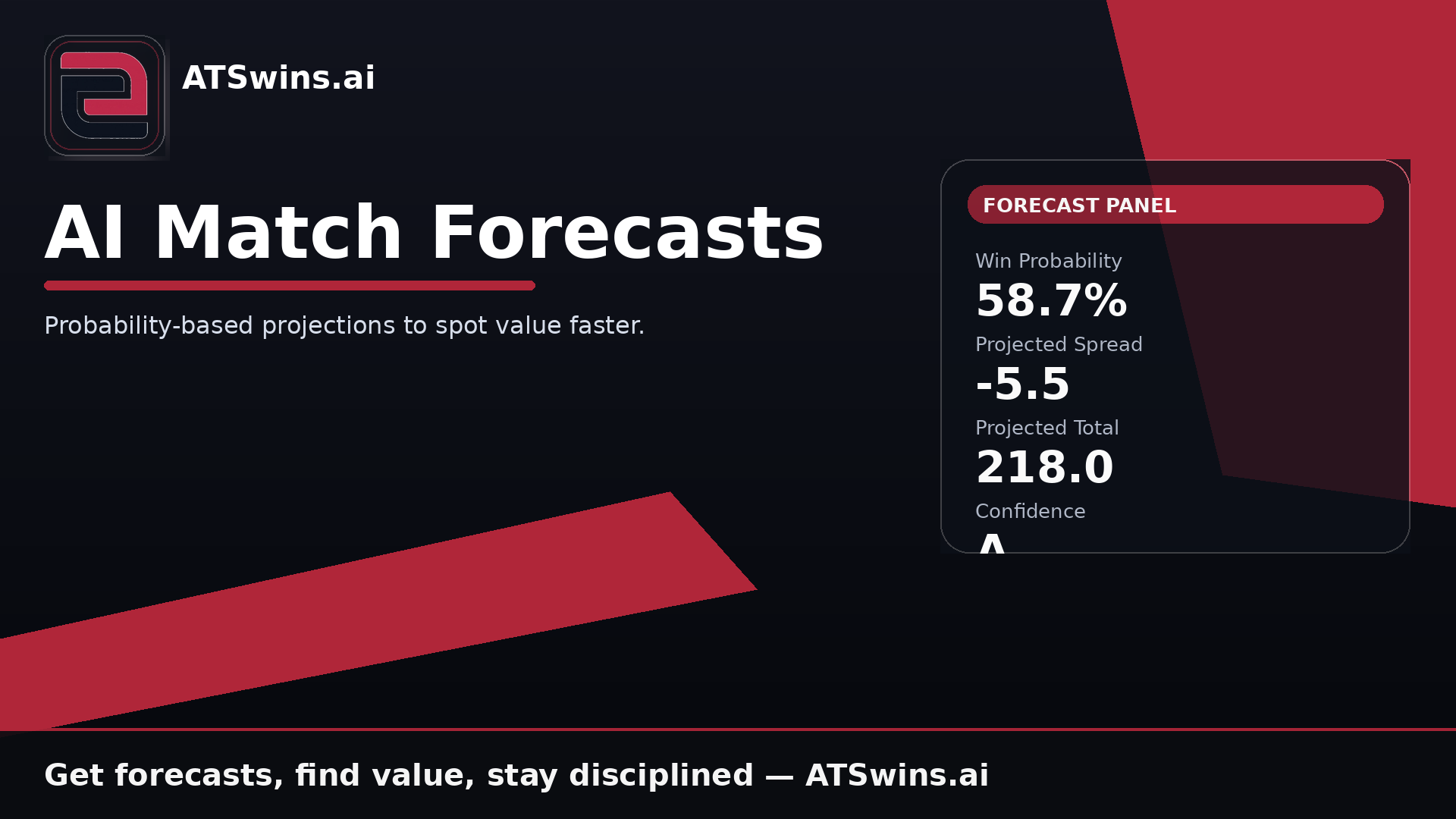
An AI match forecast doesn’t try to sound confident. It tries to be correct over time. It takes a game—something messy, emotional, and chaos-filled—and turns it into a set of probabilities you can actually use: win chances, expected margins, projected totals, and confidence levels. In other words, it doesn’t just tell you what might happen. It tells you how likely each outcome is, and how that compares to what the market is already assuming.
And that’s where the edge lives.
This article explains what AI match forecasts are, how they’re made, why they work when used correctly, how to read them without overthinking, and how ATSwins.ai fits into the picture as a practical tool for finding and acting on forecast-driven value.
What “AI Match Forecasts” Actually Are
At a basic level, an AI match forecast is a model-generated expectation for a specific game. It’s not a “pick” and it’s not a “prediction” in the sense of certainty. It’s closer to a weather forecast.
If the weather app says there’s a 70% chance of rain, that doesn’t mean rain is guaranteed. It means that in similar conditions, rain happened about 70% of the time. You’d probably still bring a jacket. You might not cancel your entire day. You’re just making a smarter decision because you have an actual probability attached.
AI match forecasts work the same way.
Instead of “this team is better,” you get something like:
- Team A wins 61% of the time
- The most likely margin is 5–7 points
- The expected total lands around 218
- The forecast confidence is stronger than average because the matchup indicators align
That’s fundamentally different from the typical sports conversation. And it’s why forecasting is valuable. It forces you to stop thinking in absolutes and start thinking in ranges.
Why Humans Struggle With Match Forecasting
Even smart sports bettors (or analysts) get wrecked by the same mental habits because sports are built to trigger emotion. You remember the big shot, the blown coverage, the “they wanted it more” game. Your brain naturally turns a season into a story.
AI doesn’t do that. It doesn’t care that a team “always chokes” or that a player “has that dog in him.” It cares about measurable inputs and how those inputs have behaved historically.
Humans also tend to overrate the most recent thing they saw. If a team just got smoked on national TV, people decide they’re broken. If a team just hit a ridiculous shooting night, people decide they’ve “figured it out.” In reality, both of those could be variance. AI models are designed (when built correctly) to account for variance instead of worshiping it.
The goal isn’t to remove intuition. The goal is to stop intuition from driving the car off a cliff.
Forecasts vs Picks: The Difference That Changes Everything
A forecast is information.
A pick is an action.
This distinction sounds small, but it’s the difference between being disciplined and being impulsive.
A forecast might tell you:
- Team A should be -6
- The market is -3.5
- That’s a meaningful gap
But it doesn’t force you to bet it. It gives you a reason to investigate further, or to act if everything checks out.
A pick, on the other hand, is where people get emotional. They decide they “like” something, then they go shopping for evidence to support it. Forecast-first thinking flips that. You start with probability and edge, then decide whether it’s worth your money.
ATSwins.ai is built around helping you do exactly that—turn forecasts into a clear view of what’s actionable and what’s noise.
How AI Match Forecasts Are Built (Without the Fake “AI Magic”)
The word “AI” gets thrown around so much that people assume it’s basically a robot with superpowers. In reality, the best forecasting systems win because they’re rigorous, consistent, and validated—not because they’re mystical.
To understand AI match forecasts, you just need to understand the pipeline. Think of it like cooking: ingredients, prep, recipe, taste test.
Step 1: Data Inputs (The Ingredients)
Forecast quality starts with what the model is fed. A serious forecast needs inputs that capture team strength, player impact, and context. Raw box score stats aren’t enough because they don’t adjust for opponent quality, pace, or randomness.
In most sports, useful input categories include:
- Efficiency metrics (how well teams score and prevent scoring relative to possessions/plays)
- Pace/tempo (how quickly games are played and how that affects totals and variance)
- Shot profile or play-type tendencies (depending on sport)
- Rebounding/turnovers/penalties (possession swings matter a lot)
- Player availability and role changes (minutes, usage, lineup stability)
- Scheduling context (rest, travel, back-to-backs, condensed stretches)
- Home/away effects and venue-specific tendencies
This is where most low-quality “AI” falls apart. If your inputs are weak, your forecast is just a fancy guess.
Step 2: Feature Engineering (The Prep Work)
Feature engineering is the unsexy part that makes forecasts smarter.
It’s taking messy stats and turning them into meaningful signals. For example, points per game is a weak stat by itself. A fast team can score a lot while still being inefficient. A slow team can score less but be more effective. So instead of points per game, a model might prioritize points per possession, adjusted for strength of schedule.
It may also weight recent games more than early-season games, but not so heavily that one random outlier dominates the forecast. The best models do “recency” carefully—because recency matters, but overreacting is how models get dumb fast.
Step 3: Modeling (The Recipe)
This is the part people imagine when they think “AI.” It’s where the model turns signals into outputs: win probability, projected spread, projected total, distribution of outcomes.
Good models usually don’t rely on one approach. They often blend methods (an ensemble) to reduce the chance that one specific assumption breaks everything.
But the key isn’t the specific math. The key is the output: probabilities, not certainties.
Step 4: Calibration and Validation (The Taste Test)
This is the part that separates real forecasting from marketing.
Calibration asks: when the model says 60%, does that team actually win about 60% of the time across a large sample?
Validation asks: does the model hold up over time, or did it just get lucky during one stretch?
The reason this matters is simple: if a model is overconfident, it will push you into bad risk decisions. It’s not enough to be “right” sometimes. The forecast needs to be trustworthy as a probability.
That’s where ATSwins.ai focuses: giving you forecasts you can actually use for decision-making, not just content.
What a Good AI Match Forecast Includes
A strong forecast typically gives you multiple angles of the same truth:
Win probability answers “how often does this team win?”
Projected margin answers “what should the spread be?”
Projected total answers “what should the total be?”
Confidence grade answers “how strong is the edge and how stable is the signal?”
When you only have one of these, you’re missing context. For example, a team can have a strong win probability but still not cover a spread reliably. A total can look sharp, but pace volatility can make it risky.
The forecast is a toolbox. Not a single hammer.
How to Read AI Match Forecasts Without Getting Lost
Here’s the simplest way to interpret forecasts like a pro.
Start with the gap.
If ATSwins.ai is projecting a spread that differs from the market by a meaningful amount, that’s the first signal. Then you ask: is that gap supported by stable factors, or is it built on something fragile like one hot shooting run or one weird matchup outlier?
You’re basically doing two checks:
- Is there value?
- Is the value real enough to act on?
That’s where confidence grading helps. It’s not telling you “bet this.” It’s telling you how much the model trusts the edge.
The Most Common Ways People Misuse AI Forecasts
People don’t fail with AI match forecasts because the model is “wrong.” They fail because they use it like a cheat code instead of a decision tool.
Mistake one: treating a 60% forecast like a lock.
A 60% edge still loses 40% of the time. That’s not the model failing. That’s probability.
Mistake two: betting too many games because forecasts exist.
The existence of a forecast is not the same as the existence of value. You want selective volume, not blind volume.
Mistake three: ignoring the number and chasing late movement.
Even good forecasts get killed by bad price. You don’t want to be “right” with a bad number. You want to be right and priced correctly.
Mistake four: using AI to justify a bias.
If you already love a side and only check the forecast to feel better, you’re not using AI—you’re using validation.
ATSwins.ai becomes most powerful when you let it lead your shortlist instead of using it to rubber stamp your gut.
A Practical Workflow Using ATSwins.ai (Low Bullets, High Usefulness)
If you want a clean system, this is it:
First, open ATSwins.ai and look for the strongest forecast grades. You’re not trying to bet 12 games. You’re trying to find the small handful where the model sees real separation between its projection and the market.
Then, compare the forecast projection to the line you’re seeing. If the model thinks a team should be -6 and the market is -3.5, that’s a meaningful difference. If it’s -4.5 vs -4, that might be noise.
Next, sanity-check context. This is where humans still add value. Is there a key injury that changed today? Is the team on brutal rest? Is there a rotation question that makes the game volatile? You don’t need to outsmart the model—you just need to avoid stepping on landmines.
After that, pick your spots. The goal is to come out with a short card that is based on edge, not entertainment.
Finally, track outcomes and review your decisions. Not to tilt. To improve. If you consistently take edges with strong grades and good numbers, the math will do its job over time.
That’s the whole point: forecasts give you a process that doesn’t depend on your mood.
Why ATSwins.ai Match Forecasts Are Built for Action (Not Just Opinions)
A lot of platforms give you “picks.” ATSwins.ai is built around forecasts that help you understand why value exists and how strong it is.
The practical advantage is that you can filter quickly. You can sort for high-confidence edges, avoid the gross matchups, and focus on the games where the forecast is actually telling you something meaningful.
The biggest hidden benefit is speed. When you’re trying to work through a slate, most people waste time on the wrong games. ATSwins.ai helps you stop spending energy on coin flips.
It’s not about betting more. It’s about betting smarter.
What “Value” Means in AI Match Forecasts
This is where most people get tripped up, so let’s make it plain.
Value is not “I think this team wins.”
Value is: the market price implies one probability, but the forecast implies a higher probability.
Example:
- Market implies Team A wins 52% of the time
- ATSwins.ai forecast implies Team A wins 58% of the time
That gap is your edge.
If you consistently take edges like that at good numbers, you don’t need to be perfect. You just need to be disciplined and let the math play out over volume.
That’s why forecasts matter. They don’t just help you pick winners. They help you identify mispriced outcomes.
The Future of AI Match Forecasts (And Why It Matters)
Forecasting is getting better fast, especially in areas like:
- Player impact modeling (not just “star is out,” but how the rotation actually shifts)
- Better handling of uncertainty (range outcomes instead of single-point outputs)
- Live updating as information changes (lineups, injuries, market movement)
- More personalization (filtering forecasts by your preferred markets and risk profile)
ATSwins.ai is positioned for that future because it’s already built around usability—forecasts that translate into decisions.
The Bottom Line
AI match forecasts are the fastest way to stop gambling like a fan and start deciding like a pro.
They don’t promise certainty. They give you probabilities.
They don’t eliminate variance. They help you price it.
They don’t replace your brain. They prevent your brain from lying to you.
And when you want forecasts that are built to be used, not just read, ATSwins.ai is the move. Use it to find the best edges on the board, filter out the noise, and build a repeatable process that holds up when the slate gets weird.
Because the goal isn’t to “win tonight.”
The goal is to win the long run—one disciplined forecast-driven decision at a time.
Related Posts:
AI For Sports Prediction - Bet Smarter and Win More
AI Football Betting Tools - How They Make Winning Easier
Sources:
The Game Changer: How AI Is Transforming The World Of Sports Gambling
AI and the Bookie: How Artificial Intelligence is Helping Transform Sports Betting
How to Use AI for Sports Betting
Keywords:
MLB AI predictions atswins
AI MLB predictions atswins
NBA AI predictions atswins