

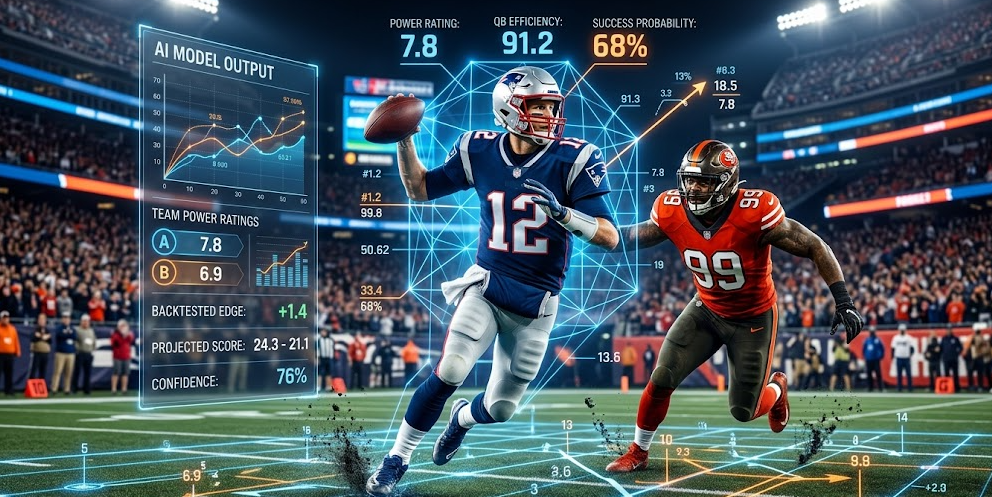
In sports analytics, clean data is everything. Turning raw stats into actionable predictions requires more than intuition; it demands a structured approach that blends proven metrics, situational context, and rigorous modeling. AI betting models with power ratings are designed to do exactly that. These models take team and player strength numbers, layer in context like home advantage, rest, injuries, pace, and market movements, and produce probabilities you can compare directly to sportsbook lines. ATSwins demonstrates how to turn that information into practical, actionable insights for bettors, providing picks, props, betting splits, and profit tracking across NFL, NBA, MLB, NHL, and NCAA. By focusing on consistency, transparency, and testable predictions, these AI models help bettors navigate the noise and maintain discipline in their wagering. This piece walks through building a robust AI betting model with power ratings, from foundational data to deployment, monitoring, and bankroll management.
Table Of Contents
- Power Ratings Foundations And Data Pipelines
- AI Model That Fuses Power Ratings With Market And Context
- Backtesting, Calibration And Bankroll
- Deployment, Monitoring And Explainability
- Conclusion
- Related Posts
- Frequently Asked Questions (FAQs)
Power Ratings Foundations And Data Pipelines
A power rating compresses a team’s or player’s strength into a single number on a common scale. It doesn’t need to be visually intuitive; consistency and predictiveness are the priorities. Team ratings typically represent expected point margin on a neutral field against an average opponent. Player ratings are relative to an average player, often measured in points, wins above replacement, or other performance metrics. For granular modeling, ratings can split offense and defense or even segment offensive and defensive units, like pass/run efficiency, half-court/transition, or bullpen rotation in MLB.
Building these ratings starts with structured, time-ordered data. Box scores, final scores, and play-by-play provide the foundation. Possession-based adjustments normalize for tempo in NBA and NCAA, while NFL uses plays per game, MLB normalizes by league run environment, and NHL leverages an NHL power rating system based on expected goals, shots, and goalie-adjusted metrics to create stable, predictive ratings. Home/away status, rest days, travel distances, altitude, and weather are essential contextual factors. Closing lines and totals anchor the labeling process, ensuring your model reflects market reality without leaking future information. First-pass team ratings can resemble a simple SRS computation, adjusting for opponent strength and normalizing league average to zero, with home advantage modeled as a separate constant. Player contributions are then folded in using RAPM-style splits, EPA per play, or wOBA/OPS+ metrics, depending on sport.
Blending multiple rating systems, like SRS, Elo, and Massey, adds robustness. SRS captures point differentials with schedule adjustments, Elo provides rapid adaptability for win probabilities, and Massey least squares models fit observed margins. Using shrinkage prevents overreacting to early-season variance, while combining these approaches allows spreads, totals, and moneyline probabilities to all be modeled efficiently. Feature engineering enhances predictiveness with metrics such as rating differences, home edge, rest and travel, tempo/style measures, environmental factors, market anchors, recent form windows, and matchup-specific interactions. Neutral margin priors, win priors, rest/travel adjustments, injury impacts, market context, environmental variables, and recent performance deltas are core features consistently valuable across leagues.
AI Model That Fuses Power Ratings With Market And Context
The AI model begins by defining what it is predicting. Win probability, against-the-spread outcomes, and totals are the most common targets, each defined relative to closing lines to reduce bias. Using closing lines ensures that ATS and over/under labels reflect market consensus and minimize artificial edges in the data. Games with late-breaking injuries that were not captured in features are flagged or excluded. Features strictly predate game locks to maintain temporal integrity.
Baseline models are simple and interpretable. Logistic regression handles win probabilities and ATS, while linear regression tackles totals. Standardizing features and applying minimal interaction terms ensures clarity and prevents overfitting. Probability quality is evaluated using out-of-sample log loss, mean absolute error, and Brier score. Once baselines plateau, gradient-boosted trees or XGBoost models capture non-linear interactions. Calibration using isotonic regression or Platt scaling ensures that predicted probabilities reflect true likelihoods. Totals can be modeled using quantile regression for predictive distributions.
Early-season instability and sparse data require Bayesian hierarchical smoothing. Team-level intercepts and offense/defense effects are drawn from league priors, while player availability is shrunk toward zero for small-sample players. Embeddings compress multi-dimensional team profiles into dense vectors, which can be concatenated with power ratings and context features. Injury effects are mapped into expected point contributions, adjusting for minutes, position, and probabilistic availability. Time-based cross-validation and walk-forward splits prevent leakage and enforce temporal consistency. Retraining cadences vary by league, typically weekly for NBA, NHL, MLB, and biweekly or per-bye week for NFL.
Backtesting, Calibration And Bankroll
Backtesting must simulate real betting experience. Running season-by-season simulations with only information available at the time of each game ensures realistic results. Recording model probabilities, edge versus closing line, recommended stakes, outcomes, log loss, Brier score, ROI, and CLV allows rigorous evaluation. CLV is critical, as consistently positive CLV over time indicates genuine edge, even amid variance. Calibration ensures probabilities reflect actual outcomes. Reliability plots, expected calibration error, and post-hoc adjustments using isotonic regression or temperature scaling help maintain trust in outputs.
Sensitivity analysis examines model robustness to drifting assumptions. Variations in home advantage, pace, injury priors, and weather are simulated to detect overfitting or instability. Fractional Kelly staking governs bet size, using a conservative fraction of the theoretical edge. Per-bet and per-league exposure caps limit variance, while correlation adjustments manage bets on related outcomes. Stop-loss limits enforce bankroll protection during streaks of adverse results. Simulation of worst-case outcomes using binomial or Poisson frameworks informs stake sizing decisions.
ROI and CLV monitoring guide model trust. Tracking edge distribution, segmenting by league, market type, injury uncertainty, and closing line movement informs adjustments. Stress testing across rule changes and schedule shocks verifies robustness. Compressed schedules, pitch clock limits, foul rule emphasis, and kickoff adjustments are all factored into recalibrated features. Continuous comparison to ATSwins outputs allows benchmarking and improves confidence in predictions. These steps are the essence of AI betting systems for consistent ROI, where disciplined backtesting, careful calibration, and smart bankroll management turn edges into sustainable long-term returns.
Deployment, Monitoring And Explainability
Reproducible deployment treats the pipeline like production software. Raw and processed data are versioned and hash-verified. Model artifacts for ratings, feature generation, and final predictions are stored separately, enabling independent updates. Experiment tracking logs parameters, data windows, calibration, ROI, and CLV time series. Scheduling ensures nightly ETL of box scores and odds, with intraday updates for injuries and weather. Data quality checks validate freshness, ranges, consistency, stability, and drift. PSI and calibration error thresholds trigger retraining when violated. Labels are checked for parity and leakage.
Explainability focuses on actionable insights rather than technical math. SHAP-style explanations quantify feature contributions, with concise narratives describing why a team is favored. Global importance measures, human-readable rationales, and weekly summaries reinforce bettor trust. Ethical guardrails include documented assumptions, responsible wagering guidelines, daily/weekly caps, and transparent disclaimers.
The end-to-end workflow moves from raw ratings to deployed AI. Raw data is stored, base ratings are computed, features are engineered, targets are built, models are trained and calibrated, backtests are executed, stress and sensitivity tests run, staking rules applied, predictions deployed, and explainability delivered. Sport-specific nuances are incorporated, such as EPA features for NFL, back-to-back adjustments for NBA, SP and bullpen metrics for MLB, goalie and special teams stability for NHL, and hierarchical shrinkage for NCAA. Common pitfalls, including early-season volatility, correlated bets, and live market shocks, are mitigated with structured adjustments.
ATSwins fits into this workflow by providing benchmarking, discovery, and tracking tools. Bettors can compare their model probabilities to ATSwins outputs, identify under-covered opportunities, and log results for variance learning. Free and paid plans allow validation and scaling across NFL, NBA, MLB, NHL, and NCAA markets.
Conclusion
Building AI betting models with power ratings starts with clean data, structured ratings, and honest backtesting. Calibrating to the closing line, tracking CLV, and managing bankroll are core pillars. Starting simple and scaling gradually ensures both accuracy and stability. ATSwins provides a platform for data-driven picks, player props, betting splits, and profit tracking, giving bettors insights to make smarter, more informed decisions. By following structured modeling, calibration, and deployment practices, bettors can turn statistical advantages into practical, repeatable strategies.
Frequently Asked Questions (FAQs)
What is an AI betting model with power ratings?
It blends team and player strength numbers with machine learning to price games. Power ratings establish a baseline for how Team A compares to Team B on neutral terms. AI layers in context such as home edge, rest, injuries, pace, weather, and market movements. The output is probabilities and fair odds, which bettors can compare to sportsbooks to identify edges.
How do I start building an AI betting model with power ratings, step by step?
Define your target—win probability, ATS, or totals. Build initial ratings using historical scores and possessions, adjusting for opponent strength and tempo. Shrink early-season ratings toward league average. Engineer features including rating differences, home/away, rest, travel, injuries, and recent form. Train models starting with logistic regression, then explore tree ensembles like XGBoost. Use Bayesian smoothing for sparse data. Validate with walk-forward splits, tracking Brier score, log loss, and calibration. Reliable data comes from sources like Sports Reference and Football-Data.co.uk. Export probabilities, compare to market, and log results.
How accurate is an AI betting model with power ratings vs the closing line?
The closing line is difficult to beat, but a well-calibrated AI betting model with power ratings can find edges in niche situations. Key metrics include CLV, which measures how your model performs relative to the market close, and calibration, ensuring predicted probabilities match actual outcomes. Expect variance; models prioritize steady CLV and manageable drawdowns over daily wins.
How does ATSwins.ai use an AI betting model with power ratings to help me bet smarter?
ATSwins uses the model as a core input and layers in real-time context for player props, betting splits, and profit tracking across multiple leagues. It provides data-driven insights and comparisons to your own models. Free and paid plans allow gradual adoption, letting bettors validate their approaches and scale effectively.
What bankroll rules pair best with an AI betting model with power ratings?
Use fractional Kelly sizing, typically 25–50% of theoretical edge. Cap exposure per league and per day, reduce stakes during periods of high uncertainty, and track all wagers including stake, edge, CLV, and outcomes. This disciplined approach ensures long-term profitability while mitigating variance risks.
Related Posts
AI For Sports Prediction - Bet Smarter and Win More
AI Football Betting Tools - How They Make Winning Easier
Bet Like a Pro in 2025 with Sports AI Prediction Tools
Sources
The Game Changer: How AI Is Transforming The World Of Sports Gambling
AI and the Bookie: How Artificial Intelligence is Helping Transform Sports Betting
How to Use AI for Sports Betting
Keywords:
MLB AI predictions atswins
AI MLB predictions atswins
NBA AI predictions atswins
basketball ai prediction atswins
NFL ai prediction atswins