

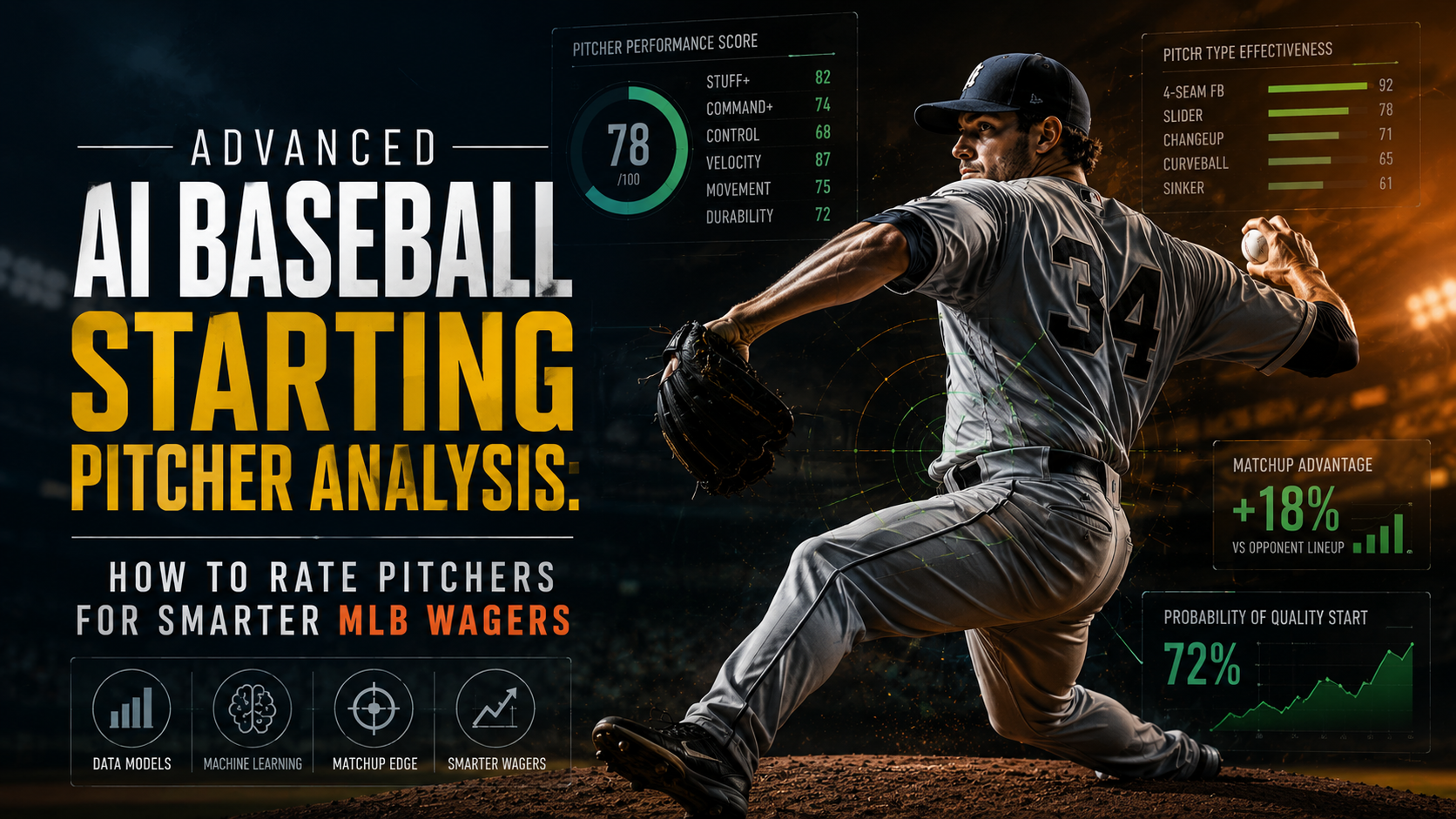
Predicting how a Major League Baseball starting pitcher will perform on any given day requires moving past outdated, surface-level metrics. By building an automated workflow that blends pitch-level Statcast data, plate discipline splits, weather variables, and roster context, you can generate precise probabilities that uncover major market inefficiencies. This comprehensive guide outlines the exact data foundations, feature engineering strategies, and validation protocols required to construct a highly predictive starting pitcher evaluation model.
Table Of Contents
- AI-First Starting Pitcher Workbench for Sharper MLB Picks
- Data Foundations for AI Baseball Starting Pitcher Analysis
- Feature Engineering and Target Design
- Modeling and Validation
- Game-Day Updating and Ops
- Betting Applications at ATSwins
- Communication, Risk, and Ethics
- Frequently Asked Questions (FAQs)
Key Takeaways
Start with clean data, then test it using date-based splits, keep targets tied to real bets, and update near first pitch with confirmed lineups, park factors, weather, and catchers.
Focus on what truly moves outcomes, including velocity and spin trends, pitch-mix balance, times-through-order, opponent chase and whiff rates, rest, and travel.
Output probabilities instead of hot takes, monitor Brier or log loss, and display uncertainty so risk remains visible.
Automate data pulls, set alerts for pitch-count caps or injuries, version your models, and log predictions alongside results to learn fast.
ATSwins.ai is an AI-powered sports prediction platform offering data-driven picks, player props, betting splits, and profit tracking across major sports to help bettors make smarter decisions.
AI-First Starting Pitcher Workbench for Sharper MLB Picks
Building a high-performing projection system requires treating starting pitcher evaluation as a dynamic data science problem rather than a set of static trends. Successful sports analytics professionals rely on an organized, automated pipeline that ingests raw physical measurements and transforms them into predictive probabilities. By focusing heavily on stable underlying metrics and adjusting for daily environmental factors, you can consistently outpace public betting lines. The goal is to establish a repeatable system where clean features, strict validation, and automated game-day operations handle the heavy lifting.
Data Foundations for AI Baseball Starting Pitcher Analysis
To model starting pitcher outcomes with high precision, you must begin at the pitch-by-pitch level. The official MLB.com Statcast feed provides the necessary raw ingredients, such as velocity deltas, spin rates, induced vertical break, and horizontal movement. Tracking the absolute release point and its variance within an outing allows you to flag subtle physical fatigue or mechanical tweaks early. Additionally, monitoring location intent through attack zone rates and called strikes plus whiffs (CSW%) helps establish reliable short-term performance snapshots. Computing rolling 3-game and 10-game exponentially weighted moving averages ensures that a pitcher's recent form carries more weight than their early-season baselines.
Pitching is only half of the equation, meaning opponent metrics are equally critical to your success. You need to gather opponent plate discipline profiles, evaluating whiff and chase rates against the expected lineup while adjusting carefully for handedness splits. Quality of contact metrics like hard-hit percentage, barrel rates, and groundball tendencies help define a lineup's true threat level. Furthermore, integrating rolling 14-day team statistics helps capture recent approach changes without overreacting to single-game outliers.
Environmental and structural factors complete your foundational data layer. Park factors must extend beyond simple home run metrics to account for how specific environments alter breaking ball movement and carry. Weather inputs like temperature, wind speed, wind direction, and humidity can quickly turn routine fly balls into home runs. Finally, tracking bullpen fatigue by monitoring recent pitch counts and consecutive days worked allows you to model the expected relief depth available if a starter exits early.
To organize these pipelines efficiently, use the pybaseball library to automate Statcast and plate discipline data collection. Retrosheet serves as an excellent resource for historical scheduling, umpire logs, and play-by-play data to support rigorous back-testing. All ingested data should be saved as standardized parquet files within a structured feature store, separating feature engineering from post-game labels to prevent accidental target leakage during training. At ATSwins, we maintain a lightweight feature store keyed by date and pitcher ID alongside a secondary store for lineups to keep our hourly projection updates running smoothly.
Feature Engineering and Target Design
Your model targets must align directly with actionable wagering markets to provide real value. Focus on predicting concrete outcomes like Quality Start probability, strikeout and walk percentages per batter faced, and first five innings runs allowed buckets. Modeling pitch-count efficiency through pitches per batter also helps project exact innings pitched limits for player prop markets. Avoid broad, arbitrary performance ratings that do not map cleanly to available betting derivatives or daily fantasy sports tiers.
Quantifying a pitcher's deception and sequencing requires measuring pitch-mix entropy. This calculation determines how unpredictable a pitcher remains across their arsenal, which heavily influences their success when facing a lineup for the third time. Keeping tabs on velocity and movement separation between fastballs and secondary offerings helps identify when a pitcher's planes are flattening out. It is essential to break these metrics down by opponent handedness, as specific pitch shapes can dominate same-handed batters while getting heavily punished by opposite-handed hitters.
Command proxies and physical degradation metrics add another layer of predictive power. Tracking the standard deviation of horizontal and vertical release points within a game helps pinpoint exactly when an arm begins to tire. Combining this with edge versus waste zone percentages reveals who can efficiently steal strikes and maximize pitch counts. To account for structural decline during a game, compute times-through-the-order penalties by assessing changes in weighted on-base percentage (wOBA) or velocity drops after a starter crosses the 75-pitch threshold.
External stress and situational variables must also be factored into the equation. Calculate schedule strain by checking rest days against previous pitch counts, and implement travel heuristics to flag cross-country trips or sudden altitude changes. Incorporate catcher framing metrics alongside historical umpire strike zone tendencies, as even a minor shift in called strike percentages can alter a strikeout prop line. Lastly, adjust for opponent lineup construction, applying slight contact quality penalties to players recently returning from the injured list who may experience timing delays against elite velocity.
Modeling and Validation
Before building complex machine learning architectures, you must establish simple, rule-based baselines to evaluate your progress. Compare your model against league-average quality start rates adjusted for park factors, alongside basic rolling pitcher versus hitter matchup averages. If your advanced model cannot comfortably beat these native baselines within a few hundred basis points on Brier score, your feature engineering pipeline likely requires debugging.
For classification tasks like quality start probabilities and runs allowed buckets, utilize calibrated logistic regression or gradient-boosted decision trees via LightGBM or CatBoost. For discrete counting metrics like strikeout and walk props, Poisson regression or multi-output models with post-hoc calibration function best. To evaluate performance accurately, apply a strict walk-forward cross-validation strategy split by date rather than using randomized rows. For instance, train your model on March through May data, validate on June, and then roll the training window forward to validate July, keeping your feature windows tightly frozen to mimic live betting conditions.
Hyperparameter optimization should be managed with frameworks like Optuna, focusing on bounding max depth, learning rates, and subsample ratios to prevent severe overfitting. Prioritize absolute probability calibration over minor gains in area under the curve (AUC). Check your outputs using Brier score metrics and reliability plots across deciles, applying Platt scaling or isotonic calibration if your 60% probability buckets fail to cash at a matching 60% historical clip.
Model interpretability is vital for maintaining trust during volatile stretches of the season. Generate feature importance rankings alongside Partial Dependence Plots to visualize how a 2 mph drop in fastball velocity explicitly alters a pitcher's quality start outlook. Ensure you stress-test your final models across specific environmental sub-slices, verifying that the algorithm remains highly accurate during extreme conditions, such as high-wind games at Wrigley Field or high-temperature days in smaller ballparks.
Game-Day Updating and Ops
Executing a profitable sports betting strategy requires a strict, multi-stage operational schedule leading up to first pitch. Your day should follow a structured timeline. First, at twenty-four hours before the game, generate initial baseline projections using highly probable starting pitchers, neutral projected lineups, and early weather ranges. On the morning of the game, refresh local weather models, integrate updated park factors, and apply official umpire assignments. Once lineups lock, immediately ingest official starting lineups from MLB.com to calculate exact handedness splits, platoon advantages, and updated lineup metrics. Throughout the final hourly countdown, continuously refresh weather data and monitor market betting splits, flagging any unexpected velocity or injury rumors for manual review.
Operational rules must also handle real-world uncertainty and news spikes. If a manager indicates a strict pitch count or a starter is returning from a rehab assignment, manually cap their projected innings pitched to protect your player prop calculations. When sudden injury red flags surface, increase the variance of your outcomes and lower the pitcher's efficiency ceiling. Environmental alerts, such as sustained outfield winds above twelve miles per hour, should automatically trigger minor upward adjustments to home run and walk distributions.
To track long-term efficiency, your serving infrastructure should remain lightweight and completely reproducible. Deliver forecasts through a streamlined internal API that outputs clean JSON contracts containing calibrated probabilities, confidence intervals, and brief text notes highlighting key model shifts. Every single prediction, along with the precise feature states present at the time of the calculation, must be logged in a database. Comparing these historical records against actual game results allows you to run weekly post-mortems that measure your exact edge against closing market lines.
Betting Applications at ATSwins
Transforming raw probabilities into a profitable betting portfolio requires identifying the specific markets where your data edge is largest. First five innings totals are highly lucrative because they isolate your starting pitcher projections from late-game bullpen variance. For individual strikeout and walk player props, evaluate the entire modeled distribution rather than relying on a simple mean. This allows you to accurately price alternative lines, where substantial betting value often exists on plus-money outcomes.
When analyzing major market movements, verify whether a line shift aligns with a corresponding change in your feature store, such as a confirmed lineup scratch or a major weather update. If the market moves significantly without a clear structural driver, exercise caution or shade your position accordingly. For comprehensive context on navigating early-season volatility and tracking postseason roster adjustments, review our strategic breakdowns of MLB early season betting strategy baseball and our analytical coverage of NHL playoffs betting trends AI analysis AI model reveals how to pick winners.
Managing your bankroll requires using a disciplined fractional Kelly Criterion staking model that scales your bet sizing based on your verified mathematical edge and historical calibration confidence. Avoid building highly correlated same-game parlays in environments where performance variables can move in opposite directions. ATSwins.ai subscribers on both free and premium tiers receive direct access to these data-driven picks, player prop edges, and live profit tracking tools, allowing you to benefit from complex feature store modeling without needing to manage raw databases yourself.
Communication, Risk, and Ethics
Successful sports analytics requires communicating model outputs with transparency and acknowledging inherent sports variance. Projections should always be presented as percentages and ranges rather than absolute declarations. Showing the specific drivers behind a shifting projection, such as an umpire change or an adjusted lineup, helps prevent users from anchoring to outdated narratives.
Maintain rigorous data lineage records by documenting all scrape policies, respecting website rate limits, and versioning historical datasets. This ensures you can easily recreate and audit past slates to find errors. Additionally, use robust smoothing techniques and conservative priors when analyzing small sample sizes, such as a pitcher introducing a new sweeper grip or a young player making their debut.
Finally, blend qualitative manager insights with your quantitative data, converting public coaching statements about pitch counts into hard input constraints. If you want to see how this walk-forward modeling and validation framework translates to high-liquidity basketball markets, check out our insights on NBA playoff betting trends AI analysis, which highlights the exact same core modeling discipline applied to a fast-paced, possession-driven sport.
Frequently Asked Questions (FAQs)
What is AI baseball starting pitcher analysis, and how does it help me model SPs better?
AI baseball starting pitcher analysis uses pitch-level data and context to rate how a starter will perform today. When you model SPs, you blend measurable skill (velo, spin, movement), discipline results (K% & BB%), and context like park, weather, umpire zones, rest, plus lineup handedness. Done right, this turns a fuzzy opinion into live probabilities for strikeouts, runs allowed, and outs recorded. It matters because it reduces guesswork and gives you a clear risk and reward picture, not just a gut call.
Which data sources should I start with for AI baseball starting pitcher analysis when I’m learning how to model SPs?
Begin with reliable, public data you can refresh daily. First, you should target Statcast from Baseball Savant for pitch velocity, spin, movement, release points, and batted ball outcomes (see Baseball Savant at Baseball Savant). Second, gather FanGraphs data for plate-discipline and contact splits, park factors, and projections (see FanGraphs Library at FanGraphs). Third, extract Retrosheet data for historical play-by-play and umpire assignments history (Fox Sports). Fourth, integrate weather inputs (temperature, wind, humidity) from a trusted feed; even a simple park-wind flag helps. Fifth, establish a lightweight Python pipeline with pybaseball to pull MLB stats (ESPN).
For modeling SPs, track features like pitch-mix share, pitch-mix entropy, velo trend over last 5 starts, times-through-the-order penalties, rest days, catcher framing signals, K% and BB% deltas vs. opposite-handed hitters, and opponent chase/whiff rates. Keep it clean—small, stable feature sets beat noisy everything-and-the-kitchen-sink builds.
How do I build a simple, solid model for AI baseball starting pitcher analysis—basically how to model SPs end to end?
Start small and be strict about time. First, define targets that match your decisions: K total, earned runs bucket, outs recorded (18+, 15–17, <15), or quality start probability. Second, create features available before first pitch only: pitch-mix & velo trend, spin axis movement, release-point variance, lineup handedness, park factor, travel + rest, bullpen fatigue, projected ump zone. Third, split by date with walk-forward validation to avoid leakage. Train on past weeks, test on the next slate. Roll forward. Fourth, use straightforward models first (logistic regression or gradient-boosted trees). Calibrate probabilities (Platt or isotonic). Fifth, evaluate with Brier score, log loss, and calibration curves. Check stability by park type and weather bands. Sixth, ship a tiny inference script. On game day, refresh lineups, weather, and any last-minute scratches. Recompute; don’t overfit last night’s noise.
If you want one fast path: Gradient boosting (e.g., XGBoost or LightGBM) with 30–60 well-chosen features, walk-forward CV, and basic calibration will get you 80% of the way—clean data wins, not fancy tricks.
How do I update AI baseball starting pitcher analysis on game day, and what moves the model most for SPs?
Two hours pregame, pull confirmed lineups, park & weather, and the projected ump. Re-run projections with final batting order to watch platoon edges and late scratches. Factor in temperature and wind to measure the direct impact on home run and extra-base hit risk. Update the catcher assignment to adjust for framing and game calling. Review manager quotes about pitch count or workload because you cannot afford to ignore this context. Finally, evaluate the opponent bullpen plan if it affects aggression on the bases.
What moves it most? Lineup handedness flips, pitch-count limits, and meaningful velo changes in the last start. Minor notes like a new grip can matter if it changed shape (IVB or horizontal run) more than 1–2 standard deviations. Keep it simple: big edges usually come from clear changes, not tiny model wiggles.