

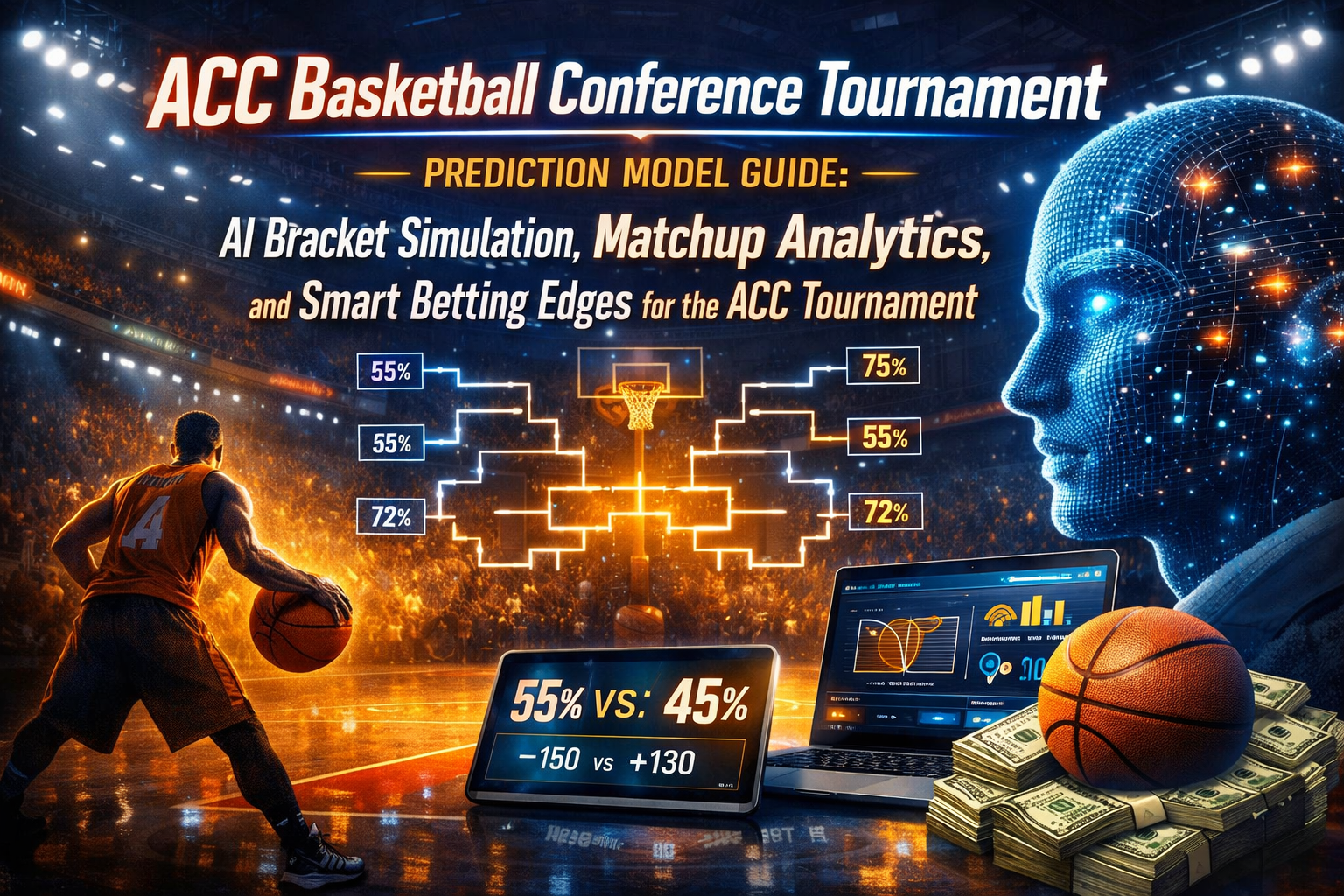
March is when college basketball gets chaotic in the best way possible. If you follow the ACC tournament closely, you already know that regular season stats only tell part of the story. Teams are playing on a neutral floor, schedules get compressed, rotations tighten up, and fatigue suddenly becomes a real factor. That is exactly why building a solid ACC basketball conference tournament prediction model is one of the most interesting analytics challenges in sports betting.
A good model does not just spit out power rankings. It translates real basketball matchups into probabilities, then uses those probabilities to simulate the entire bracket thousands of times. That process helps you understand not only who might win a single game, but how the entire tournament could unfold.
At ATSwins, the focus is always on transparency and data driven betting insights. Instead of chasing narratives or media hype, the idea is to build models that rely on measurable factors like efficiency, tempo, turnovers, lineup health, and fatigue. When those pieces come together the right way, you get a much clearer picture of which teams actually have a path to the title.
This guide walks through how an ACC basketball conference tournament prediction model works from start to finish. We will go through the context of tournament modeling, how data gets assembled, how machine learning models are built and validated, how bracket simulations generate probabilities, and how the final outputs translate into real betting insights.
The goal here is not hype or clickbait predictions. The goal is to show how modern analytics can turn raw basketball data into realistic tournament projections.
Table Of Contents
- Context and objectives for an ACC Basketball Conference Tournament Prediction Model
- Data assembly and feature engineering
- Modeling and validation
- Bracket simulation and outputs
- Operations and reporting
- Step by step build: from raw data to bracket odds
- Useful tools and lightweight templates
- Practical tips that keep the model honest
- How ATSwins presents this for bettors
- Conclusion
- Frequently Asked Questions (FAQs)
Building an ACC Tournament Model That Bets Smart
Context and objectives for an ACC Basketball Conference Tournament Prediction Model
The ACC tournament is completely different from the regular season. During the regular schedule teams benefit from home court, predictable rest cycles, and game preparation that sometimes stretches across several days. The conference tournament flips all of that upside down.
Games happen on a neutral court, which removes the home crowd advantage that college basketball is famous for. Teams can end up playing on back to back days, especially lower seeds that need to win multiple games just to reach the semifinals. Coaches shorten rotations and rely heavily on their best players. At the same time, fatigue and travel can creep in quickly.
All of these conditions mean that a basic power rating system is not enough. A true ACC basketball conference tournament prediction model needs to capture the environment of the tournament itself.
The first objective is simple. Estimate the probability that Team A beats Team B on a neutral floor given their current form and roster situation.
The second objective expands that idea to the entire bracket. Once individual game probabilities are known, the model can simulate thousands of tournament scenarios. Those simulations estimate how often each team reaches the semifinals, the championship game, or wins the tournament.
The third objective involves risk awareness. Upsets are a natural part of conference tournaments. A good model highlights not only the likely outcomes but also the volatility of certain matchups. Some games are nearly coin flips even if one team is technically favored.
At ATSwins, those probabilities eventually become fair betting prices and edge indicators. When the model probability differs significantly from the market implied probability, that gap becomes a potential betting opportunity.
Another major objective is transparency. The model should be explainable. Analysts and users should be able to see which factors drive predictions instead of trusting a mysterious black box.
When those principles guide the design, the result is a prediction system that focuses on real basketball edges rather than hype.
Data assembly and feature engineering
Before any model gets built, the most important step is assembling the data correctly. Tournament predictions rely on several layers of information, starting with standard team statistics and expanding into more contextual features.
Season long performance metrics are the backbone of the system. Offensive efficiency measures how many points a team scores per 100 possessions. Defensive efficiency measures how many points they allow per 100 possessions. These metrics are far more reliable than raw scoring averages because they adjust for pace.
The famous Four Factors also play a big role. These include effective field goal percentage, turnover rate, offensive rebounding rate, and free throw rate. Each of these statistics captures a different part of basketball strategy. Effective field goal percentage reflects shooting quality. Turnover rate reflects ball security. Offensive rebounding measures second chance opportunities, and free throw rate reflects how aggressively teams attack the rim.
Tempo is another key input. Some teams push the pace and thrive in high possession games. Others prefer slower half court battles. When those styles clash, the tempo difference becomes an important feature in the prediction model.
Schedule strength adjustments also matter. A team that posts strong numbers against elite competition might actually be stronger than another team with similar stats built against weaker opponents. Adjusting efficiencies for schedule difficulty helps normalize that difference.
Recent form also deserves attention. Teams evolve during the season. Injuries heal, lineups change, and players improve. Many prediction models track the last five or ten games separately from the full season to capture those trends. However, recent form must be used carefully because small sample sizes can create misleading streaks. Most models shrink those short term numbers toward the season average to keep predictions stable.
Tournament specific features add another layer of realism. Neutral court conditions are different from both home and road environments. Shooting percentages can fluctuate more without familiar backdrops, and crowd influence disappears.
Rest and fatigue variables also matter a lot during conference tournaments. A team playing its third game in three days may not perform the same way as a team entering the bracket with a double bye and two days of rest.
Travel distance can also be incorporated. While ACC teams are usually located within the same general region, travel still affects preparation schedules and recovery time.
Seeding is another factor worth including. Higher seeds typically face weaker opponents early in the bracket and often benefit from additional rest days. Those structural advantages can slightly increase their tournament probabilities.
Lineup continuity is one of the more underrated signals. Teams missing key players or adjusting to new rotations often struggle with consistency. Tracking how many minutes from the typical rotation remain available helps quantify that effect.
The final step in feature engineering is creating matchup specific variables. Instead of simply measuring how strong each team is, the model compares styles directly. For example, a team that relies heavily on three point shooting might struggle against an opponent that excels at defending the perimeter. Similarly, a team that pressures the ball aggressively may force turnovers against an opponent with shaky ball handling.
These interaction features allow the model to capture stylistic advantages that basic ratings might miss.
Modeling and validation
Once the dataset is ready, the next step is building the prediction model itself. A common starting point is logistic regression. Even though it is relatively simple compared to modern machine learning techniques, logistic regression works extremely well for sports prediction when the features are meaningful.
The model estimates the probability that one team wins a game based on the difference between the teams in various statistical categories. Efficiency margins, turnover rates, tempo differences, rest advantages, and seed gaps all feed into the equation.
One reason logistic regression remains popular is transparency. Each feature receives a coefficient that shows how strongly it influences the prediction. Analysts can easily inspect the model and confirm that the weights align with basketball logic.
After establishing the baseline model, more advanced techniques can be tested. Regularized regression models such as Elastic Net help control overfitting by shrinking unnecessary feature weights. Gradient boosting algorithms can capture nonlinear relationships and interactions that linear models might miss.
However, more complexity does not always mean better performance. Conference tournaments contain relatively small sample sizes, which increases the risk of overfitting. That is why validation procedures are extremely important.
Time based cross validation is the standard approach. The model is trained on historical seasons and then tested on future tournaments that were not part of the training data. This method mimics the real world scenario where predictions must be made before the games happen.
Evaluation metrics include log loss and Brier score. Both metrics reward accurate probability estimates rather than just correct picks. Calibration is also crucial. If a model predicts that a team has a 60 percent chance to win, that prediction should be correct roughly 60 percent of the time across many games.
Calibration techniques such as isotonic regression help align predicted probabilities with real outcomes. When the model is properly calibrated, its probabilities become much more trustworthy for betting analysis.
Bracket simulation and outputs
Once reliable game probabilities exist, the most exciting part of the process begins. Bracket simulation.
The idea behind bracket simulation is simple but powerful. The model uses its win probabilities to simulate the entire ACC tournament thousands of times. Each simulation randomly determines winners based on the probability of each matchup.
If a team has a 70 percent chance to win a game, it will win roughly 70 percent of the time across many simulations. By repeating this process for the entire bracket, the model generates realistic tournament distributions.
After fifty thousand or more simulations, the system records how often each team reaches different rounds. The results show probabilities for reaching the semifinals, making the championship game, and winning the tournament.
This process also highlights upset potential. Certain matchups may look balanced despite a small seed gap. If the simulations frequently produce an upset in that spot, the model flags the game as volatile.
Another benefit of bracket simulation is path analysis. Some teams may appear strong overall but face difficult potential opponents early in the bracket. Others might benefit from a favorable path where stylistic matchups align in their favor.
These insights are incredibly valuable when evaluating tournament futures bets or bracket pools.
At ATSwins, simulation results are translated into fair betting prices. A team with a 25 percent simulated chance to win the tournament would correspond to a fair moneyline around +300. If the market offers significantly better odds, the difference may represent a betting edge.
Operations and reporting
During tournament week the model becomes part of a daily workflow. Data updates must happen quickly and accurately.
Each morning analysts refresh the dataset with updated injury reports, lineup news, and any late corrections to game statistics. The model then recalculates probabilities for upcoming matchups.
Sanity checks are important at this stage. If the model suddenly produces extreme probabilities that contradict common sense, the underlying data must be reviewed.
Probabilities also get compared against market odds to identify potential edges. When a model estimate differs significantly from sportsbook pricing, the discrepancy becomes a candidate for further analysis.
Another key task involves documenting assumptions and limitations. Tournament games often involve high variance elements such as three point shooting streaks or late game fouling strategies. Communicating that uncertainty helps maintain realistic expectations.
Post tournament analysis is equally valuable. After the event concludes, the model’s predictions are compared with actual outcomes. Calibration charts and accuracy metrics help determine whether adjustments are needed for the following season.
Step by step build from raw data to bracket odds
Building a tournament prediction model from scratch involves several clear stages.
The first stage defines the historical modeling window. Many analysts choose roughly a decade of past seasons to provide enough examples while keeping the data relevant to modern basketball trends.
The second stage gathers game level statistics and transforms them into advanced metrics such as efficiencies and Four Factors.
The third stage constructs matchup features by comparing the statistical profiles of each pair of teams.
The fourth stage fits the baseline prediction model and evaluates its performance using time based validation.
The fifth stage experiments with more advanced machine learning techniques to determine whether they improve predictive accuracy.
The sixth stage locks the final model configuration and prepares it for tournament scoring.
The seventh stage generates win probabilities for every possible matchup in the ACC bracket.
The eighth stage runs large scale Monte Carlo simulations to estimate tournament outcomes.
The ninth stage publishes the probabilities and analytical insights for users on the ATSwins platform.
The tenth stage monitors predictions during the tournament and records results for future improvements.
Practical tips that keep the model honest
Even well designed models can drift if analysts are not careful. A few practical guidelines help keep predictions realistic.
Separate regular season trends from tournament effects. Teams often change their rotations and strategies once elimination games begin.
Avoid overreacting to short term shooting streaks. Basketball contains a lot of randomness, especially with three point shooting.
Prepare for injury scenarios in advance. When key players become questionable shortly before tipoff, the model should already have contingency predictions.
Maintain a simple baseline model as a reference point. If a complex algorithm suddenly produces wildly different predictions, the baseline helps identify potential problems.
Focus on probability ranges rather than absolute certainty. Even strong favorites lose sometimes, especially in single elimination tournaments.
How ATSwins presents this for bettors
Once the prediction system produces probabilities and bracket simulations, the final step is presenting that information in a clear and useful way.
ATSwins focuses on straightforward insights rather than overwhelming users with technical details. Each game includes a model win probability and a calculated fair price. These numbers allow bettors to compare model expectations with market odds.
The platform also highlights potential upset spots and tournament futures probabilities. Instead of vague predictions, users see clear percentage estimates for each team’s path through the bracket.
Short explanations accompany each prediction. These notes describe the key matchup factors driving the model’s decision, such as turnover pressure, rim protection, or rest advantages.
The goal is not to guarantee wins. The goal is to give bettors a transparent analytical framework that improves long term decision making.
Conclusion
The ACC tournament is one of the most unpredictable events in college basketball. Neutral courts, short rest cycles, and elimination pressure create a unique environment where traditional power rankings only go so far.
A well built ACC basketball conference tournament prediction model takes that chaos and organizes it into measurable probabilities. By combining efficiency metrics, matchup analysis, injury tracking, and bracket simulations, analysts can estimate realistic paths through the tournament.
At ATSwins, those probabilities become practical tools for bettors. Instead of guessing which team looks hot, users can evaluate matchups based on data driven projections and fair betting prices.
No model is perfect. Basketball contains randomness that no algorithm can fully eliminate. But when probabilities are calibrated correctly and supported by strong data, they provide a much clearer picture of tournament dynamics.
That clarity is what separates smart betting strategies from pure guesswork.
Frequently Asked Questions (FAQs)
What is an ACC basketball conference tournament prediction model?
An ACC basketball conference tournament prediction model is a statistical system designed to estimate the probability that each team wins individual games and ultimately the tournament itself. The model uses historical performance data, efficiency metrics, tempo statistics, lineup health indicators, and other contextual variables to predict outcomes on a neutral court. Once those game probabilities are calculated, the model runs thousands of simulated tournament brackets to estimate advancement probabilities for every team.
Why are neutral court adjustments important in an ACC tournament model?
Neutral court games remove the home court advantage that normally influences college basketball results. Teams often shoot differently in unfamiliar arenas, and crowd impact disappears. Because of this, models adjust shooting variance and efficiency expectations when predicting neutral site games. These adjustments help the model reflect the unique environment of conference tournaments rather than relying on regular season conditions.
How do bracket simulations work in a tournament prediction model?
Bracket simulations use Monte Carlo methods to recreate the tournament thousands of times. In each simulation, the winner of every game is determined randomly based on the predicted probability for that matchup. If a team has a 60 percent chance to win a game, it will win roughly sixty percent of the simulated versions of that game. After repeating the process across many simulations, the model calculates how often each team reaches each round.
What statistics matter most when predicting ACC tournament games?
The most important statistics usually include offensive and defensive efficiency, effective field goal percentage, turnover rate, rebounding rates, and free throw frequency. Tempo also matters because it determines how many possessions each game will contain. Matchup specific factors such as three point defense, ball pressure, and rim protection often become decisive when teams with different playing styles meet.
Can an ACC prediction model actually beat betting markets?
Prediction models can sometimes identify value when sportsbook odds do not fully reflect certain matchup dynamics or injury news. However, betting markets are generally efficient, which means edges are often small. The goal of a model is not to guarantee wins but to provide accurate probability estimates that allow bettors to recognize value opportunities when they appear.
Related Posts
AI For Sports Prediction - Bet Smarter and Win More
AI Football Betting Tools - How They Make Winning Easier
Bet Like a Pro in 2025 with Sports AI Prediction Tools
Sources
The Game Changer: How AI Is Transforming The World Of Sports Gambling
AI and the Bookie: How Artificial Intelligence is Helping Transform Sports Betting
How to Use AI for Sports Betting
Keywords:
MLB AI predictions atswins
AI MLB predictions atswins
NBA AI predictions atswins
basketball ai prediction atswins
NFL ai prediction atswins