

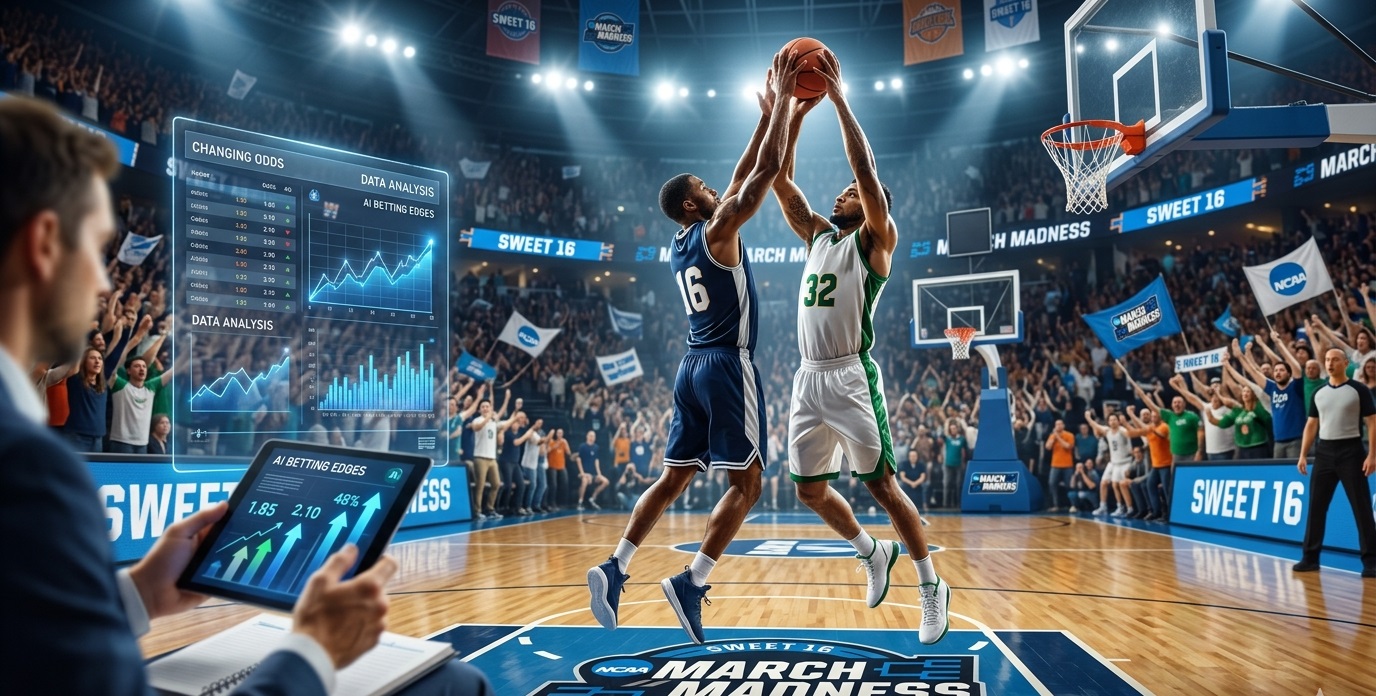
March always hits different once the field tightens up and every possession actually matters. By the time we get to the Sweet 16, you are no longer dealing with random mismatches or teams that snuck through on a hot shooting night. At this point, every team is good, every coach has a real plan, and every betting line is sharper than what you saw in the first weekend. That is exactly why this round is one of the most interesting, and honestly one of the most beatable, if you know what to look for and you are not just following surface level narratives. For a deeper breakdown of how to approach this round strategically, check out The Ultimate Sweet 16 Betting Blueprint
I approach this as someone who builds AI-driven models for college basketball, but I do not just blindly trust numbers. The edge comes from blending hard data with context that the market either underweights or reacts too late to. Things like tempo control, shot quality, travel fatigue, and even referee tendencies all play a role. The goal is simple. Strip away the noise, isolate what actually translates in a neutral-site tournament setting, and turn that into bets that make sense instead of guesses that feel good. You can also explore a game-specific application of these ideas in this in-depth matchup breakdown.
Table Of Contents
- Market Reality in the Sweet 16
- Matchup Angles That Actually Travel
- Historical Angles With Real Signal (verify each year)
- Data Workflow & Betting Construction
- Step-by-Step: From handicap to ticket
- Practical Tools and Templates
- How to measure the key inputs quickly
- Examples of turning the angles into tickets
- How I blend AI modeling with human context
- Caveat on source material and validation
- Useful Resources
- Frequently Asked Questions (FAQs)
Key Takeaways
The Sweet 16 betting market is sharp, but it is not perfect. Public money still leans toward favorites and overs, especially when brand-name programs are involved or when teams are coming off blowout wins. That creates small pockets of value if you are willing to go the other way at the right number. Matchups matter more than anything else at this stage. Tempo, rim defense, rebounding, and how teams guard ball screens are way more important than general narratives about who is “hot.” According to coverage and analytics discussed on major outlets like ESPN’s March Madness section, matchup efficiency and pace consistently drive tournament outcomes more than short-term shooting variance.
A simple, structured model goes a long way. You do not need something overly complex. If you can project possessions, estimate efficiency, and layer in contextual factors like travel and officiating, you already have an edge over most casual bettors. Live betting is also extremely valuable in this round, but only if you are disciplined and waiting for real deviations from expectation instead of chasing momentum.
ATSwins plays a role here as a support system. It helps you validate your reads with data-driven projections, betting splits, and tracking tools so you are not operating in a vacuum. It is not about blindly following picks. It is about making smarter decisions faster.
Market Reality in the Sweet 16
One of the biggest mistakes people make is assuming that because the tournament is deep, the market becomes unbeatable. That is not true. What actually happens is the market becomes more efficient on the surface, but still leaves gaps when it comes to context.
Favorites get inflated. It happens every year. A team wins by twenty in the Round of 32 and suddenly the public treats them like they are unbeatable. The line opens at something reasonable, then gets pushed a point or two higher just from ticket volume. That is not always sharp money. Sometimes it is just people chasing what they saw last.
Totals behave the same way. If two teams have strong offensive reputations, the number gets pushed upward even if the matchup suggests a slower game. This is where understanding the difference between perception and reality matters.
Neutral-site games introduce variables that most bettors ignore. Sightlines are different, arenas are larger, and players are dealing with unfamiliar backgrounds. That can impact shooting, especially early in games. First halves often start slower than expected, not because teams are bad, but because they are adjusting.
Travel is another underrated factor. Teams that move across time zones with limited prep time are at a disadvantage, even if it is subtle. It shows up in pace, in shot selection, and sometimes just in energy levels early in the game. The market does not always fully price that in.
Then you have referees. This is something most people do not even think about, but it matters. Some crews call more fouls than others. That impacts the flow of the game, free throw volume, and late-game scoring. A high-foul crew can turn a slow game into an over simply because of how often teams get to the line.
Sweet 16 Schedule: March Madness 2026
Thursday, March 26
Matchup Angles That Actually Travel
At this stage, matchups are everything. You are no longer betting teams in a vacuum. You are betting how Team A interacts with Team B.
Tempo is the starting point. Possessions drive outcomes. If a fast team plays a slow team, someone is going to dictate the pace. Usually, it is easier for the slower team to drag the game down than for the faster team to speed it up. That benefits underdogs because fewer possessions increase variance.
Three-point shooting is another major factor, but not in the way most people think. It is not just about how well a team shoots. It is about how often they shoot and how well the opponent defends that. A team that relies heavily on threes can struggle if the opponent runs shooters off the line and forces tougher looks.
Rim scoring is one of the most reliable indicators of success. Teams that consistently get to the basket and finish efficiently tend to carry that advantage from game to game. If the opponent cannot protect the rim, that becomes a repeatable edge.
Rebounding is the hidden factor that swings games. Offensive rebounds create extra possessions, and in close games, that is everything. A team that can consistently grab second chances can outperform expectations even if they are not as efficient on initial shots.
Ball-screen coverage is more important than most bettors realize. If a team runs a heavy pick-and-roll offense and the opponent struggles to defend it, that advantage compounds over time. It is not a one-play edge. It shows up over dozens of possessions.
Depth and foul trouble also matter more in the Sweet 16. Rotations tighten, and one key player picking up early fouls can completely change a game. Teams with limited depth are more vulnerable, especially against aggressive offenses.
Historical Angles With Real Signal
History does not predict the future perfectly, but it gives you patterns that are worth paying attention to.
Underdogs tend to perform better in lower total games. When scoring is expected to be limited, each possession carries more weight, which makes it harder for favorites to pull away. That creates value on both the spread and the moneyline.
Favorites coming off blowout wins are often overvalued. The market reacts strongly to dominant performances, even when they are not fully repeatable. That creates opportunities to fade those teams in the next round.
Elite defenses tend to control games against one-dimensional offenses. If a team relies heavily on one scoring method, a well-prepared defense can take that away. That often leads to lower scoring games.
Travel and timing also show up historically. Teams that travel farther or play earlier relative to their body clock can start slower. That creates opportunities in first-half markets.
The key is not to blindly follow trends. You still need to validate them each season and make sure they align with current team profiles.
Data Workflow & Betting Construction
Building a model does not have to be complicated. In fact, simpler is often better.
Start with efficiency. How good is each team offensively and defensively when adjusted for competition. Then look at pace. How many possessions will the game likely have.
From there, layer in shot quality. How often does each team shoot threes. How often do they get to the rim. How well do they defend those areas.
Turnovers and rebounding come next. These factors determine how many extra or lost possessions each team will have.
Free throws are also important, especially in close games. Teams that get to the line and convert at a high rate have an edge late.
Once you have all of that, you can project a score. That gives you a spread and a total. Then you compare that to the market.
If your number is meaningfully different, you have a potential bet. But you still need to test it. Adjust for small changes in assumptions and see if the edge holds. If it disappears easily, it is not strong enough.
ATSwins helps in this phase by giving you a second layer of validation. You can compare your projections to broader data and see if you are aligned or if you are missing something.
Step-by-Step: From handicap to ticket
The process starts with building a game sheet. You gather all the relevant information. Teams, location, travel, rest, and matchup details.
Then you project possessions. This sets the foundation for everything else.
Next, you estimate efficiency. How each team will perform offensively against the specific defense they are facing.
After that, you convert those numbers into a projected score. That gives you your spread and total.
Then you check the market. Look at where the line opened and where it is now. Try to understand why it moved.
If you still see an edge, you place the bet. Keep your stake reasonable. This is not about going all in on one game.
You also plan for live betting. Decide in advance what conditions would trigger a bet during the game.
Finally, you track everything. Not just wins and losses, but how your projections compared to reality.
Practical Tools and Templates
Having a consistent structure makes everything easier. A game sheet keeps your process organized and repeatable.
You want to track pace, shot profiles, rebounding, turnovers, and free throw rates. You also want notes on depth, foul risk, and defensive schemes.
Market data is just as important. Knowing where the line opened and how it moved gives you context for your bet.
ATSwins fits into this by helping you track results and compare your decisions over time. It turns your process into something measurable.
How to measure the key inputs quickly
Efficiency ratings give you a baseline. They tell you how good a team is overall.
Shot profiles tell you how they score. Are they relying on threes or attacking the rim.
Rebounding and turnovers tell you about possession control.
Free throws tell you about late-game potential.
Travel and rest add context. They are small adjustments, but they matter.
Referees add another layer. More fouls mean more free throws, which can impact totals.
Examples of turning the angles into tickets
Imagine a game where a popular favorite is getting heavy action after a big win. The line moves up, but the matchup suggests a slower pace and strong defense from the underdog. That is a spot to take the points and possibly the under.
Another example is a slow-paced underdog with a strong rebounding edge. In a low-total game, that creates value on the underdog and possibly the moneyline.
Then you have matchups where one team cannot defend pick-and-roll effectively. That creates a scoring edge that can justify betting the favorite and looking at player props.
How I blend AI modeling with human context
The model gives me a baseline. It tells me what should happen based on data.
Context tells me what might actually happen. Travel, fatigue, coaching adjustments, and even pressure all play a role.
If the model and context align, that is when I am most confident. If they do not, I reduce my stake or pass.
ATSwins is part of this process. It gives me another perspective and helps confirm whether my edge is real.
Caveat on source material and validation
No system is perfect. Trends change. Teams evolve.
You have to stay flexible and keep validating your assumptions. The goal is not to be right every time. It is to make good decisions consistently.
Useful Resources
The best approach is to combine your own analysis with tools that help you move faster and stay organized. ATSwins is one of those tools, especially for tracking performance and comparing projections.
Frequently Asked Questions (FAQs)
Sweet 16 betting comes down to a few core ideas. Tempo, shot quality, and matchup fit are the biggest factors. Neutral courts can impact shooting, especially early, which is why first-half unders sometimes make sense.
If you are not a coder, you can still build a simple model. Focus on efficiency, pace, and a few key matchup stats. You do not need anything complex to find edges.
Live betting is worth it when the game is clearly deviating from expectations. That could be pace, shooting, or foul trouble. The key is being patient and not chasing.
Props and derivatives can sometimes offer cleaner value than full-game bets. First-half totals, team totals, and rebound props are all worth considering.
ATSwins helps by giving you structured data, projections, and tracking tools so you can make more informed decisions and stay disciplined over time.
Related Posts
Sweet 16 March Madness 2026 Matchups and Best Bets
10 Things Every Serious March Madness Bettor Must Know in 2026
11 Sweet 16 Betting Trends the Public Gets Wrong and How to Exploit Them
Sources
The Game Changer: How AI Is Transforming The World Of Sports Gambling
AI and the Bookie: How Artificial Intelligence is Helping Transform Sports Betting
How to Use AI for Sports Betting
Keywords
The Ultimate Sweet 16 Betting Blueprint for Serious Bettors
10 Sweet 16 Betting Angles That Actually Work in March Madness
7 Sweet 16 Trends That Predict Blowouts vs Close Games
11 Sweet 16 Betting Trends the Public Always Gets Wrong
8 Sweet 16 Betting Angles Sportsbooks Don’t Want You to Notice
10 Sweet 16 Upset Trends That Predict Elite 8 Teams
Sweet 16 Betting Guide: 9 Angles Backed by Real Data
The 12 Most Profitable Sweet 16 Betting Angles (Ranked by ROI)
7 Sweet 16 Betting Trends That Have Crushed March Madness
10 Sweet 16 Betting Angles Sharps Are Using Right Now