

 newsweek
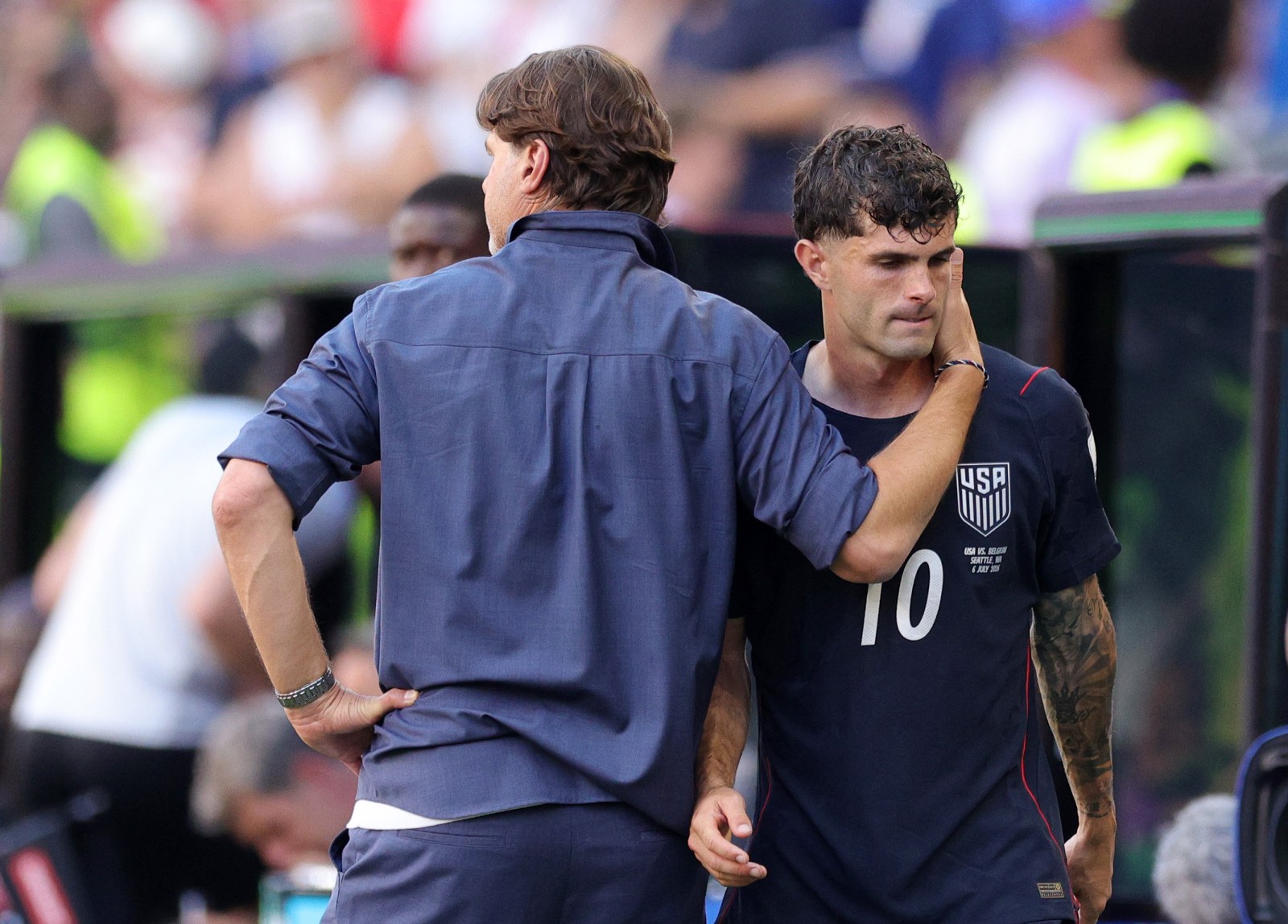
The final whistle in Seattle had barely sounded when the question returned.
Belgium's 4-1 dismantling of the United States men's national team on July 6 ended the Americans' World Cup on home soil at the Round of 16, the same stage where they exited the previous three tournaments they played, and by the heaviest margin the team has suffered at a World Cup since 1934.
And so began, once again, the conversation that follows every American elimination: when, if ever, will the U.S.
become a soccer superpower? Why can't the country that dominates nearly every other sport it plays produce a men's team capable of beating the world's best? Commentator Clay Travis, wrote on X that American youth development "has to get more affordable," prompting a response from Alexi Lalas, former national team defender turned Fox Sports analyst, who defended the country's fee-based model.
"Youth soccer (youth sports) is a competitive market with businesses selling a product that obviously customers are willing to pay for," Lalas wrote.
"I'd love if soccer was free to all.
But who is going to pay for all this free soccer?" The responses came quickly, and from every corner.
Television host Kevin Frazier, appearing on The Dan Patrick Show, accused Lalas of defending a system he had personally benefited from as a suburban kid in Michigan.
"We've got to stop Alexi Lalas," Frazier said.
"Every four years, we lose, and we go through this thing where we say, 'What's the problem with U.S.
soccer?' and then he gives his explanation.
He's like, 'oh, the pay-for-play system works,' and it's okay.
And I'm like, 'Alexi, what are you talking about? You benefited from it.
You are part of the problem.'" The Pay-to-Play Problem Landon Donovan, the national team's joint all-time leading scorer, has spent months making the case that the system prices out talent before it can be found.
"Only 2 percent of kids who were playing organized soccer in America came from households that made less than $50,000," Donovan said in an interview with Junior Rodigan.
"Think about how many kids you are missing out on in this country because they can't afford to play the game." The criticism crossed the Atlantic.
Stan Collymore, the former England striker who played for Premier League clubs Liverpool and Aston Villa, posted a lengthy response to Lalas arguing the cost of the American system will permanently cap the country's ceiling.
"Why the USA will never be a football superpower.
Pay to play," Collymore wrote.
Collymore said his mother paid roughly 200 pounds ($267.95) in total over six or seven years of junior soccer in England, against the $4,000 or more American families routinely pay each year.
"Money, greed, pay to play.
99.9 percent of greats to play the game wouldn't have made it in America.
Because they couldn't afford $4000 (plus) to play," he wrote on X, calling on the U.S.
Soccer Federation to organize low-cost junior leagues, ban profiteering and offer cheap coaching licenses for volunteer parents.
Retired stars including Alex Morgan have joined the push, with Morgan advocating for a more accessible youth system.
How the American System Compares The structural gap between the U.S.
and the sport's traditional powers is stark.
In the U.S., competitive youth soccer is largely run by private clubs that operate as businesses.
Families typically pay between $3,000 and more than $10,000 per year to cover coaching salaries, tournament fees, travel and facility rentals.
Because club revenue depends on registration fees, clubs are incentivized to field as many paying teams as possible.
American families spent an average of $1,016 on a child's primary sport in 2024, a 46 percent increase since 2019, according to Project Play, a youth sports research initiative at the Aspen Institute.
In Europe and South America, the elite pathway runs in the opposite direction.
Professional club academies in countries such as France, England, Germany, Spain, Brazil and Argentina absorb the cost of developing players.
If a child is selected, the family generally pays nothing.
Travel, equipment, coaching and often housing and education are covered by the club, which treats development as an investment recouped through first-team promotion or transfer fees.
France's model, anchored by the national Clairefontaine academy and a network of free professional club academies, has produced consecutive World Cup finalists and a steady stream of players drawn heavily from working-class immigrant suburbs.
In South America, informal street soccer and low-cost neighborhood clubs remain the primary entry point into the professional pipeline.
FIFA rules reinforce those systems through two mechanisms: training compensation and solidarity payments, which direct a share of future transfer fees back to the clubs that developed a player between the ages of 12 and 23.
That gives even small grassroots clubs a financial stake in finding talent rather than charging families for access.
Those mechanisms barely function inside the U.S.
The U.S.
Soccer Federation has argued the payments could violate American antitrust law, and Major League Soccer (MLS) does not pay solidarity fees or training compensation to independent domestic youth clubs whose players pass through its academies.
Is Pay-to-Play the Whole Story? Not everyone agrees the youth system explains the Belgium result.
Analysts have noted the current national team pool was developed largely through free MLS academies and European clubs, and the squad's stars play at top European sides.
The majority of specialized postmortems argued the problem in Seattle was simpler: the players were not good enough against elite opposition, and no coach, including Mauricio Pochettino, could change that.
Former national team goalkeeper Tim Howard said before the elimination that the gap remained too wide.
"The U.S.
cannot, unequivocally, win the World Cup," he said on the Unfiltered Soccer podcast.
"The U.S.
would have to play the greatest game they've ever played..
four games in a row." Critics of the pay-to-play framing point to other culprits: coaching quality, the absence of promotion and relegation, the college soccer detour and a youth culture that prioritizes tournament wins for 10-year-olds over technical development.
Reform advocates counter that all of those problems trace back to the same root, a system that selects for family income before it selects for talent, shrinking the effective player pool in a country of 340 million.
The debate has reached Congress.
In May, Connecticut Senator Chris Murphy and Pennsylvania Representative Chris Deluzio, both Democrats, introduced the "Let Kids Play" Act, which would force certain private equity investors to divest from youth sports businesses, prohibit hidden fees and create a youth sports fund for scholarships and local facilities.
The bill has not advanced since its introduction.
"As a hockey dad, I've seen how viciously these private equity companies rip families off," Murphy said when the bill was introduced.
"It is shameful to deny that opportunity to millions of kids just so some greedy Wall Street executives can boost their bottom line.
We are getting these profit-obsessed corporations out of kids' sports for good." Experts and former players have coalesced around a set of proposals: expanding free professional academies beyond MLS markets, implementing training compensation and solidarity payments domestically so grassroots clubs are rewarded for developing talent rather than charging for it, subsidizing coaching education, and rebuilding low-cost local leagues and school-based soccer as genuine pathways.
"U.S.
soccer culture still selects for income much more than we do for talent," Doug Andreassen, the former president of Washington state's youth soccer association who led U.S.
Soccer's diversity task force, told WLRN days before the elimination that the problem starts with who gets filtered out.
"We're still a pay-to-play system in this country.
Follow the money.
The costs have escalated.
Travel, food, hotels, coaches, gear, tournament fees, and the referee fees.
It's an overall system that we've got to fix." The Interest Argument Doesn't Hold Up A common counterargument holds that the U.S.
underperforms because Americans simply do not care enough about soccer, and that indifference translates into underinvestment.
The numbers from this tournament tell a different story.
The U.S.-Belgium match drew 30 million viewers on Fox, the most-watched soccer telecast in U.S.
history.
Five days earlier, the Americans' Round of 32 win over Bosnia and Herzegovina averaged 26.4 million viewers on Fox's English-language broadcast and another 9.8 million on Telemundo and Peacock, a combined audience that shattered the previous U.S.
record for any soccer match.
Group stage matches averaged 5.1 million viewers on English-language television, up 92 percent from 2022.
"We're seeing numbers for some of these matches that we don't see for anything but the NFL," Michael Mulvihill, Fox Sports' president of insight and analytics, told Variety.
Polling points in the same direction.
Gallup found last month that 40 percent of American adults planned to watch at least some of the tournament, matching the 38 percent recorded in 1994 and well above the roughly 30 percent measured in other World Cup years.
Twenty-seven percent of American adults describe themselves as fans of professional soccer, and the sport's fan base has held steady over the past decade even as fandom for several traditional American sports has declined.
Felipe Cardenas, an Atlanta-based soccer journalist who has covered the sport's growth in the U.S.
for years, told Newsweek the disconnect is not between Americans and soccer, but between the game's gatekeepers and the fans who already exist.
"This idea of 'Americanizing' soccer isn't really coming from American fans.
It's coming from FIFA," Cardenas said.
"FIFA believes it needs to reshape parts of the experience to appeal more to the American sports consumer." American soccer audiences, he argued, were already there, international, immigrant and bilingual, connected to soccer cultures from around the world.
"They were already invested into the game," Cardenas said.
The composition of that fan base explains why soccer's footprint is often underestimated.
Interest skews heavily toward younger Americans, 34 percent of whom identify as soccer fans, and toward Hispanic Americans, an average of 47 percent of whom have identified as soccer fans in Gallup polling since 2012.
YouGov data shows soccer is one of only two major sports, alongside basketball, that is more popular among adults under 35 than among the general population.
American soccer interest is also uniquely fragmented.
Rather than concentrating on a single domestic league, as NFL and NBA fandom does, it is spread across the Premier League, Liga MX, MLS, the Champions League and international tournaments.
That diversification makes the sport look smaller in any single measurement than it is in aggregate.
The question, reform advocates say, is not whether the appetite exists but whether the money it generates reaches the base of the pyramid.
Fox paid $485 million for the English-language rights to the tournament, and FIFA is projecting record revenue from the 48-team event.
Four in ten Americans watched their national team this summer.
The debate now consuming American soccer is whether the next generation of those viewers will be able to afford to play.
Contact Newsweek editors for this story: Jason Lemon and Anthony Murray.