

 espn
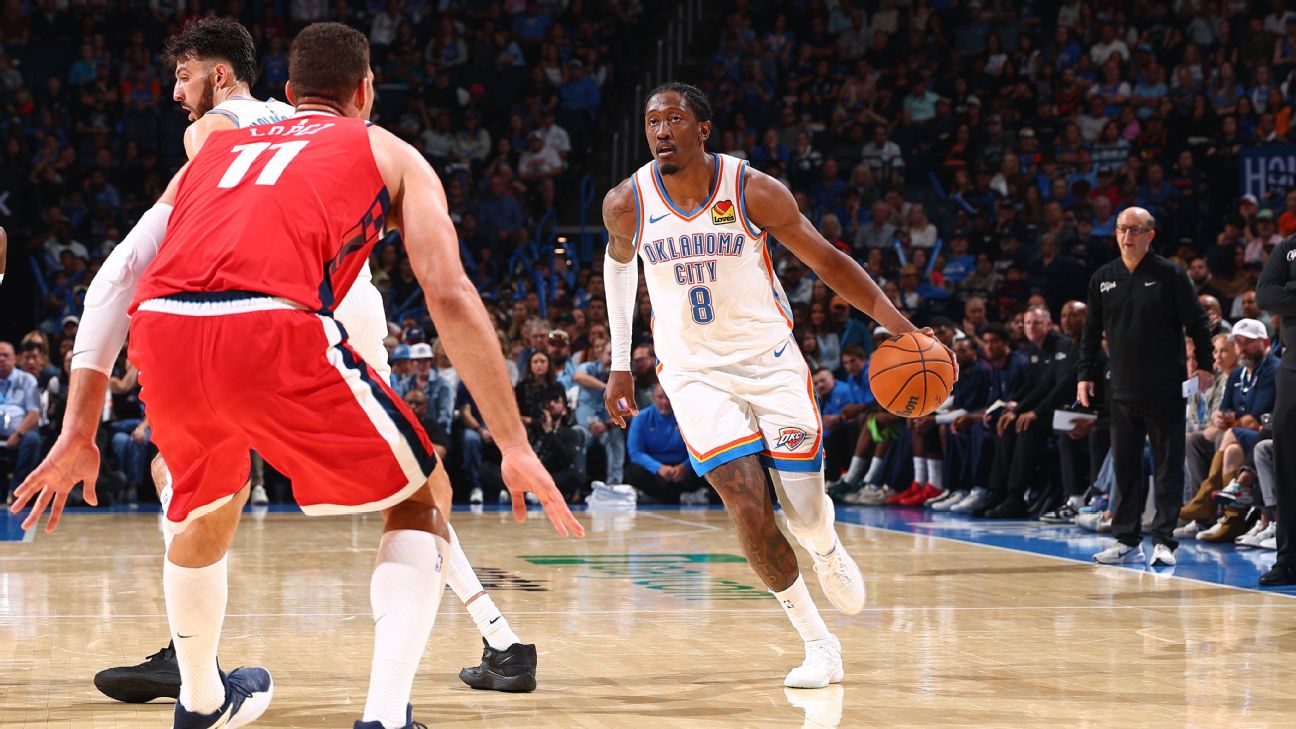
The Oklahoma City Thunder's promising start to the season has been overshadowed by devastating news: two key starters, Jalen Williams and Cason Wallace, will undergo surgery for serious injuries and are expected to miss several months. The injuries occurred during Sunday night's 108-101 victory over the LA Clippers.
General manager Sam Presti announced on Monday that Williams will have surgery to repair a dislocated left ankle and fractured fibula, while Wallace will undergo a procedure for a torn labrum in his left shoulder. Williams was stretchered off the court after suffering his injury on a drive to the basket late in the fourth quarter, and Wallace left the game in the first quarter and did not return.
These losses are particularly painful for a Thunder team that had high hopes for both players. Williams was expected to return to his All-Star form from the 2024-25 season, while Wallace was slated to step into the starting lineup after signing a five-year, $139 million contract extension just before the season began.
Williams' recent history has been marred by injury misfortune. He missed 49 regular-season games last season due to surgery on his right wrist and subsequent hamstring injuries, and he appeared in only five postseason games (107 total minutes) as the Thunder fell to the San Antonio Spurs in seven games in the Western Conference finals. Despite these setbacks, Williams' heroic performance in the 2025 NBA Finals—playing through a wrist injury that required surgery and scoring 40 points in a pivotal Game 5—remains legendary in Oklahoma City.
The emotional toll on the team was evident, with star guard Shai Gilgeous-Alexander visibly tearing up on the court. The Thunder, a tight-knit group, have already had to cope with the departures of title-winning teammates Luguentz Dort, Isaiah Joe, and Aaron Wiggins in salary-slashing trades over the summer. Now they must navigate another emotional challenge while figuring out how to fill a massive hole in the lineup.
Key Analysis
The impact of these injuries on the Thunder's championship aspirations cannot be overstated. Oklahoma City still boasts excellent depth and star power at the guard and center positions, but the summer trades that shipped out Dort, Wiggins, and Joe already thinned their perimeter depth. Without Williams, the team is perilously thin on the wing.
Williams' absence will be felt on both ends of the floor. Offensively, his unavailability might have been the difference in last season's playoff loss to the Spurs, though the Thunder still have Ajay Mitchell and Jared McCain to support Gilgeous-Alexander. However, the larger concern is on defense, which is the core of Oklahoma City's identity. The Thunder have led the league in defensive rating for two consecutive seasons and rank second thus far in 2026-27. Last season, they had four perimeter players who were recent All-Defensive honorees. Trading Dort removed one, and the injuries to Williams and Wallace remove two more, leaving only Alex Caruso among the elite perimeter defenders—and the team prefers to load-manage Caruso to keep him fresh for the postseason.
Even if Wallace returns from his torn labrum for the playoffs, he is smaller and less physically stout than Dort or Williams, which could create significant matchup problems against the West's top teams. In the postseason, the Thunder will need to defend combinations of De'Aaron Fox, Dylan Harper, and Stephon Castle; LaMelo Ball and Anthony Edwards; Luka Doncic and Austin Reaves; and Amen Thompson and Kevin Durant. Caruso can't guard them all.
Moreover, the simultaneous injuries further reduce Oklahoma City's margin of error, which had already been diminished by the summer trades. The season is only three games old, and more injuries are likely—but the Thunder can't afford many more given their reduced roster depth.
Financial Flexibility and Potential Moves
Oklahoma City is likely to receive a $15 million disabled player exception, which would allow the team to sign or trade for a player in the last year of his contract. However, using more than $6.9 million would push the Thunder past the second apron. They are not hard-capped and can exceed the threshold. Additionally, the team has three large trade exceptions ($17.8 million, $11.3 million, and $9.2 million) and can use them while exceeding the second apron. The Thunder also possess seven tradeable first-round picks—including three in 2027—and 21 second-rounders, and their acquisition of McCain last season demonstrated a willingness to make in-season moves.
Finding a suitable replacement via trade will be challenging due to salary-matching constraints. The only Thunder players making more than $7.8 million this season are effectively untradeable: Williams, Gilgeous-Alexander, Caruso, Chet Holmgren, and Isaiah Hartenstein. Barring a shocking trade—perhaps involving Williams—the Thunder won't be able to match salaries for high-profile targets like Trey Murphy III (New Orleans) or Michael Porter Jr. (Brooklyn). Nor can they replicate Williams' rare blend of offense, defense, and size.
However, a few lower-cost trade targets from teams likely headed to the lottery could be attainable. Murphy's teammate Herb Jones is a lesser offensive player but could replicate Williams' defensive impact; he might be available as new Pelicans coach Jamahl Mosley has removed him from the starting lineup and reduced his playing time. The Wizards' Justin Champagnie is off to a strong start and would add a brotherly dynamic to the Thunder's rivalry with the Spurs and Julian Champagnie. From Golden State, De'Anthony Melton and Gary Payton II will be trade-eligible after Dec. 15 and could fill a Wallace-sized gap on the perimeter. Neither 6-foot-2 guard matches Williams' size, though Payton plays bigger and is an elite defender. Milwaukee's Jaime Jaquez Jr. has better size but is more of an offensive force than a two-way star, and his hot start suggests the Bucks might try to re-sign him. Ironically, the most fitting trade targets might be the two Clippers defenders involved in the collision that ended Williams' season: Derrick Jones Jr. and Kris Dunn. Both are in the final seasons of their contracts, and LA needs draft picks more than their contributions to a losing cause in 2026-27. They are also excellent defenders, albeit with similar offensive question marks to Herb Jones.
Playoff Outlook
The combination of Williams' loss and hot starts by the Timberwolves, Rockets, and Lakers makes it less likely that the Thunder will secure the West's top seed for a fourth consecutive season—and therefore likelier that Oklahoma City and San Antonio end up on the same side of the playoff bracket, forcing them to meet before the conference finals. For now, Oklahoma City projects to fall to the No. 3 seed with a much less imposing defense than usual. An even greater downside scenario exists if more players miss significant time in the coming months.
Still, the Thunder remain the top team in the West even with this injury. Their 39-10 record without Williams last season proved they can still be a great team, and their bench depth—along with the roster resources to improve—should keep them afloat.
Originally reported by espn.