

 nbcnews
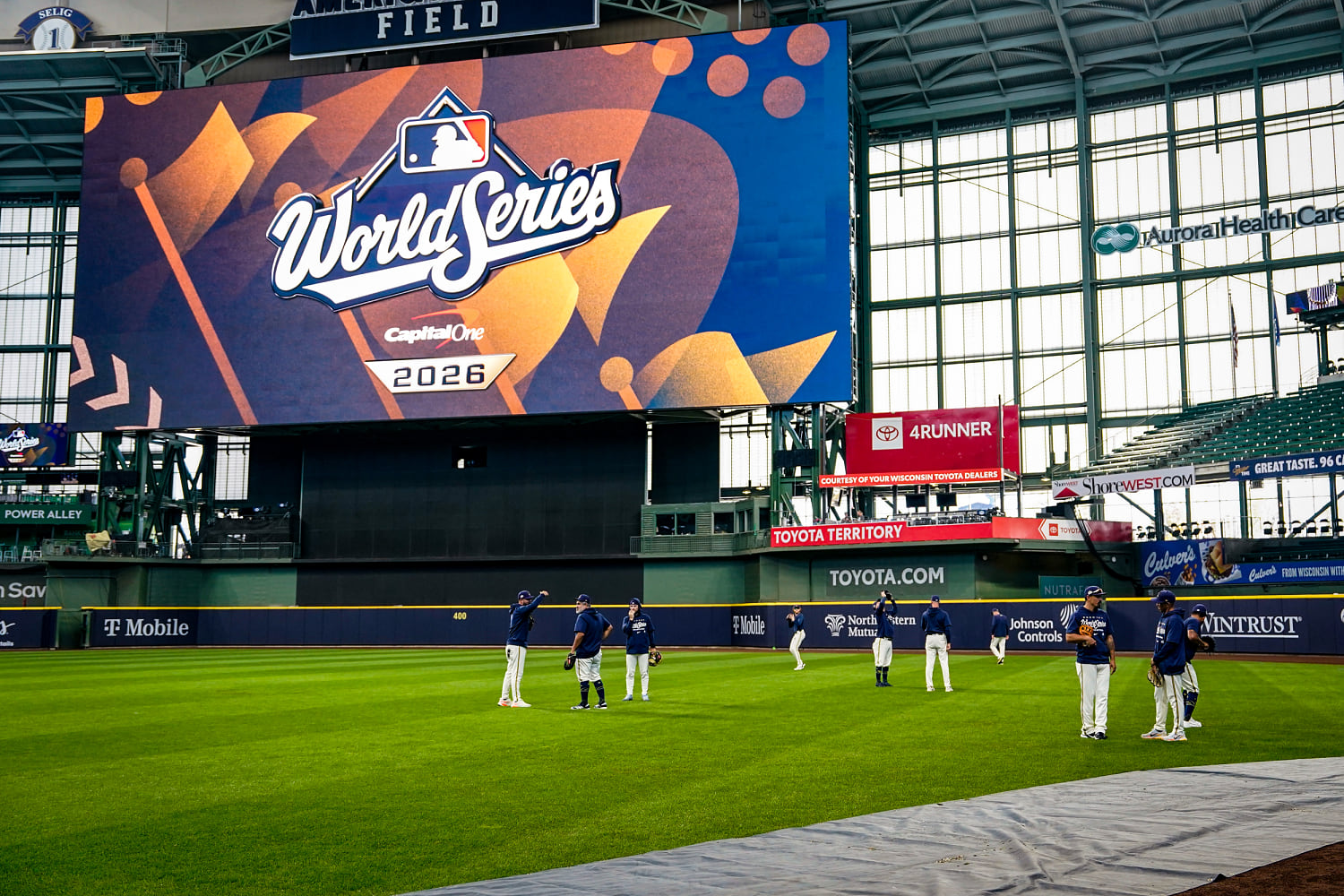
When the 2026 Major League Baseball season began in March, it was widely assumed to be the last before contentious labor negotiations in the winter. Bruce Meyer, acting executive director of the MLB Players Association, stated in February that a lockout is all but guaranteed at the end of the current agreement, and the league has essentially confirmed that expectation.
Now, in October, the World Series between the Tampa Bay Rays and the Milwaukee Brewers is as intriguing for its on-field implications—deciding a champion—as for its off-field significance. Terms like market size, payroll, and revenue sharing have become as integral to baseball as hits, home runs, and RBIs. Here are key points to consider as the Fall Classic unfolds.
Low-Spending Teams Defy Payroll Odds
Despite preseason concerns about payroll disparity, this World Series features two of the lowest-spending teams in the sport. According to FanGraphs, the Brewers rank 19th in payroll, while the Rays rank 28th. Their combined salaries of roughly $232 million would still be lower than eight other clubs. Both teams had to overcome high-spending opponents to reach the World Series: Milwaukee swept the Los Angeles Dodgers, whose payroll is $412 million, in the NLCS, and Tampa Bay defeated the New York Yankees, with a $310 million payroll, in the ALDS.
This marks the first championship matchup featuring two teams in the bottom half of MLB payrolls since 1991, according to The Associated Press. It should be noted that the Rays are not necessarily a small-market team despite their low spending; the Tampa-St. Petersburg area is the 11th-largest television market in the U.S., per Nielsen. Nevertheless, this year's winner will be the first bottom-half spender since the 2015 Kansas City Royals—a rebuke to MLB Commissioner Rob Manfred's comments earlier this year.
In July, Manfred said, "In order for this game to reach its full potential, we need to continue to address concerns that our fans have, particularly concerns that go to the core of what we're about—that is, competitive balance. We need to make sure that fans in markets at the beginning of the season have a realistic belief that their team has a chance to win." Manfred made these remarks amid an ongoing push for a salary cap, which MLB has aggressively pursued, claiming payroll correlates with performance—a claim that is somewhat disputed.
The players union, however, views the World Series matchup as evidence that the sport is functioning well. "It's further evidence that the league's purported competitive balance justification for a salary cap holds no water," Meyer told NBC News in a statement. "But that's never been the real reason why they want a salary cap. They want it to juice their profits and franchise values."
Television Ratings and Market Size
Given the small-market nature of this matchup, online discourse will inevitably focus on World Series television ratings. Will fan interest wane because these are not marquee teams? Combined viewership for this year's ALCS and NLCS was up slightly over last year, according to Nielsen. The last two World Series, both featuring the Dodgers along with the Yankees and Toronto Blue Jays, averaged over 15 million viewers, the most since 2017. Tampa Bay's first World Series appearance in 2008 averaged 13 million viewers and was the lowest-rated series in history at the time. Its 2020 appearance during the pandemic, a Dodgers-Rays series, drew an average audience of 9.8 million, which remains the second-smallest average all time, per Nielsen.
Market size has appeared to affect Milwaukee and Tampa Bay during the playoffs. The Rays drew 3.7 million viewers against the Cleveland Guardians after drawing 4 million against the Yankees, per Nielsen. The Brewers and San Diego Padres drew only 2.6 million viewers in the Division Series, while Milwaukee vs. Los Angeles was seen by 7.9 million people per night.
Are These Teams Actually Good?
Yes, they are. This is not a fluke matchup based on postseason randomness; the Brewers and Rays finished at the top of their leagues during the regular season. How both teams reached this point is a feat in itself. Every MLB team wants to scout prospects well, but consistency is vital for penny-pinchers like Milwaukee and Tampa Bay. "They just don't have a lot of margin for error," said a senior executive who oversees scouting for an MLB team and was not permitted to speak publicly. "And yet, the $80 or $90 million payrolls are in the World Series, and the $400 million ones are on the sideline."
That success stems from how Milwaukee and Tampa have compensated for their lack of spending power. Both teams have strong Latin American scouting systems but rely on slightly different approaches. "Tampa is more scout-friendly with an analytic backbone, while Milwaukee is very analytic-driven, more than a scout-driven process, in selecting their players," the executive said. Their limited budgets also require both to identify castoffs elsewhere who could become valuable contributors. Milwaukee first baseman Andrew Vaughn is a 28-year-old former No. 3 overall pick, while 31-year-old Jake Bauers, on his fifth team, has driven in six runs this postseason. The teams also have a knack for knowing when to trade players to maximize returns. In one case, the Brewers traded pitcher Freddy Peralta to the Mets last offseason; Peralta was later traded to Tampa, where he was named MVP of the ALCS.
Ultimately, whoever wins the World Series will merely set the stage for an offseason that could have massive ramifications for the sport. Expect both MLB and the players to use the result in some fashion. Enjoy the games while you can.
Originally reported by nbcnews.