

 kqed_org
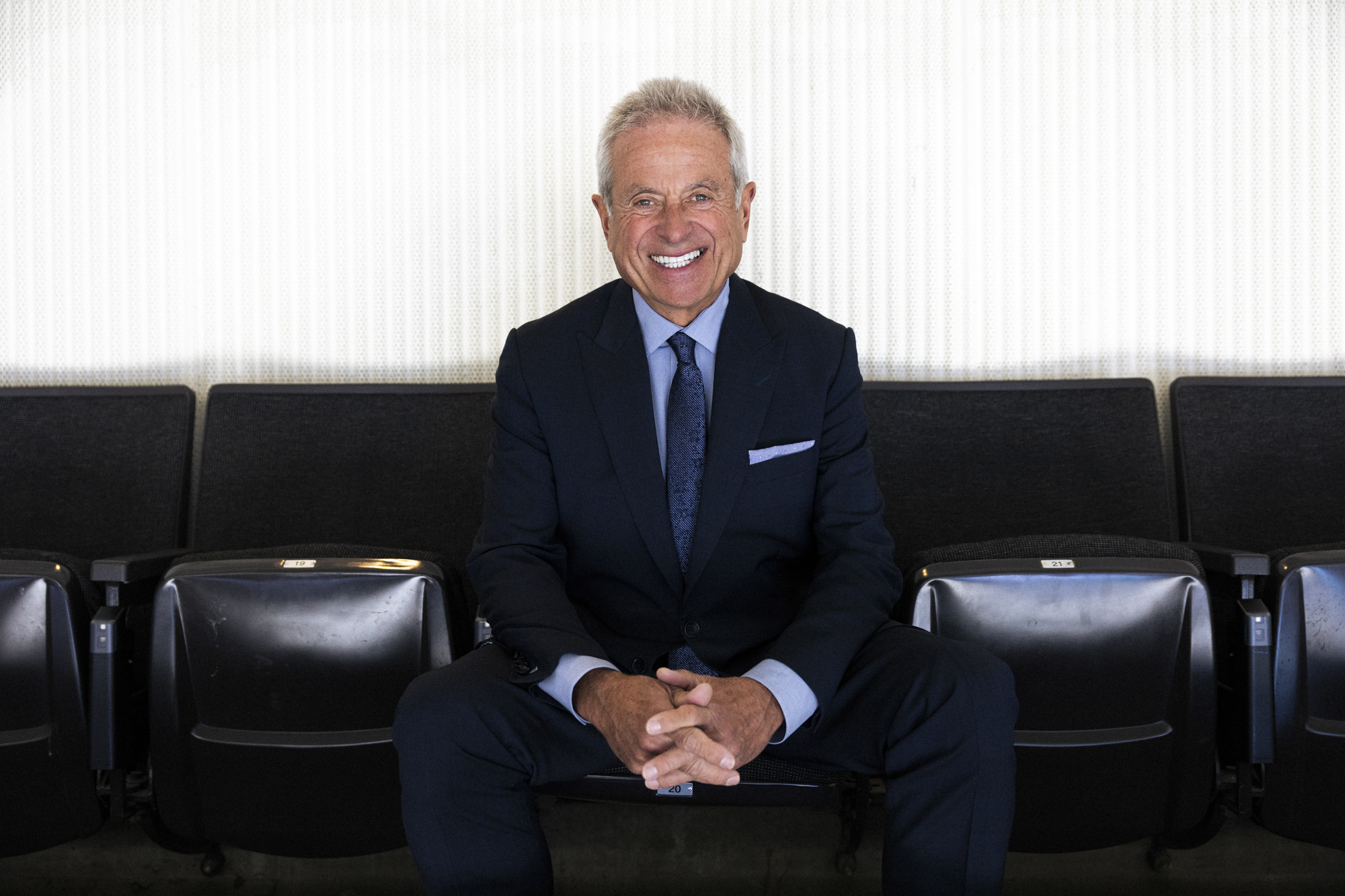
For 35 years, Randy Hahn has been the soundtrack of San Jose Sharks hockey, calling games since the franchise's birth in 1991. In a sport filled with transient voices, Hahn's longevity with a single team stands as a rare constant, endearing him to generations of fans across the Bay Area.
Many supporters, like Stanford employee Mark Gavartin, grew up listening to Hahn with their fathers and now share that tradition with their own children. Gavartin recalls the 2019 playoff series against the Vegas Golden Knights, when his 4-year-old twins were introduced to the family passion. Watching from home, Gavartin depended on Hahn to channel the arena's energy into his living room. Even now, the memory of Hahn's call in Game 7 overtime gives him goosebumps. "We were so emotional," Gavartin said. "With the Sharks and Randy Hahn, it was like we were all together on this. We were like buddies, watching the game together."
But as the Sharks advanced to the conference final that year, Gavartin noticed a jarring shift: Hahn's voice was replaced by a national announcer. "It was not the same as listening to Randy Hahn," he said. "It's some other guy who was meh, okay. Like, he didn't go through what we went through." This phenomenon isn't unique to hockey; it happens across sports when national networks take over postseason broadcasts. Yet the bond between Hahn and Sharks fans offers a perfect case study of why this decision leaves so many feeling a deep sense of loss.
The Man Behind the Mic
At the SAP Center, known as the Shark Tank, Hahn is more than a broadcaster—he's a living legend. Tristan Nickey, a former San Jose resident now in Idaho, watches Hahn on ESPN+ and calls him "a Sharks encyclopedia" whose statistical insights make every game enjoyable. For 18-year-old Mia Dimmock, who discovered hockey through TikTok, Hahn's storytelling makes the sport accessible to newcomers. "He shares details about players that bring them to life," she said. "He's at every home game and every away game. He's on the same buses and planes as the team, in the same hotels. He's at the practice rink, in the weight room. He sees and hears a lot. He is that connection to the team that we need. He is the team and the team is him."
From his open-air booth in section 215, Hahn doesn't just narrate plays; he crafts a narrative. He gives each game a dramatic arc, weaving in historical context and turning players into characters. Currently, the spotlight is on 20-year-old phenom Macklin Celebrini, but Hahn also highlights family ties, like Celebrini's brothers Aiden (a Vancouver Canuck) and 13-year-old RJ, who is already challenging Macklin's records. Equally telling is what Hahn chooses not to share. If he spots a player with an ice bag or bandage, he stays silent during broadcasts. "There might be somebody on another team who knows that if that player has a sore left knee, I'm gonna go after that knee," Hahn explained. "It's pro sports; it's cutthroat. People are playing for money." Instead, he adjusts his commentary to be less critical, a subtle way of supporting the player. "It's our way of putting our arm around him, if you will," he said.
This approach creates an inherent tension. Hahn works for NBC Sports Bay Area, not the Sharks, and is expected to maintain professional distance. Yet the boundary blurs, especially given the time he spends with players. Sometimes he catches himself saying "we won" before correcting to "they won." Fans, however, see him as part of the team. "He is the Sharks to me," said Trevin Cholmondeley, a fan from Napa.
That tension peaked last December when the Sharks faced the Pittsburgh Penguins. Trailing 5-1, San Jose mounted a stunning comeback in the third period, scoring four goals to force overtime and eventually win. Hahn's call built like a crescendo, capturing the roller-coaster emotion he often describes. "They scooooore!" he roared. "One of the most amazing comebacks in franchise history! Sharks win! I'm beside myself, and there's tears in my eyes." It was a masterful performance, blending drama with vulnerability. Afterward, Hahn worried he'd crossed a line, but players and coaches praised his calls, affirming that he'd struck the right balance. "When something like that happens, it's emotional for all of us because we all have so much invested in the process," Hahn told Sharks podcaster Brodie Brazil. "To me, it was them saying, 'You captured the way we felt even though we couldn't show it.' A head coach can't show that; it just wouldn't look right. But inside, you feel it."
Fans felt it too. When Hahn teared up, so did Tristan Nickey. When Hahn got excited, so did Caleb Edwards. When Hahn screamed into his mic, Trevin Cholmondeley screamed back at the TV. "The dude lost his voice halfway through," Cholmondeley said. "I think he understands the energy that's in the clubhouse that we, as a fan, don't get to experience. We can live, sort of, through him."
Why Local Voices Fade in the Playoffs
Sociologists often compare sports to religion: arenas are churches, fans are congregations, and announcers are idols. When the playoffs arrive and local voices are replaced, it can feel like blasphemy. "It will suck," Edwards said, echoing many fans. The question isn't limited to hockey. "There are baseball fans who are always wondering, 'Why, if my team makes the playoffs, can't I get my local announcers?'" said Richard Deitsch, a sports journalist who has worked for Sports Illustrated, The Athletic, and CBC Radio. "By and large, the answer to these questions is the eternal answer to most questions. And the answer is money."
When the Sharks first made the playoffs in 1994, local announcers called every game through four rounds. But as national networks like ESPN and Fox began airing the Stanley Cup Finals and paid high rights fees, they demanded exclusivity. Gradually, that exclusivity expanded. The latest contract, a seven-year, $600 million deal with ESPN and TNT, grants exclusive rights to the final three rounds. These games draw massive audiences—close to one million for the Stanley Cup Finals, 20 million for the World Series, and 120 million for the Super Bowl. "These are massive numbers, and that's very, very rare in society today," Deitsch said. "It's a very, very divisive and polarized time. It is very hard to get Americans to agree on anything, but sports is one thing."
Because national broadcasts attract diverse audiences, networks prioritize neutrality. Hahn's passion for the Sharks, or even his affiliation, is seen as a liability. "It's a brutal reality for local announcers," Deitsch said. "To follow a team to the climax of the season, then be forced to turn the mic over to someone else. It's like you go to this great movie, it's unbelievably dramatic, you're there, and literally seven minutes before the movie's over, an usher asks you to leave."
In 2019, Hahn watched the playoffs from the stands at the Shark Tank, while fans at home wished he were in the booth. They want his partiality; they prefer his bias. "I tend to actually turn the volume down during the playoffs," Cholmondeley admitted. "Every season's a little microcosm of life, and not having someone like Hahn, or any team's local announcer, on the big stage just brings the quality down for me."
Last winter, after the Sharks' stunning win over Pittsburgh, Hahn predicted they would make the playoffs—if not last season, then this season for sure. Fans will be tuning in, ready for Randy Hahn to be their prophet, their guide, their buddy, through every twist and turn. As Gavartin put it, "This is our team. We live here." And they want to hear Hahn's voice if—or when—the Sharks win the Stanley Cup. "It hasn't happened yet, but wouldn't that be amazing?" Gavartin said. "Like, to hear his voice saying that?" But even if the Sharks do win the title, that won't happen.
Originally reported by kqed_org.