

 cbssports
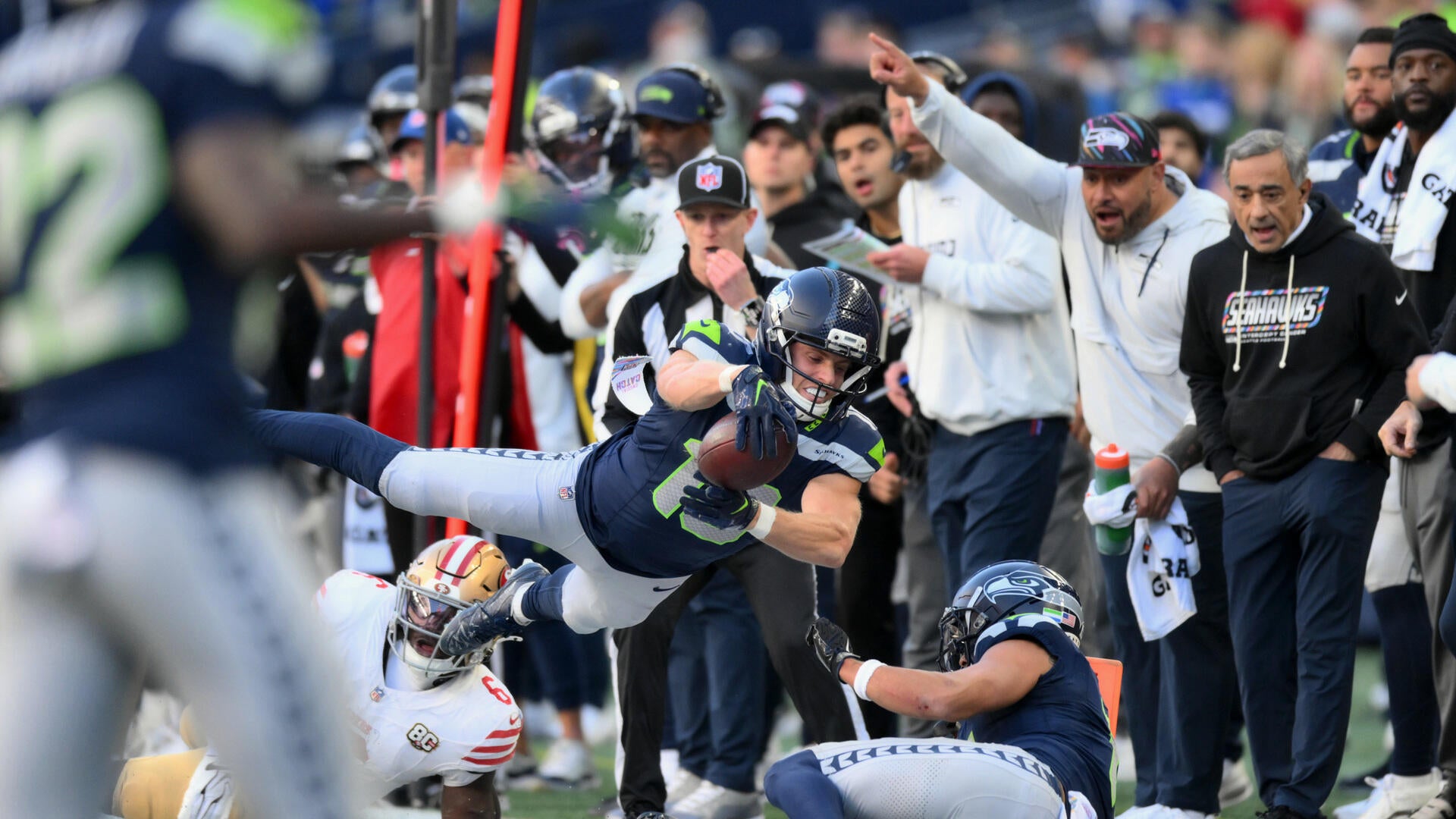
Football's reputation as a game decided by inches was on full display in Week 5 when the Seattle Seahawks narrowly missed a chance to tie or take a late lead against the San Francisco 49ers. A critical call on the game's pivotal play reignited discussions about why the NFL still relies on human judgment for ball spotting, as a potential error may have determined whether Seattle could stay alive against its NFC West rival in a 32-29 loss.
Trailing by three points with 54 seconds left, Seattle faced a fourth-and-10 from midfield. Quarterback Sam Darnold connected with Cooper Kupp, who sprinted toward the 40-yard line and lunged for the first-down marker as he went out of bounds. Officials marked Kupp short of the line to gain, and after a booth review, the call stood. With only one timeout remaining, the 49ers knelt to run out the clock and secure their fifth straight win to start the season.
The Seahawks were left frustrated, as a first-down ruling would have given them time to pursue a go-ahead touchdown or a game-tying field goal. Had the on-field call been a first down, it likely would have stood due to insufficient evidence to overturn it. The opposite outcome underscored the importance of getting calls right in real time and the persistent gray area in ball spotting.
As the league increasingly adopts technology for player tracking, camera angles, video reviews, and virtual measurements, many wonder why digital ball spotting isn't already a reality. The answer: the technology isn't reliable enough yet.
Why Ball-Chip Technology Isn't Used for Spotting
The NFL started embedding RFID microchips in footballs in 2017. These chips collect data like speed, distance, and rotation for Next Gen Stats. Weighing just three grams, they are inserted during production. While they function as accelerometers, they lack the precision needed for spotting. A 6-inch margin of error makes them unsuitable for determining ball position.
"In some cases, those 6 inches might be good enough [to spot the ball]," Jill Stelfox of Zebra Technologies said in 2017 when her company partnered with the NFL to create the chips. "But in all cases, it's probably not good enough at this point with the technology being where it is. It also depends on where your feet are, and your knees are, and we don't have those tagged with chips. They're only in the shoulder pads. So the NFL is still going to need referees to do that."
Combining video and chip data isn't a simple fix. Even if replay officials sync the chip's timestamp with video showing when the ball carrier went down or out of bounds, the measured distance could still be up to 6 inches off. This is no better than officials misjudging the ball's location with their own eyes. For instance, if replay showed the ball in Kupp's hand breaking the sideline plane, syncing the chip with that video might determine its position, but if it's within a half-foot of the first-down line, certainty is impossible.
Camera angles pose another challenge. Despite the many cameras used in NFL games, there isn't always an angle showing the exact moment a player hits the ground or the ball crosses a line. Precision requires over-the-top cameras directly above the ball and down-the-line cameras on each yard marker, sideline, goal line, and end line. Even then, situations where the ball is obscured remain problematic.
Hawk-Eye's Role and Limitations
The NFL's replay system got a major boost in 2021 with Sony's Hawk-Eye technology, which processes live video in real time and syncs camera angles with timestamps. In 2025, Hawk-Eye expanded to virtual measurements, using six 8K optical-tracking cameras per stadium to mark the ball's exact position relative to the line to gain. This is more accurate than RFID chips but has its own drawbacks.
The biggest issue is the need for a clear line of sight. For measurements, officials manually spot the ball and step aside so cameras can detect its position. During play, the ball is often blocked from view. This is why Hawk-Eye excels in tennis and soccer, where cameras can clearly see if a ball lands in or out, or if it crosses the goal line or a player is offside. Football's crowded field makes consistent tracking difficult.
Will Virtual Spotting Ever Be Feasible?
Given the NFL's embrace of technology and its commitment to accurate calls, the league would likely adopt digital spotting if a reliable solution emerged. The fact that RFID chips and Hawk-Eye capture so much additional data suggests a breakthrough may come eventually. However, the timeline for such a capability remains uncertain.
Originally reported by cbssports.