

 vaildaily
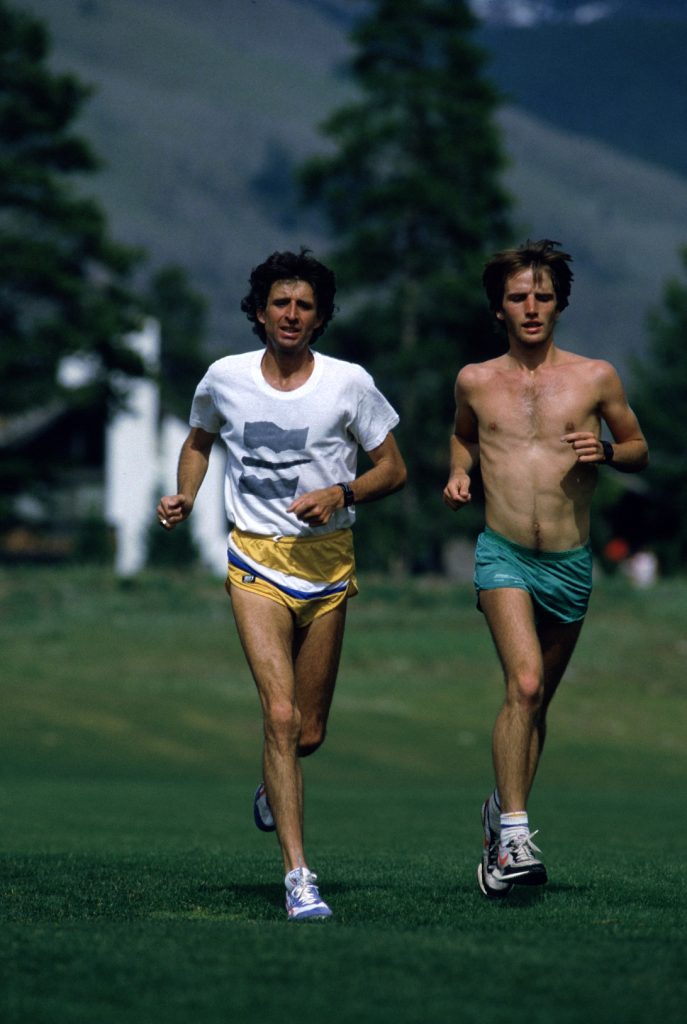
If a picture is worth a thousand words, then the photo Rex Keep snapped of Frank Shorter striding alongside Matt Carpenter around the Vail Athletic Fields on a summer day in the late 80s has to be worth at least 8,150.
We had a couple days a week that wed all try to get together for training runs, Keep said, speaking of the old Vail Running Club he helped start.
When Frank was in town, Id take my camera and try to get a few shots.
Keeps frame captured the fleeting, impossible intersection of two American long-distance icons: Shorter, an aging titan of the tarmac at the tail end of his career, and Carpenter, the young mountain monk just beginning to realize his high-altitude trail talent.
While they ruled separate running worlds, both possessed an unspoken respect for the others dominance.
My thought was, if I could help him be better going up the mountain, he might feel he could help me gain mountain strength (for) the flats, Shorter said.
It was sort of a mutually beneficial thing.
Carpenter always figured if Vail was good enough for Shorter, it was good enough for him.
Frank was my idol, he added.
On that particular day, Shorter caught up with Carpenter cooling down from a speed workout.
The legends jogged silently together for just a couple laps on a 2-foot wide, grass 400-meter track.
I actually built (the track) in honor of him, continued Carpenter, who said the Town of Vail gave him permission to shovel out a berm around the end.
And then I (had) a rock and was going to put a plaque there dedicated to Frank.
Because a lot of people dont realize, when he won the gold, he was training in Vail.
Shorter originally discovered an altitude advantage training in Taos prior to his final two seasons at Yale during the late 60s.
After graduation, he moved to Florida to work out with Jack Bacheler, the countrys top distance runner at the time.
Hoping to hone his engine in Vail alongside Bacheler and Jeff Galloway prior to the Munich Olympic Trials, Shorter wrote a letter to Bob Parker a 10th Mountain Division veteran and one of Vails founders in early 1972.
He wrote back and said, yeah we have a place where the three of you can stay,' Shorter recalled.
A month before coming up, however, Shorter happened to be having dinner in Boulder with then-Colorado Secretary of State Mary Estill Buchanan and Bob Lange.
I was explaining what we were going to do, going up to Vail in 72, Shorter said.
And (Lange) said, Well, I have a place up there.
Why dont you stay there?' Shorter trained out of Langes house on Beaver Dam Road for three months that spring.
Since 8,150 feet (a callback for those confused by the opening line of this story) was a bit high for speed work, the trio would drive down to Boulder for intervals on the CU track.
It worked: All three ended up punching their Olympic tickets at the trials in Eugene, Oregon that June.
They returned to Vail immediately after and stayed until Team USAs pre-Olympic camp at Bowdoin College.
Two months later in Germany, Shorter famously captured the first American marathon gold medal in 64 years.
When he brought home silver in Montreal a quadrennial later, most of his preparations were completed in Boulder, where he also launched a running store and helped start a little road race called the Bolder Boulder.
But Vail always held a special place in his heart.
In this photograph taken in Boulder, Colo., on Saturday, Sept.
8, 2012, U.S.
Olympian Frank Shorter displays the gold medal that he won in the 1972 Summer Olympics.
David Zalubowski/AP photo In fact, Shorter looked at real estate near the golf course, where he logged a high percentage of his 120 weekly miles, before eventually purchasing an A-frame in East Vail from Scott Hopman.
Shorter remembered the old Ore House manager being tightly connected to the local running community.
(He) was a 250-pound middle guard for the University of Washington football team.
He then got into running, got down under 200 pounds and ran 2:52 for a marathon, Shorter said of Hopman.
He was truly a convert.
One summer morning in 1984, Shorter was eating waffles and reading the paper when he noticed an ad for the Vail Hill Climb.
On a whim, he ripped down to the start and hopped in.
Streaking up the long, gradual fire road climb towards Eagles Nest reminded him of his mountain runs with the legendary Steve Prefontaine.
I took him down to Taos to train the year he died, Shorter recalled of Prefontaine, who set American records at every distance between 2,000 and 10,000 meters across a two-year stretch ending in 1975, when an automobile accident claimed the 24-year-olds life.
Frank Shorter gets ready to run the 1984 Vail Hill Climb.
Vail Trail Archives We would run halfway down the mountain, run back up so, about 7-8 miles, Shorter continued.
Then we would ski I taught him how to ski and after, we would run up the access roads to over 10,000 feet and then run down.
In other words, I did hill training, but it was my easy training.
Carpenter was drawn to trails for a similar reason.
I didnt want people to see how slow I ran on easy days, he admitted.
My hard days were very hard and my easy days were very, very easy.
Of course, Carpenter knew how to run fast on the mountains, too.
He set or still holds course records at the Vail Hill Climb, Barr Trail Mountain race, Imogene Pass Run, Aspen SkyMarathon, Turquoise Lake 20K, Leadville 100, Piney Lake Half Marathon, Mt.
Werner Hill Climb, Lake City 50, Mt.
Evans Ascent, Winter Park Mary Jane Hill Climb, Mt.
Taylor Winter Quadrathlon and of course, the Pikes Peak Marathon.
Carpenter also posted world records for flat marathons held at altitude.
He ran four 26.2-mile races in the shadow of Everest , clocking a 2:52:57 at 14,350 feet and later 3:22:25 at 17,060 feet.
But the Manitou Springs resident wasnt always a mountain man.
Originally from Mississippi, Carpenter visited Vail for a week with his aunt in early August of 1984, right after his mom committed suicide.
He still remembers driving across the plains and seeing the mountains for the first time.
I saw what I thought were clouds, he said.
And I was like, Oh look at the clouds.
And then its like, holy ..
those are mountains.
And I went out there and I fell in love with it.
Carpenter returned to Vail the next few summers, permanently parking his van in one spot and running wherever he needed to go until it was time to go back to college.
In addition to the aforementioned chance encounter, the legends paths crossed a couple of other times.
Shorter showed up the year Carpenter set the Piney Lake Half Marathon course record.
He came up to me afterwards and said, you are the fittest person in the world.
..
I dont know about fastest, but fittest,' recalled Carpenter, who also found himself in Shorters presence at a running camp.
I still remember to this day: we were doing a minute on, a minute off at the track and after we finished, I distinctly remember him saying, theres only one guy out here having fun,' Carpenter said.
And he pointed at me.
And hes like, this guy knows his body.
Twice he gave me really awesome compliments.
Both perfectly encapsulate the physiological distinctions between elite flatland runners and their mountain counterparts.
Biomechanical efficiency reigns on the roads, but an acute internal aerobic awareness is required to fully express ones fitness over untamed trails.
Right around the time Shorter won the Vail Hill Climb in 1984, mountain running was reaching an inflection point.
I think it was sort of where the performance curves were crossing on the mountain runners the people specializing in it, Shorter said.
Running is like being on the edge of the envelope.
And you develop this ability of, OK, where am I right at the edge? And these guys have a talent for doing this going uphill.
Carpenter lived on that edge.
Mountains to marathons and back In September 1990, his VO2 max the maximum amount of oxygen your body can utilize during intense, all-out exercise was tested at 90.9 milliliters per kilogram per minute in Colorado Springs.
Hed later hit 94.9 in a sea-level test, but Italian scientists conducting the lab assumed their instruments were broken.
For context, a normal fit male typically scores between 45 and 55.
Shorter sat a touch above 71 and Prefontaine earned mythical status for reaching 84, a fraction higher than Lance Armstrongs peak.
Its a two-sided coin because thats the size of your engine and the other side is the size of your economy, Carpenter explained.
(Shorter) had one of the best economies in the world his VO2 wasnt that high.
Conversely, I had a pretty bad economy.
Never one to back down from naysayers arguing his efficiency was locked in, Carpenter hit the roads in the early 90s.
Lured by the tantalizing potential of his motors capacity, he integrated speed sessions with 5-to-1 work-to-rest ratios used by former American mile record holder Steve Scott.
Sure enough, I improved my economy quite a bit, Carpenter stated.
Though he never broke 61 seconds for 400 meters, Carpenter routinely hammered out 20 one-lap repeats at 66 seconds a pop with just 54 seconds of rest at 6,000 feet of altitude.
While he was notoriously frugal Carpenter didnt own a car and lived off Ragu and spaghetti, according to a 1991 Vail Trail feature he splurged for a $10,000 Quinton Q65 treadmill in 1990.
The medical-grade machine didnt blink when asked to power the belt under a 4-minute mile pace or tilt it to 23% grades.
Two decades after Shorters gold, Carpenter had retooled his chassis for the road in search of a 1992 Olympic marathon berth.
Matt Carpenter training on his famous Q65 treadmill in Vail prior to the 1992 Olympic Marathon Trials.
Vail Trail Archives The ambitious crossover experiment looked to be a promising investment as Carpenter led the 1990 Columbus Marathon through the halfway mark.
After splitting 1:05:26, however, the concretes taxing toll pushed back on the 120-pound runner, dragging him to a 2:32:08 finish.
In January 1992, Carpenter hit the qualifying standard with his 2:19:44 in Houston.
He returned to Columbus three months later for the Olympic Trials, but his road chapter ended with a 50th-place finish and another 2:32 clocking.
Looking back, Carpenter admitted he might have bailed on the road scene a little soon and could have possibly fine-tuned some things and maybe got it right.
But he harbors no regrets.
In his mind, weaving through arbitrary grids of mind-numbing city courses paled in comparison to conquering a mountain.
Fortunately, an invitation to race across Europe in 1992 rekindled his trail appetite at just the right time.
I found that after that stint, my mountain running was so much better, he said.
One sort of fed off each other.
Carpenter continued to incorporate traditional speed sessions within his trail-specific plan.
Like Shorter, he was ahead of his time, always searching for innovative advantages in nutrition, tactics and training.
Both pioneered the advantages of altitude training, with Carpenter emphasizing time spent above tree line.
He often drove to the top of Pikes Peak to conduct intervals on the top three miles of Barr Trail his favorite place to run in the world.
Back home, Vail Resorts offered Carpenter a lift pass; his only gondola rides, however, went down the mountain after he ran up.
While he didnt obsessively pound out the Vail Hill Climb route, it wasnt abnormal for Carpenter to set a new course record in training.
In his 1993 win, he set the still-standing Vail Hill Climb best, becoming the only runner to complete the old course in under 47 minutes.
It was a prelude to his Pikes Peak masterpiece a month and a half later.
After a conservative start, Carpenter clipped off increasingly faster splits above tree line, reaching the top of Americans Mountain in 2:01:06.
Only halfway done, he bolted back to Manitou Springs at 5:45 per mile pace, hopping over rocks and dashing past participants still climbing the narrow dirt path.
With air temps rising, Carpenter careened around The Ws final switchbacks, his Nike flats trail shoes lugs were just extra weight, he said smoothly transitioning from the Barr Trails dirt to Ruxton Avenues pavement.
He high-fived his way to the finish, bowing before the clock as it ticked to 3:16:39 , a marathon record no one has even sniffed at in more than three decades since.
Like many of his mind-boggling performances, it arose out of the ashes of defeat.
The previous year, Carpenter reached the halfway point in a then-record 2:05:05 ascent split, only to collapse at the summit.
After a few minutes of lying in a bed of rocks at the top, Carpenter finally pulled himself away from anxious volunteers.
But by the time he finished, race winner Ricardo Mejia was cooling down.
A similar defeat-redemption pattern happened at the Vail Hill Climb.
In 1987, Carpenter lost to Jay Johnson after burning precious matches responding to various moves by Leadville rival Tom Sobal.
In a Vail Trail feature previewing the 1988 rematch , Carpenter explained how his obsession was driven not by winning, but by the relentless pursuit of his own ceiling.
I have no problem with somebody running a better race than me if I run my best, Carpenter told Scott Kersgaard.
But I cannot stand to lose if I did not do my best.
Carpenter won the 1988 race by four minutes over a field which included Johnson, Shorter and eventual eight-time Pikes Peak Ascent winner Scott Elliott.
But the sting from 1987 still lingers.
I hate to admit this, Carpenter said last weekend.
The defeats still hurt to this day.
And Ill still catch myself thinking, you know, if I wouldnt have gone so hard to try to catch Tom (Sobal), I probably would have been alright and could have held off Jay (Johnson).' Carpenter doesnt disavow his intense reputation, but in some ways, it makes the current process of mellowing out all the more enjoyable.
In June, he reunited with past rivals at his Trail Con Hall of Fame induction in California.
Instead of hashing out former grievances, Carpenter traded ordinary updates, listening to stories about their kids youth soccer matches and sharing details of his daughters Pacific Crest Trail thru-hike.
Shes learned shes got some hard-headedness in herself, too, Carpenter said of his only child.
The meaning behind the miles Frank Shorter poses with Birk after running a 5-mile race in 2018 in Alamosa, Colorado to commemorate the 50th anniversary of the 1968 Olympic Marathon Trials, which were held there.
Greg Birk/Courtesy photo These days, Shorter logs 70% of his runs in the pool.
The 78-year-olds other miles are run-walks around his Falmouth, Massachusetts neighborhood.
Every Friday at 5 p.m., he and his running buddies meet at the bar.
It used to be in the years past, there was a five-mile run and then everyone would go to the bar.
Now, people just go to the bar, Shorter laughed.
First thing you do is you talk about your injuries.
And then the training that youre able to do, and if possible but often not any performance you might have had.
While both Shorter and Carpenter acknowledged Father Times undefeated record, theyve navigated the homestretch differently.
I was always realistic, said Shorter, who could extrapolate how close he was to cresting the proverbial hill by glancing at his watch in practice.
The turning point came in a 1983 dual with New Zealands Rod Dickson at a race around his childhood home of Middletown, New York.
It looked like I might win, Shorter recalled.
But the thought that went through my mind in that race was, this is a lot harder than it should be.' Shorter did win that day, but later in the fall, Dickson captured the New York City Marathon crown in a time of 2:08:59.
Theres no way I could have run that, admitted Shorter.
Even though he no longer factored into world marathon rankings and with nothing left to prove Shorter reeled off regular 100-mile weeks throughout the mid-80s.
Because I could still race, he said regarding his motivation.
It was fun.
Slowing down has never deterred him from pinning on a bib, either.
Shorters friend Greg Birk whos collected almost all of the t-shirts from past Vail Hill Climb races said the Olympic icon doesnt care about being just another participant.
Hell still run, the part-time Breckenridge resident said.
And he has no pride about, you know, being in the back of the pack like me.
It doesnt bother him at all.
The same could not be said of Carpenter.
His running resume also appeared complete when he placed a distant seventh in the 2003 Vail Hill Climb.
Almost 40 at the time, Carpenter offered a characteristically blunt assessment after crossing the line: he didnt train hard enough.
Funny thing is, with other priorities in my life now, I am not going to get too worked up about it, he wrote in a 2003 blog.
I thought I was done, he explained recently.
He wasnt.
Carpenter pivoted to ultramarathons, decimating the Lake City 50-mile course mark by 43 minutes in 2004.
Later that summer, he infamously limped across the Leadville Trail 100 finish line, only to return in classic fashion in 2005.
Dialing in his nutrition to the exact number of sips between aid stations, Carpenter shattered the course record by over 90 minutes.
The thrilling cadenza to these masterful encores followed from 2006 to 2011: Carpenter capped his career off with six-straight Pikes Peak Marathon titles.
But the music almost stopped on the morning of his final race.
Mr.
Pikes Peak was almost too scared to get to the start line.
Trying to come up with every excuse in the book, he later admitted in a post-race interview.
At 47, recovering from his intense regimen required four-hour naps.
Carpenters life balance was out of whack.
He described the pressure he put on himself as being insane.
The intensity I put into it was kind of even killing me, Carpenter said.
Somewhere in that era it switched from winning a race and feeling a great sense of accomplishment and pride which I feel are great motivators it switched to being more just relief, he continued.
Relief that I didnt lose.
Carpenter walked away on top, pouring his self-identified obsessive-compulsive gene into running a custard shop.
In the same way hed memorized where to step and which rocks to avoid on Barr Trail, he intentionally calibrated every aspect of his Manitou Springs store.
Carpenter optimized the menus appearance, streamlined ingredients for efficient cone construction and analyzed how many steps existed between the counter and the garbage can.
And then the same thing started to happen, he said.
Theres a very fine line between running a business and a business running you.
After working 10 hours a day during the four-month heart of the pandemic, COVID-19 mandates finally wore Carpenter out.
He hired his daughter part-time to see if she wanted to take it over.
When she declined, he sold it.
And I still loved it when I sold it, so I didnt take it too far, he said.
All the while, Carpenter maintained a 12 1/2-year stretch of running for at least one hour a day.
He even kept it alive during a nine-day, 767.4-mile bike trip to Mesa, Arizona.
There were moments during the streak where a restlessly competitive Carpenter would wake up at night and wonder if he should go and try and lower one of his old course records.
Especially Leadville I always thought that was one of my weakest records.
Even a half-dozen years ago, Im like, I got to go back and break that record.
Id go to bed thinking that and Id wake up thinking, I dont want to train,' Carpenter said.
Theres a difference between running and training.
When youre training, you got to do it.
While Shorter gracefully slid back into the pack, Carpenters standard for success precluded him from adopting an age-group mindset.
I was obsessive beyond being reasonable, Carpenter said.
And I didnt want to get back into that.
So, I let it go, and Im happy with where I left it.
Carpenter still resides in Manitou Springs.
He still keeps tabs on Pikes Peak, joining a panel of past champions at the 70th anniversary last fall.
While he hasnt run up the route since his last victory, he rode the train to the top and hiked down recently albeit for a very specific, Carpenter-esque purpose.
I want to find out when the last day you can run up and not touch snow is, he said.
Even coming down, its like, I recognize that rock, I recognize that stop.
Ah! Thats a new water cross, that tree has grown funny.
While it might be true that near the end of his competitive career, Carpenters personality tormented him, today he seems to have made peace with who he is, joyfully redirecting his unique spirit towards new goals.
He made it his mission to bench press his body weight.
Unsurprisingly, he succeeded.
Also not shocking was that he documented his progress from 90 pounds in January to 129 pounds six months later in meticulous fashion on his website right next to a laundry list of race wins and records.
Carpenter rides his bike some days and runs on others.
The almost 62-year-old took up boxing and bought a basketball hoop.
Im out there sometimes, saying Not going in until I make 10 in a row ..
Three hours later, finally got it, Carpenter said.
The obsessive-compulsive doesnt go away.
Neither will running.
Whether on the roads or the trails, the sport has served both Shorter and Carpenter exponentially more than even what theyve poured into it.
At Yale, running was Shorters stress relief.
Then, he pursued a law degree at the University of Florida while training for the Olympics.
It was a paradigm shift.
Law school became my stress relief, he explained.
I needed something else to do to compartmentalize.
To take my mind off of something that I was truly focused on.
For Carpenter, running was a way to fit in during high school, a way to pay for college as a young adult and a way to see the world as a pro.
Always, it was the one thing he felt he could control.
How high I was going to go, how fast I was going to go, where I was going to go, he explained before offering a rare peek under the hood at what perhaps was always the real heart beat powering this once-in-a-generation aerobic engine.
And I touched on it very seldomly, but my mom committed suicide when I was 18.
Carpenter explained how hed broken his toe in an accident and how his mom waited until the cast came off before writing him one final message.
In the letter she said, Just run.
Dont be sad.
Just run,' Carpenter continued.
And there were many times where I ran up a mountain and just said, Mom, Im doing it.' Matt Carpenter enjoys a mountain training run with his old friend, the late Harald Fricker, in Vail during the winter of 1991.
Vail Trail Archives.