

 newsobserver
AI-generated summary reviewed by our newsroom.
- 2006 Cup spurred growth; 2026 may fuel another rise in youth hockey.
- USA Hockey registrations in North Carolina rose from 2,149 in 1998-99 to 8,698 in 2024-25.
- Wake County currently has five facilities and seven sheets of ice.
When Chris Derrenbachers son, Jack Derrenbacher, was 5 years old, he asked his dad if he could play hockey.
Chris had introduced Jack to the sport by taking him to Carolina Hurricanes games as season-ticket holders.
Jack would also shoot pucks on mini-nets around the house, but now he wanted to hit the ice himself.
There was one problem, though.
I really didnt know how to get (Jack) into hockey, Chris said.
There was no publicity about it.
At the time, around 2010, there werent many rinks in or near Raleigh Chris said three and a somewhat niche youth hockey scene.
Under the circumstances, it took three years for Chris to find and enroll Jack into a learn-to-play program, he said, at the Polar Ice Cary skating facility.
Since those earlier years, not long after the Canes won their first Stanley Cup in 2006, youth hockey has boomed in Raleigh.
That Cup victory, coupled with success over the past eight seasons under coach Rod BrindAmour, has led to increased interest in the sport.
In 1998-99, USA Hockey reported 2,149 registered players youth and adults in North Carolina, a number that rose to 8,698 in 2024-25.
Since 2006, Polar Ice has built more locations and sheets of ice, while multiple youth programs have started and expanded across the Triangle.
Meanwhile, the Carolina Junior Hurricanes the largest youth program has developed into a program that produces professional players, including its first NHL Draft pick, Skyler BrindAmour, Rod BrindAmours son, in 2017.
Following the Canes 2026 Cup win over the Vegas Golden Knights in Game 6 Sunday, youth organizers, parents and others expressed optimism that the grassroots game can take another leap.
The limited number of hockey rinks and warm climate remain challenges, but many of those involved in the sport at the youth level are excited about the potential for the Canes success to continue raising hockeys popularity in Raleigh.
I dont see (hockeys growth) slowing down here, Chris Derrenbacher said.
The origins of popular youth hockey in North Carolina Before the Canes arrival in 1997, some fans in the Triangle might have been exposed to hockey by the professional minor league Raleigh IceCaps, who played at Dorton Arena on the North Carolina State Fairgrounds, drawing between 4,000 and 5,000 fans per game.
Still, in the 1990s, the youth hockey scene was sparse, and the sport itself wasnt much of a part of local mainstream culture.
Boys and girls might have been exposed to the sport through transplant friends or national headlines, but much of the local craze centered on college basketball.
If I told somebody local I was going to a hockey game, Derrenbacher said, there was a chance back in the early 2000s they might not know we had a hockey team.
When the Canes reached the Cup Final in 2002 and won the Cup in 2006, the scene began to change.
In February 2007, the Canes attached their branding to youth hockey through a partnership with the Raleigh Youth Hockey Association, creating the Carolina Junior Hurricanes.
The travel hockey program provides competition and skill development across different age groups and levels.
Initially, Derrenbacher said the local youth programs provided high-level talent development but lacked elite local competition.
Players traveled out of state, to places like Florida and Texas, to play in notable events.
This problem still exists, but closer youth programs are emerging, such as those in Charlotte.
Facility-wise, Derrenbacher said most local rinks had only one sheet of ice and limited spectator space, which made it difficult to host meaningful competitions and further pushed young hockey players onto the road.
The necessity to travel so often made the sport less appealing to families considering having their kids play hockey.
Today, Wake County has two facilities with double-sheet setups.
Skyler BrindAmour, a forward for the AHLs Chicago Wolves, said he noticed Junior Canes growth throughout his childhood.
The 26-year-old acquired many of his fundamental hockey skills when he played for the Junior Canes before attending the college-preparatory South Kent School in Kent, Connecticut.
Skyler BrindAmour said his Junior Canes teams traveled extensively to competitions across the country, with high-level travel competitions held outside North Carolina.
Many of his teammates had been inspired by the 2006 Canes Cup and dreamed of playing college hockey.
We kind of always joked in our team, were kind of part-time high school students, Skyler BrindAmour said, because we always have to miss Thursdays (and) Fridays for tournaments.
Skyler BrindAmour said his early Junior Canes teams werent very competitive against other states travel programs.
But during his teenage years, they improved and began beating those same squads.
He credited the programs coaching staff for being in his corner and providing him the confidence to recognize his talent when he mightve doubted it.
Skyler BrindAmour became the first Junior Canes player to be selected in the NHL Draft when the Edmonton Oilers took him 177th overall in 2017.
Theres no reason that Raleigh cant be a great junior program, Skyler BrindAmour said.
It already is, but even probably a little more.
As of 2023-24, six Junior Canes alumni have gone on to play professional hockey, 34 to play junior hockey and 72 to play collegiate hockey, according to the program.
Shane Willis, the Canes manager of youth and amateur hockey, has helped bring about youth hockeys rapid growth over the last 15 to 20 years.
At the start, he said he worried about people wearing jerseys of opposing NHL teams stars, like Pittsburghs Sidney Crosby or Washingtons Alex Ovechkin.
He no longer encounters this as frequently.
Attaching the Canes branding to Polar Ice NC, which owns the local rinks, and to the Junior Canes has been huge in exposing the community to the team, he said.
In 2019, the Junior Canes took another notable step when it and local rival Carolina Eagles pooled their staff, coaches and players under the Carolina Junior Hurricanes Hockey Association to provide an even higher level program for 8-under to 18-under boys and girls.
(The growth) can never be pointed to one thing or one person, Willis said.
Its about multiple partnerships and things working together.
Then just spotlight the success of an NHL team in the city, and it creates a firestorm.
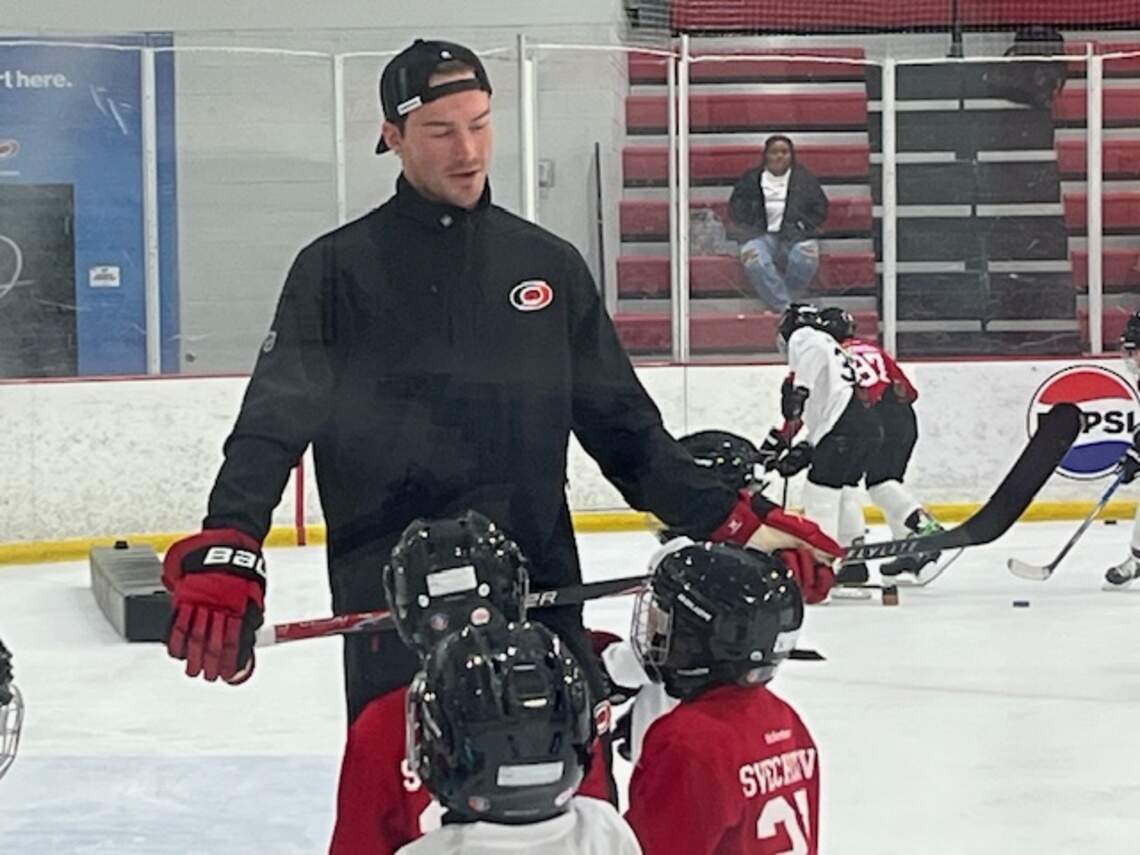
Initially exposing kids to hockey At an even more fundamental level, the Canes have supported the development of youth hockey with their First Goal Program.
Part of a league-wide initiative to provide boys and girls ages 5 to 10 with equipment and instructional sessions, the program has introduced more than 6,000 people to the game since 2016.
First Goal Program participants are given equipment fitting, ice time, USA Hockey membership and more benefits to introduce them to hockey.
As of Wednesday morning, Willis said the Canes had 638 sign-ups for their summer program, closing in on their 650-player target.
He said there has been greater interest in the initiative this year than in previous ones, as numerous parents have continued to enroll their kids well past the initial sign-up date.
(Its) easier, Willis said, when a winning culture is created that Rod (BrindAmour) and his team has done over the last eight years.
Paul Strand, the owner of the North Carolina Golden Bears youth hockey program, said he has seen a rise in the quality of hockey players from the Triangle since 2006.
While there have always been talented prospects, he said the level of engagement after the Cup victory increased the number of top-end players.
Strand, who played for the IceCaps in its final season, credited Rod BrindAmour for instilling a strong hockey culture in the city through the teams recent success and playing style When you win a Stanley Cup, you have a whole bunch of kids out there who get excited, Strand said, and they want to try hockey for the first time.
2006 caused that as well, and I think its definitely gonna increase that.
Girls hockey is rising at rapid rates Girls hockey has been increasing at an especially rapid rate, partly fueled by the Canes sustained success under BrindAmour, but also by the founding of the Professional Womens Hockey League in 2023.
In 2006-07, just 332 female hockey players were registered with USA Hockey, a number that gradually increased to 513 in 2016-17 and soared to 966 in 2024-25.
While the PWHL doesnt have a team in North Carolina, the Minnesota Charge and Ottawa Frost drew 10,782 fans to the Lenovo Center during the 2024-25 Takeover Tour.
Camille Lewis, the vice president of the North Carolina Trailblazers Womens Hockey Association, said when she first started playing hockey in Raleigh about 15 years ago many of her peers had learned to skate as adults.
As a Canadian, she spent plenty of time on the ice growing up, even though she never picked up a stick until adulthood.
But many of her teammates hadnt even hit the ice until they were inspired by the 2006 Cup.
It triggered a huge momentum around the womens league, Lewis said, to have women that were totally new to the sport joining in.
The Trailblazers currently have a wait list to join their league and have seen a spike in interest over the past two years, Lewis said.
With 83 women and girls across six teams this summer, Lewis said she believes the league has the most teams they have ever had, certainly since COVID-19.
Twenty of the players registered for their summer season are new to hockey one year or less of experience the most of such players they have ever fielded.
Lewis said because the Canes have been in Raleigh longer now, the skill level of their league has increased.
While the association accommodates players of all levels by spreading out talent, she said, longstanding members have noticed the pace of games increasing as more players join with youth experience.
The Canes success, just in the last few years, Lewis said, and I think all the excitement around the Cup, its definitely drawing a lot of attention.
When Chris Derrenbachers daughter, Mary, started playing hockey at 6 years old, her only option was to play with boys.
As she grew older, the opportunities to team up with girls expanded, but those teams would often face off against boys because there werent many girls teams nearby or willing to come to Raleigh.
Playing in the Polar House Hockey League and for the Junior Hurricanes, Mary progressed tremendously, Chris said, and eventually moved to Shattuck-St.
Marys School, a college preparatory school in Faribault, Minnesota.
Mary committed in late 2025 to play college hockey at Wisconsin.
If Mary wanted to grow, Chris Derrenbacher said, she had to go away.
And so we made that tough decision.
While Derrenbacher said the hockey scene up north is still more competitive, he added that if they were making that decision today, continuing with the Junior Canes mightve been a viable choice.
In 2026, all three of the Junior Canes Tier I girls teams qualified to play in the USA Hockey National Championships in Amherst, New York.
Rinks remain a strangle point for youth hockey Brad Hoffman, the youth committee chair of the Carolina Amateur Hockey Association, said the NHLs involvement in the Southeast U.S.
overall has spurred hockeys growth in Raleigh.
Five of the past seven NHL championships have been won by either the Tampa Bay Lightning, Florida Panthers and Canes.
However, Hoffman said the sports growth potential is limited by the number of rinks.
While in colder climates, kids can practice on frozen ponds and have an abundance of ice time, thanks to their long-standing hockey culture, Raleigh doesnt enjoy that luxury.
Currently, Wake County has five hockey facilities and seven sheets of ice.
Since new hockey players in Raleigh usually have to learn to skate and pick up other fundamentals through organized programs and house leagues, and ice time is scant, not all of the new interest from the Canes Cup can be accommodated easily.
Hoffman said the victory could attract investment, but building more rinks is an expensive upfront endeavor, which might deter investors.
A hockey rink can cost upwards of $18 million to build, he said.
It can be much more for a double sheet and more complex facilities.
Strand, who said his Golden Bears program has 280 players, believes that Raleigh is due for more hockey rink developments.
He said the local rinks do a good job of making space for the clubs, but as the sport continues to grow in popularity, there is a need for more ice time.
The cost of ice is expensive, Strand said, and youre not talking any small numbers if you make the wrong decision ...
But I think that winning a Cup takes quite a bit of uncertainty out.
Youve got automatic growth there.
A bright future for Carolina hockey, nonetheless Further crowding the rinks is the rise of the Triangle High School Hockey League, a 22-team league for high school students.
The league does not directly affiliate with the schools it represents, but fields teams composed of players from those schools.
President Steven Ismaili and Brian Pencola founded the league as high school students in 2023.
Now graduated, Pencola said they have expanded the league and work with the Junior Canes to assist with their bookkeeping Pencola said he played travel hockey throughout his childhood, but as a senior at Cardinal Gibbons High School, he craved the sense of pride that surrounded high school sports.
So he and Ismaili gathered a group of their classmates and reached out to numerous other schools to see which might be interested in playing.
It wasnt easy for other schools to field a team, but eventually, a team in South Carolina, Columbia Fusion, said theyd be willing to come to the Triangle for a game.
Many early games and practices would take place during unusual hours, such as 7 a.m., when ice time was free, but they made it work, and the league took off.
The idea of representing your school, Pencola said, going out there in front of your friends, your family, wearing your schools colors (and) logo, it creates a different sense of community and connection through the community in a different way than it was before compared to just travel hockey.
Ismaili and Pencola shared clips from the first game on social media soon after, and quickly, numerous other teams reached out to play.
Over the last couple of years, the league has professionalized as Ismaili and Pencola have gained mentorship from the Junior Canes, helping them secure proper licenses and related credentials.
Pencola said the league has reached out to schools to affiliate their teams with their athletic departments, but insurance costs have deterred those institutions from doing so.
Ismaili said they plan to revisit that idea in a few years.
The league has enough interest to expand to 24 teams next season, Ismaili said, but the lack of ice time has made them hesitant to grow further.
He is hopeful about future rink expansions and developments, but is still waiting for those changes to come.
We want to be able to have winter seasons and send teams to nationals, Ismaili said, which would be awesome.
But right now, that is not anywhere near, because just ice time is our biggest concern.
Logistical issues are plaguing hockey programs across the Triangle.
But perhaps that is just proof of the point.
A lack of ice teams indicates many people are excited about hockey a welcome change to the years before the sport consumed the Raleigh community.
I imagine on Monday morning, Derrenbacher said, any kid who is still in school or going to camp, every one of them, if they had a Canes shirt, they were wearing it..