

 si
si
GAINESVILLE, Fla. — When the University of Florida secured the services of Buster Faulkner, widely regarded as one of the premier offensive coordinators in college football, and surrounded him with playmakers like running back Jadan Baugh and wide receivers Dallas Wilson and Vernell Brown III, expectations for a high-octane offense soared to levels not seen in years.
Through the first four games of the 2026 season, those expectations appeared to be materializing. The Gators raced to their first 4-0 start since 2019, with the offense leading the charge by averaging 53.5 points and 532.75 yards per game. Baugh emerged as a Heisman Trophy contender, rushing for 600 yards and 11 touchdowns, while quarterback Aaron Philo drew praise for his toughness and consistency, with Wilson and Brown III serving as his primary targets.
But then the bottom fell out. Since a dominant 52-28 victory over Ole Miss, Florida's once-explosive offense has sputtered, averaging a mere 18 points and 356 yards per game. Baugh's Heisman hopes have evaporated after he managed just 72 rushing yards and one score in the two losses, and the passing attack has virtually vanished.
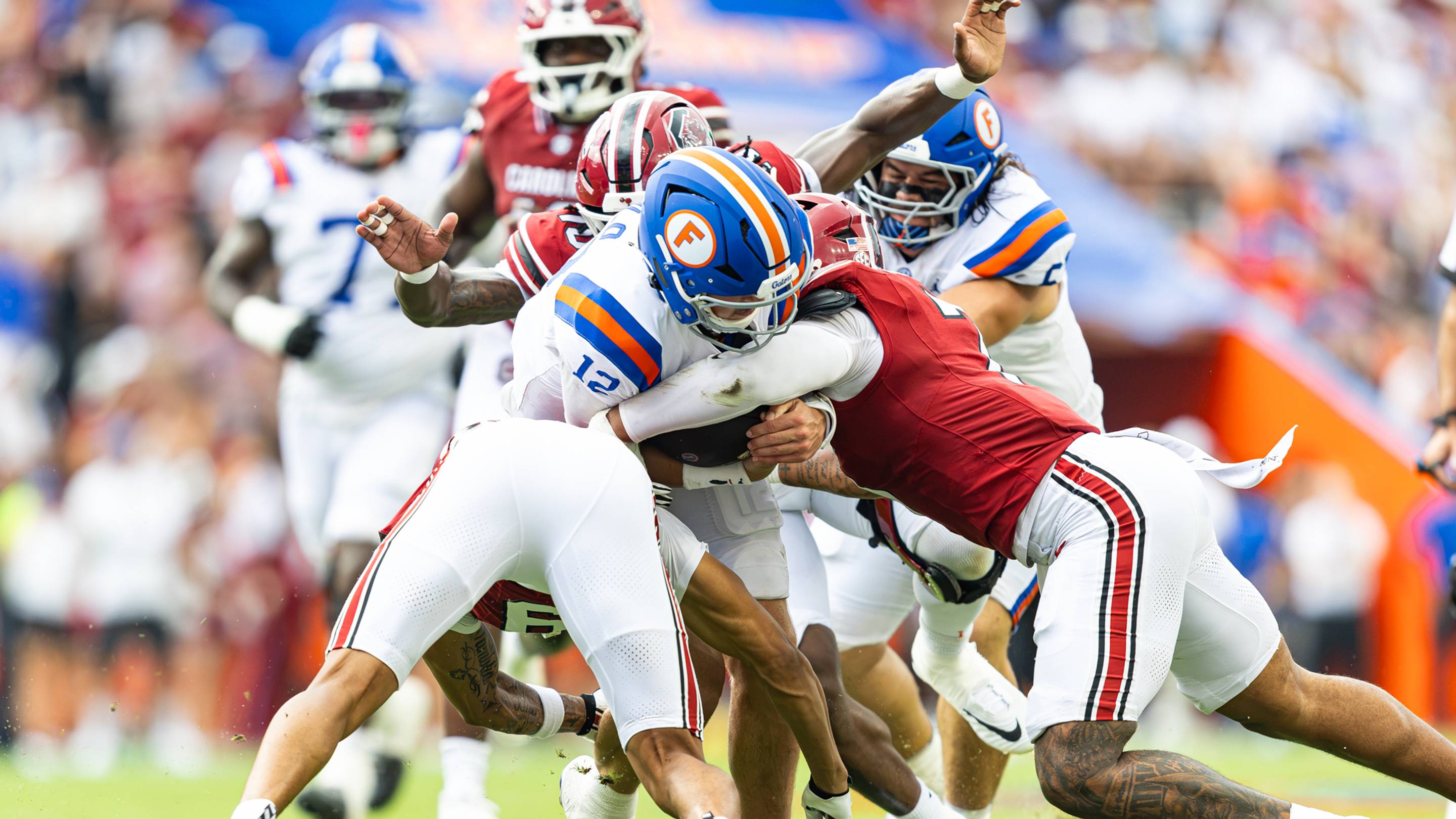
Missouri provided the initial blueprint: physically dominate Florida at the line of scrimmage and neutralize Baugh. The Tigers executed that plan perfectly, limiting him to 13 yards on 12 carries. South Carolina followed suit, holding Baugh to 59 yards and a garbage-time touchdown. Without a 26-yard run in the second half, he would have finished with just 33 yards.
By shutting down Florida's running game and winning the trenches, opponents have also eliminated the vertical passing attack. Philo has averaged only 212 yards and one touchdown in the back-to-back losses, and two turnovers against South Carolina compounded the issues. While not solely responsible, Philo has not been the consistent difference-maker needed to overcome the team's problems.
The play-calling has also come under scrutiny, with Faulkner leaning heavily on screen passes and quick throws due to injuries to Brown III and Singleton Jr. That approach proved easy for South Carolina to defend, especially with star edge rusher Dylan Stewart back from suspension. Stewart, arguably the top pass-rusher in college football, consistently beat Florida right tackle Emeka Ugorji, who earned a dismal 33.4 grade from Pro Football Focus after allowing four pressures and two sacks. Philo was sacked three times, and the Gamecocks recorded six tackles for loss.
When Philo had time, he was effective, completing 19 of 24 passes for 212 yards and a touchdown. Under pressure, however, he completed just 2 of 4 attempts for 15 yards, threw one interception, and was sacked three times.
"I'm not saying he played perfect. He didn't," head coach Jon Sumrall said. "But it's really easy to critique the quarterback position when we don't block the edge rusher very good. You're getting ready to get smacked, and you have to speed up your process, and you don't get the opportunity to take a good picture of the coverage. But yeah, there's plenty of things he's got to work on, cleanup, correct."
With Brown III (knee) out and Singleton Jr. (ankle) limited, Florida has lost two of its top deep threats, and the offense seems to have abandoned any attempt to push the ball downfield. Eight of Philo's 21 passes on Saturday were behind the line of scrimmage, and 15 completions went for fewer than 10 yards. Excluding his first completion—a 59-yard touchdown to Bailey Stockton—he would have thrown for just 168 yards.
Does Florida lack trust in Philo, who has made deep throws in the past, to do so? Does the staff lack faith in the struggling offensive line to hold up? Perhaps it's a combination of both. Faulkner and Sumrall publicly remain confident in the Georgia Tech transfer, with Faulkner emphasizing that the issues extend beyond the quarterback.
"He's a mentally tough kid," Faulkner said. "Like I said, he wouldn't be here if he wasn't really tough. So he's handling that fine. It's not just the quarterback, right? And I get it. It's the most important position in all the sports. But we got a lot of things that we got to clean up; that he's got to clean up, I got to clean up. We got to clean up some other things that I thought, again, to the naked eye, you wouldn't be able to tell that cost us either points or continuing the drive. So all around him we got to clean things up. That's kind of where we're at."
Or is the decline solely due to Brown III's absence? In the two games he has missed, Florida's offense has taken significant steps backward. His absence certainly hasn't helped, even if Faulkner insists it doesn't limit their vertical passing game.
"The thing that when you have VB is his explosiveness is unbelievable, you know, and so his ball-in-hand game is really good, and yeah, do we miss him? Yeah, we miss him. We love him, can't wait to get him back whenever that is, hes worked hard to get back. That's not the reason."
If not those factors, then what is it? These questions remain unanswered, and Florida's season could spiral out of control if they aren't resolved soon. Upcoming matchups at No. 6 Texas (Saturday), No. 1 Georgia (Oct. 31), Oklahoma (Nov. 7), which just beat Texas, and at No. 15 Kentucky (Nov. 14) offer no easy tune-up opportunities.
"We are all working towards one goal, but we got to just keeping working at it," Wilson said. "We have got to keep knick-knacking at it. Theres a lot of things were not perfect. Theres a lot of things we have to work on. Were not at our best. Coach Sumrall says were not the best team. We are not at a point where we should think were this good or that good. We need to keep working and keeping hitting that board."