

 si
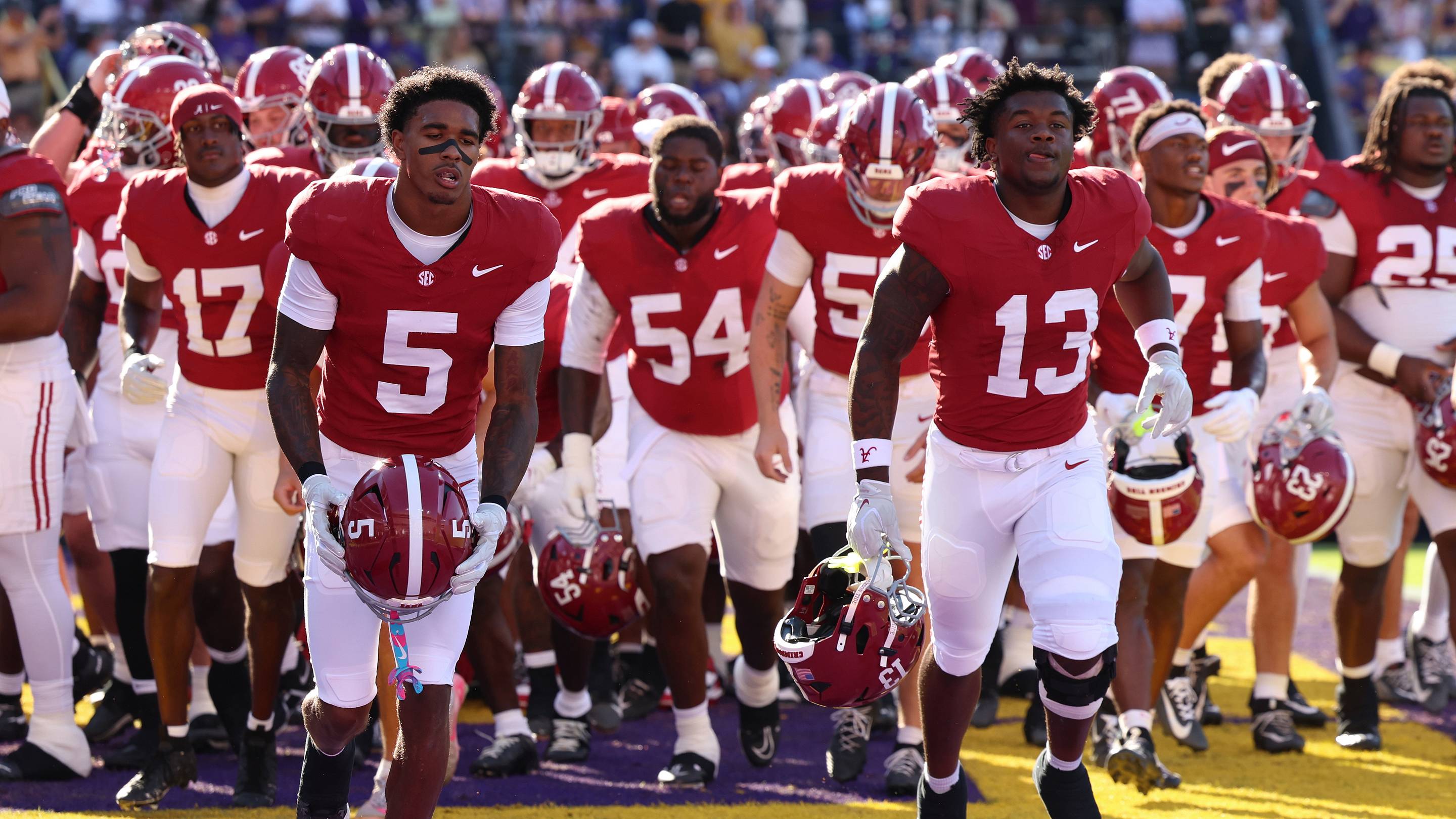
If fans expected the College Football Playoff selection committee to apply last week's logic to this week's rankings, they were mistaken—at least when it comes to Alabama. The Crimson Tide remain untouched by the same criteria that hurt other teams, according to Sports Illustrated's Pat Forde.
Last week, one-loss Indiana fell five spots in the CFP Top 25 during a bye week, from No. 4 to No. 9. The committee justified the drop by pointing to the Hoosiers' weak résumé, as all the Big Ten teams they had beaten lost. This week, two-loss Alabama saw its résumé take hits across the board: Kentucky, the Tide's best win, lost its second straight game at home to Florida; South Carolina was blown out by 46 points at Arkansas; Mississippi State lost its sixth consecutive game; Texas A&M fell at home to Tennessee; and LSU lost at home to Texas. In other words, all five SEC teams Alabama has defeated lost. Yet the Crimson Tide stayed at No. 3.
Committee chair Hunter Yurachek claimed with a straight face that Alabama's strength of schedule and strength of record were not negatively affected by those losses. He even credited the Tide for beating Vanderbilt, the SEC's co-last-place team. "We've seen throughout this college football season after a big win like Alabama had at LSU, a team will let down and lose those games," Yurachek said, glossing over the fact that LSU is now 6-4 and unranked. He added, "Credit to Alabama not playing their best in Nashville and finding a way to win." But winning in Nashville isn't as tough as Yurachek suggests—Arkansas, the SEC's 13th-place team, did it a month ago, and North Carolina State, tied for last in the ACC, would have done it in September if not for a last-play meltdown.
Forde argues that the path to the playoff has been cleared for Alabama by the committee. After routing FCS opponent Chattanooga on Saturday—a game that won't hurt the Tide's metrics—all Alabama needs to do is beat middling Auburn on Nov. 28 to lock up a CFP bid, possibly a top-four seed, and certainly nothing worse than a home playoff opener. Even a lopsided loss to Georgia in the SEC championship game wouldn't hurt them, Forde notes, because that's exactly what happened last year when Alabama suffered a three-touchdown defeat in Atlanta and faced no penalty.
Meanwhile, several teams that should already be ranked ahead of Alabama won and remained behind the Tide. Texas (8-2), which has the same number of losses as Alabama and superior wins, is No. 5. Tennessee, which beat Alabama by 16 points in a second-half mismatch, dropped to No. 9 after a 15-point road win. Indiana (9-1), which beat No. 17 USC by two touchdowns, moved ahead of the Volunteers to No. 8. Yurachek avoided strength-of-schedule talk when discussing the Hoosiers, instead citing improved offense as the reason for their rise. "Criteria continues to be applied randomly," Forde writes.
Forde imagines the reaction of Indiana coach Curt Cignetti, who delivered a three-minute rant against the committee on Monday for perceived disrespect. The double standard applied to his team and Alabama might have caused fireworks from Cignetti's famous recliner on Tuesday night.
One reason Alabama's strength of schedule remains bulletproof is the tail end of the committee's Top 25, where SEC teams fill spots simply by beating each other. South Carolina (6-4) is No. 21 despite a 28-point loss to a team with a losing record. Oklahoma (6-4) is No. 22, essentially absolved of a loss to unranked, 5-5 Michigan. Florida (6-4) is No. 24, with all four losses by at least 16 points. Mississippi (6-4) is No. 25, with three losses in its last four games and a Sept. 6 win over Louisville propping up its entire résumé. "If you beat a team that's ranked in our Top 25, that's significant for us," Yurachek said. Forde calls this "how the SEC-flavored sausage is made." The committee creates its own Top 25, then says playing those teams matters more—an echo chamber and a self-fulfilling prophecy.
The committee currently has eight SEC teams in the Top 25, guaranteeing more quality wins for the league. Meanwhile, six Big Ten teams—Wisconsin, Illinois, Penn State, Northwestern, Washington, and Nebraska—are outside the rankings, diminishing wins by Indiana (Northwestern, Nebraska), Iowa (Wisconsin, Washington, Northwestern), Oregon (Northwestern, Nebraska), and Ohio State (Illinois, Northwestern). Forde acknowledges part of that is the Big Ten's fault: five of its teams—Indiana, Nebraska, Penn State, Washington, and USC—did not play a power-conference opponent outside of league play. At the same time, the SEC increased its league schedule from eight to nine games, making strength of schedule the centerpiece of its campaign for more bids. The committee is clearly listening—Yurachek noted the ninth game on Tuesday night, even though no SEC team has played that ninth league game yet.
All things considered, the four SEC teams that should get in the tournament are in position to do so. But the continued propping up of Alabama remains this committee's blind spot, Forde concludes.