

 si
si
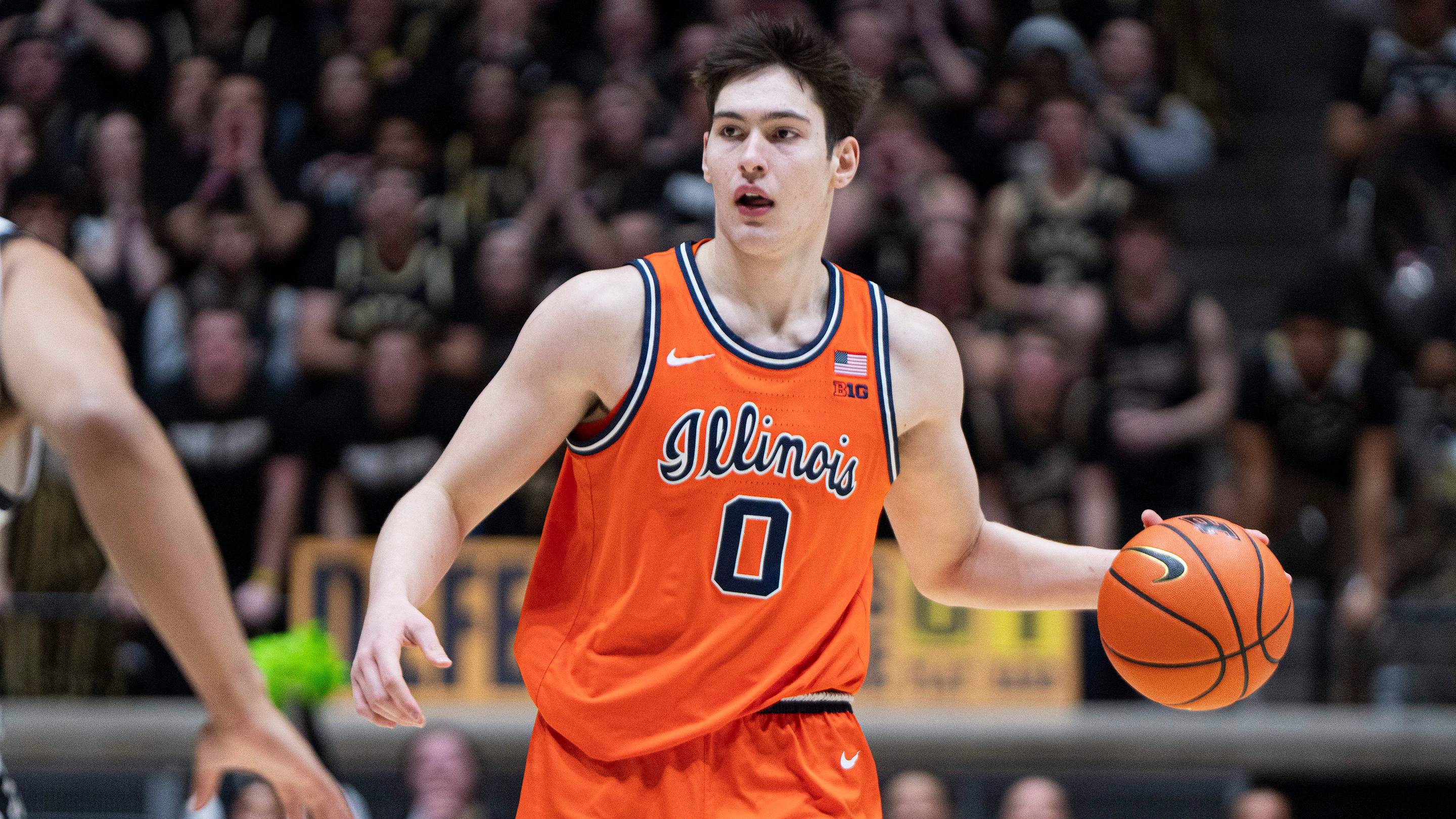
Offseason speculation often comes in whispers, but in the case of David Mirkovic, the chatter has been more of a roar. The Illinois forward's summer and fall have been filled with high-volume praise, and even a foot fracture that necessitated surgery and an ongoing recovery has not dampened the enthusiasm surrounding him.
Coaches, teammates, and analysts have been nearly unanimous in their glowing assessments of Mirkovic and his potential. NBA Draft expert Sam Vecenie has taken notice, suggesting that the hype surrounding Mirkovic rivals that of any player during Brad Underwood's tenure at Illinois—a program that has produced stars like Ayo Dosunmu, Kofi Cockburn, Terrence Shannon Jr., and Keaton Wagler.
Vecenie acknowledged that the injury slightly tempers expectations, but only marginally. He noted that Mirkovic would have been his preseason pick for National Player of the Year, but now views him as a projected All-American and a first-round selection in the 2027 NBA Draft.
In Vecenie's mock draft, Mirkovic is slated to go No. 16 overall to the Indiana Pacers, while freshman guard Quentin Coleman lands at No. 7 to the Atlanta Hawks. Such a projection for Mirkovic may seem ambitious, but all indicators point to him improving on a freshman campaign in which he averaged 13.3 points, 8.0 rebounds, and 2.6 assists in under 30 minutes per game.
However, the No. 16 slot raises questions about Mirkovic's athleticism. Vertically and laterally, he falls below NBA standards, which could pose challenges on defense. At 6-foot-9, he lacks the height to guard NBA centers, and most power forwards are too athletic for him to stay in front of. Yet, Mirkovic compensates with immense strength, length, elite anticipation, and relentless effort, allowing him to hold his own against undersized bigs and non-elite forwards.
Offensively, concerns linger about his first step and finishing at the rim. Can he consistently beat defenders off the dribble? Will his finishing package translate to the NBA? Mirkovic has just enough quickness to gain an edge in college, using his frame to capitalize. Against NBA-level athletes, however, creating that initial angle will be tougher. His finishing ability may be more worrisome, though he possesses a soft touch and a surprisingly diverse arsenal. Everything hinges on his ability to create space and find angles—will his patience, savvy, and physicality be enough? His athleticism won't gift him any easy looks.
On the positive side, Mirkovic shot 37.5 percent from three as a freshman and is an elite playmaker from the post, mid-post, and perimeter. He ranks among the best rebounders in college basketball despite limited vertical explosion. NBA front offices now prioritize production over raw potential, and if Mirkovic leads Illinois to a successful season, maintains his shooting efficiency, and shows even slight improvements in footwork, he will merit first-round consideration. His positional size, shooting, playmaking, basketball IQ, and intangible feel for the game form a compelling package that is too rich to ignore.
Still, the athleticism question marks are real. Even in a wide-open draft class, cracking the top 20 may prove difficult—though Vecenie appears convinced.
Key Analysis
Vecenie's projection underscores the high regard for Mirkovic's skill set, but the injury and athletic limitations introduce uncertainty. The forward's draft stock will depend heavily on his recovery and ability to adapt to NBA-level speed and athleticism. If he can showcase improved mobility and maintain his productivity, he could solidify his first-round status. Otherwise, teams may hesitate to invest a high pick in a player whose physical tools may not translate seamlessly.