

 si
si
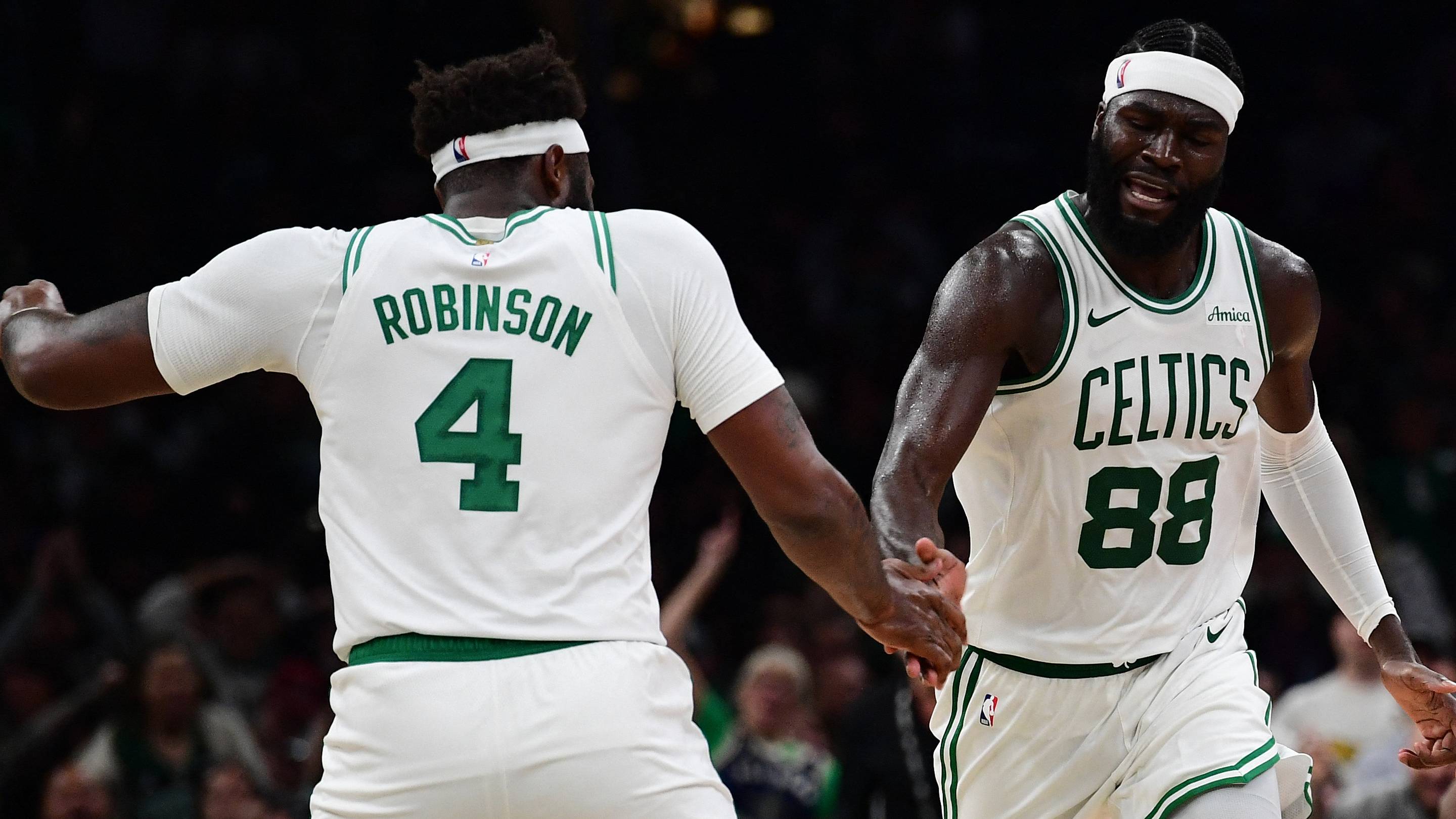
During Wednesday night's exhibition game against the Charlotte Hornets, Boston Celtics head coach Joe Mazzulla caught everyone off guard by opening the second quarter with both Mitchell Robinson and Neemias Queta on the court. The unconventional twin-tower alignment was a deliberate experiment, as Mazzulla later explained, aimed at gaining valuable film to evaluate potential adjustments. "Just kind of wanted to get some game reps in it, so we could have it on film to see what we want to work on," Mazzulla said after the win. "Just exploring."
The decision was made by the coaching staff earlier that day, but the players were not informed until the moment they stepped onto the floor. "He did not tell us," Robinson recalled in the locker room. "It was just like, just go at it. It caught us off guard. Overall, it was a little shaky at first, but after we got going and kind of learning spots and stuff like that, I think it kind of went smoothly."
The lineup produced a mix of positive and negative moments. On one play, Derrick White scored, but that may have been more a result of Boston's superior personnel rather than the scheme itself. The floor balance was noticeably off, and while Payton Pritchard could have attempted an alley-oop to White, such a play is not typically part of Boston's offensive repertoire. As one observer noted, "I'm not bookmarking this play as something the Celtics can go to when they need a bucket."
Another possession showed better execution: Queta set a pin-down screen for Sam Hauser, and because Hauser's defender chased over the top, Robinson's defender had to step over to prevent a pass and drive. White flipped the ball to Robinson, got a screen from Hauser, and then a hand-off from Robinson. White's defender, focused on preventing a corner turn and pass, lost White behind the screen, resulting in an open three-pointer. However, this action didn't necessarily require two bigs; any player could stand in the opposite corner where Queta was. In fact, the play was more instructive for Hornets coach Charles Lee, who might tell Brandon Miller not to worry about the drive since Queta was in the far corner. Naz Reid and Moussa Diabate could handle those duties because Robinson and Queta aren't dangerous in those spots while White is.
Later, the Celtics began to utilize both bigs more effectively. White and Robinson ran a two-man game with a hand-off and flipped screen, while Queta set a flare screen for Pritchard that created an open three-point opportunity, though the pass wasn't made. This is where the offensive value of two rim-pressuring bigs becomes apparent: defenses must decide what to leave and what to cover. As one analyst suggested, double-big lineups will almost have to have a piston-like effect (the engine, not Detroit) where one attacks and then the other follows after him.
Interestingly, the Celtics started parking Queta in the corner, which lent credence to the lack of preparation for this lineup. They clearly haven't looked at any double-big-specific offense. Perhaps this is a way to expand Queta's game, as he had two fun plays attacking from the wing. The whole play was a mess, but then Queta got Reid to bite on a three-point fake, allowing him the space to go to work. Honestly, Reid should be fined for biting on the fake, because until Queta shows he can consistently hit from there, getting that shot from the Celtics is a massive win for the defense.
Then there was another messy possession that came down to Queta having to create something. He again smartly got the defense to react to a fake, in this case a fake hand-off to Pritchard. Having Robinson in froze the defense and gave Queta the runway to finish the dunk, but again, one might challenge Queta to make that dump-off. "I think the best version of Neemi gives us a little bit of playmaking opportunities and being able to make plays off the dribble in the seam," Mazzulla said. "You envision him making those type of plays, but I thought they handled it well. Like I said, we threw it at them, wanted them to see what we could get out of it. Obviously I would say the spacing, just cleaning that up, but that playmaking is an area that we'd like to see Neemi take to a little bit of a different level for sure."
Queta hoisted a few threes and made some fun plays, but that's not something that can be counted on yet. Still, it's an interesting evolution for him. It'd be an understatement to say Queta growing into a viable stretch option would be a game-changer. It's not happening right now, and it might not ever, but there's a glimpse there that makes it an interesting thought experiment.
This also could simply have been a way for the Celtics to ramp up their communication. Mazzulla has been challenging the team to talk and figure problems out on their own, so this kind of lineup required a lot of the figuring things out on the fly that Mazzulla has been looking for. This might have simply been a massive curveball to make sure everyone was paying attention and to challenge the brains of players who have had enough of the preseason.
The Hornets were just as confused by the double-bigs as the Celtics were. The real value in the lineup was the defense, which barely allowed anything inside of five feet of the rim. The Celtics had plenty of studio space to explore because of their defense with these two on the floor, which just did a great job covering for one another and deterring drives. The Hornets also helped the Celtics by keeping Diabate and Reid on the floor, which gave the Celtics good matchups on the defensive end.
It remains to be seen if the Celtics will draw up any actions for this group to experiment with moving forward. The lineup might only be seen situationally, like when another team goes double-big and Boston wants to counter it and blow up the opposing rotations. There could be something there for Boston to develop, which would be another way for them to maximize their depth.
Key Analysis
The double-big experiment yielded mixed results, with defensive solidity but offensive clunkiness. While the lineup's rim protection was evident, the lack of practiced sets and spacing issues hindered its effectiveness. Mazzulla's motivation may have been to test communication and adaptability, but the long-term viability of such a lineup remains uncertain. If Queta can develop a reliable outside shot, it could become a more potent weapon, but for now, it appears to be a situational tool at best.