The NBA playoffs are rarely about who is the “better” team on paper; they are about who can solve the specific mathematical and psychological puzzle presented over a seven-game stretch. As the Los Angeles Lakers prepare to face the Houston Rockets this Sunday for Game 4, the narrative has shifted from a competitive first-round battle to a masterclass in veteran execution. Leading the series 3-0, the Lakers have the Rockets in a historical vice grip—no team in NBA history has ever climbed out of such a hole. But for bettors and analysts, the value isn’t just in the “who,” but in the “how.”
Los Angeles Lakers: The Art of Doing More with Less
The Lakers’ current form is a testament to the “next man up” philosophy, though it helps when the “next man” is a four-time MVP. Despite missing the gravity of Luka Doncic and the secondary playmaking of Austin Reaves, Los Angeles has won four of its last five games. They aren’t winning with flair; they are winning with a grinding, high-IQ defensive shell that forces opponents into “low-calorie” possessions.
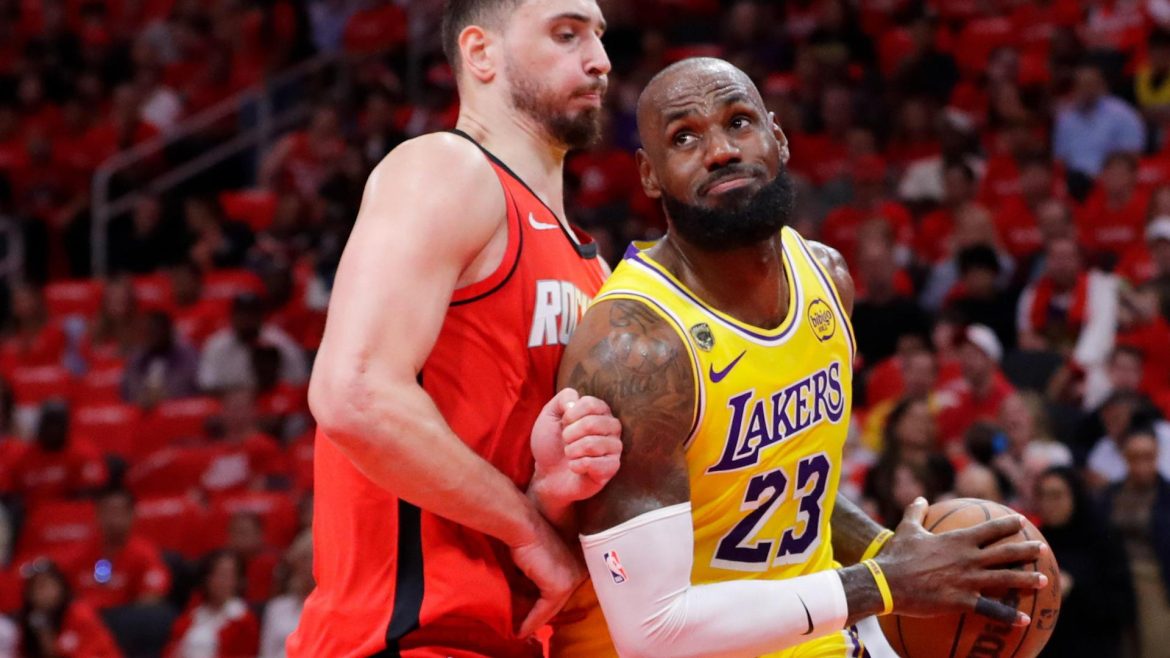
The Lakers’ strength lies in their Defensive Rating, which has spiked to a playoff-best during the fourth quarters of this series. Coach JJ Redick has shortened the rotation, leaning heavily on the duo of LeBron James and Marcus Smart. In Game 3, these two combined for 50 points, but their real impact was on the margins—Smart’s five steals and LeBron’s defensive rebounding (13 boards) neutralized Houston’s athleticism. Their primary weakness remains a lack of bench depth and a reliance on outside shooting that can go cold, as seen in their mid-game lull in Game 3. However, their ability to play “desperation basketball” while actually being ahead in the series is a psychological edge that cannot be overstated.
Houston Rockets: The High Cost of Youth
The Rockets are a team of the future that has been forced to play in a very painful present. Statistically, Houston should be more competitive. According to NBA.com, the Rockets have actually attempted 63 more field goals than the Lakers over the first three games. In a vacuum, more shots usually equal more wins. However, their Effective Field Goal Percentage (eFG%) has cratered to 44.2% in “clutch” moments.
The absence of Kevin Durant has stripped this roster of its safety net. Without Durant’s ability to demand a double-team, the Lakers have been able to stay home on shooters, daring the Rockets’ youth—specifically Jabari Smith Jr. and Reed Sheppard—to beat them with disciplined half-court sets. The Rockets’ form is trending downward; they have lost three straight and are struggling with the mental weight of squandered leads. Their strength remains their pace and offensive rebounding, but their weakness is a glaring lack of late-game poise. If Durant remains on the sidelines or is even 75% mobile, the Rockets lack the “closer” necessary to stave off a sweep.
Tactical Matchup: Poise vs. Pace
The tactical edge in Game 4 rests entirely on the Lakers’ ability to control the tempo. Houston wants to turn this into a track meet to exploit the Lakers’ aging legs. However, Marcus Smart has effectively neutralized the Rockets’ backcourt. By playing a physical, “bump-and-grind” style of defense, Smart has forced the young Rockets into 18 turnovers per game.
The key battle to watch is the Lakers’ transition defense against the Rockets’ fast-break attempts. In Game 3, Houston had multiple opportunities to put the game away but committed “baffling” turnovers in the backcourt. This is a situational factor: the Lakers are playing like they are down 0-3, while the Rockets are playing like a team that has already accepted the inevitable. According to ESPN, veteran teams with a 3-0 lead close out the series in Game 4 nearly 60% of the time when the opposing star player is injured.
Betting Insights & Trends
From a betting perspective, the movement is fascinating. The spread has remained relatively tight, respecting the Rockets’ home-court advantage and the Lakers’ injury report. However, the smart money is looking at the Total.
-
Under/Over Trend: The Lakers have seen the “Over” hit in only 40% of their road games this season, as they tend to slow the pace to preserve LeBron James’ energy.
-
The Durant Effect: If Durant sits, the Rockets’ offensive efficiency drops by nearly 8.4 points per 100 possessions.
-
Public vs. Sharp: The public is backing the Lakers to sweep, but sharps are eyeing the Rockets’ inability to score consistently against a set defense.
The risk factor here is the “Sweep Letdown.” Occasionally, a team up 3-0 will take their foot off the gas, allowing the home team to grab a “gentleman’s win.” But LeBron James’ post-game comments—emphasizing that they “don’t have a long leash”—suggest a team focused on rest rather than mercy.
Final Prediction & Best Pick
The Rockets are talented, but they are currently a ship without a rudder. Without Durant to settle the offense, they will likely fall into the same trap of taking contested, early-shot-clock threes. The Lakers know that every extra game played is a risk to LeBron’s 41-year-old frame. Expect JJ Redick to run a high-volume PNR (Pick and Roll) with James to hunt mismatches against Houston’s young bigs early and often.
The Lakers’ veteran discipline will capitalize on the Rockets’ inevitable 12-to-18-minute stretch of scoring drought. While the Rockets might keep it close for three quarters, the “youth tax” will be collected in the final six minutes.
The Pick: Lakers to win and cover the spread.
However, the most calculated play involves the total. Given the Lakers’ defensive intensity and the Rockets’ abysmal 28.7% shooting from deep in this series, the offensive ceiling for this game is lower than the bookmakers suggest. The Lakers will focus on high-percentage looks and milking the shot clock, while Houston will struggle to find rhythm against Marcus Smart’s perimeter pressure.
OVER 207.5