
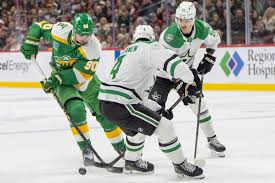
The Western Conference first round has officially devolved into a high-stakes game of chicken. Following a grueling back-and-forth in St. Paul, the Dallas Stars and Minnesota Wild return to Texas for a pivotal Game 5 with the series knotted at 2-2. In the Stanley Cup Playoffs, the winner of Game 5 in a tied series goes on to win the matchup roughly 79% of the time, making Tuesday night’s clash at the American Airlines Center the functional “Game 7” of this opening round.
This hasn’t just been a battle of skill; it has been a clash of identities. We have seen a Dallas squad that is surgically precise on the power play facing a Minnesota team that is physically imposing and dominant during 5-on-5 play. For sports bettors, this series presents a fascinating riddle: do you back the elite special teams or the superior even-strength engine?
Dallas Stars: The Power Play Juggernaut
The Stars enter Game 5 with a clear formula for success, though it is one that carries a high degree of volatility. Through four games, Dallas has found the back of the net eight times on the power play, operating at a staggering 42.1% clip. When the game slows down and the whistles start blowing, the Stars are the best team in the league.
Jason Robertson has been the focal point of this offensive clinical. After a somewhat quiet start to the series, Robertson has found his rhythm, scoring in four consecutive games. His ability to find soft ice in the high slot makes him a nightmare for a Wild penalty kill that has looked disorganized and reactive. Alongside him, Miro Heiskanen continues to be a workhorse, eating up massive minutes and facilitating the transition game that allows Dallas to punish Minnesota’s aggression.
However, the red flag for Dallas is glaring: they have only managed three even-strength goals in the entire series. If the officials decide to “let them play”—a common occurrence as playoff series get deeper and more intense—Dallas could find themselves starved for offense. Furthermore, the loss of Nils Lundkvist to a facial injury puts even more pressure on a defensive core that was already leaning heavily on its top four.
Minnesota Wild: Even-Strength Dominance
While Dallas is winning the battle of the whistles, the Minnesota Wild are winning the battle of the “blue paint.” The Wild have registered 11 even-strength goals, nearly quadrupling the output of the Stars in that category. According to NHL.com, controlling the flow of play at 5-on-5 is the most sustainable predictor of playoff success, and by that metric, Minnesota is actually the “better” team in this series.
The emergence of Matt Boldy has been the story of the Wild’s resilience. After a career-high regular season, Boldy has translated that production to the postseason with five points in four games, including the heroic overtime winner in Game 4. The Wild’s depth has also been bolstered by rookie Brock Faber, who has provided stability on the back end and surprising offensive contributions.
The biggest question mark for the Wild remains their health. Mats Zuccarello is the straw that stirs the drink for the Minnesota offense, and while he practiced Monday, his effectiveness following an upper-body injury remains to be seen. If Zuccarello can return to 100%, he provides the creative vision necessary to fix a Wild power play that has gone a dismal 1-for-15 in recent opportunities.
Tactical Edge: The Goaltending Duel
In the crease, we are witnessing a heavyweight bout between the established star and the rising phenom. Jake Oettinger remains the backbone of the Stars, but he has shown slight cracks in his armor, particularly against deflections and high-to-low plays. On the other side, Jesper Wallstedt has been nothing short of sensational. With a .929 save percentage and a 2.06 GAA, he is currently outperforming his veteran counterpart.
The tactical edge goes to Minnesota if they can maintain their discipline. The Wild’s biggest weakness is their penchant for “undisciplined” physical play. If they can avoid the post-whistle scuffles and keep the game at 5-on-5, they have proven they can outwork Dallas in the dirty areas of the ice.
Betting Insights & Market Trends
The odds currently favor Dallas as a moderate home favorite, largely due to the “Home Ice” factor and Oettinger’s reputation. However, the sharp money has been eyeing the Wild as a live underdog.
-
The Trend: Minnesota is 4-1 in their last five games following a win, showing an ability to build momentum.
-
The Total: The “Under” has been a popular play, but with both teams showing defensive lapses and a high volume of shots (both teams averaged over 40 shots in Game 4), the over/under of 5.5 is a dangerous line.
-
Special Teams Regression: Statistical models suggest Dallas’s 42% power play is unsustainable. If that number regresses toward the mean (roughly 20-25%), Dallas loses their primary source of goals.
According to ESPN’s hockey analytics, teams that lead in Expected Goals (xG) at even strength have a significantly higher win probability in late-series games. Minnesota currently leads Dallas in xG at 5-on-5 by a margin of 1.4 per 60 minutes.
The Prediction: Why the Wild Take the Lead
This game will likely be decided in the first ten minutes. If Dallas scores early on the power play, the American Airlines Center will become a cauldron of noise. However, Minnesota has shown a “road warrior” mentality throughout the season.
The Wild are younger, faster, and currently getting better goaltending from Wallstedt. While Dallas has the star power in Robertson, Minnesota has the collective depth and the physicality to wear down a Stars defensive unit that is missing Lundkvist. Expect the Wild to stifle the Stars’ transition game and force the play into the corners, where their size advantage becomes a factor.
The return of Zuccarello, even in a limited capacity, should provide just enough of a boost to the Wild’s power play to negate the Stars’ special teams advantage. For more in-depth coverage of player stats and historical trends, BBC Sport offers comprehensive insights into high-pressure playoff environments.
The Pick: Minnesota Wild Moneyline (+108)