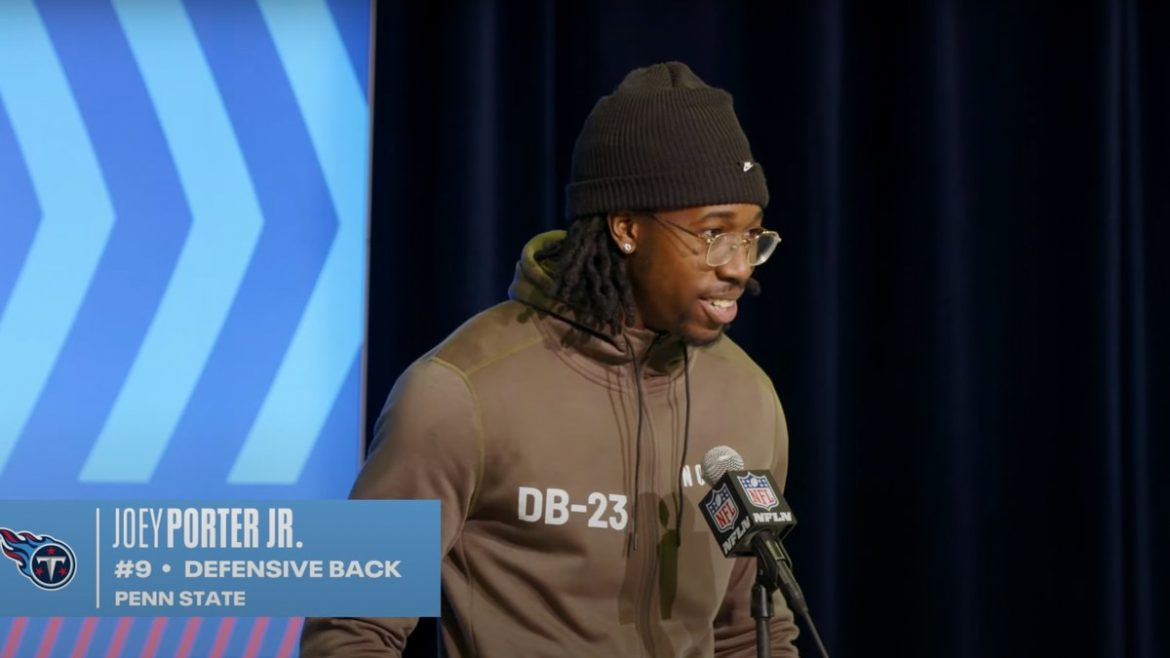
The Steelers’ cornerback situation is getting renewed attention as Joey Porter Jr. and Jamel Dean are being discussed as part of a potentially strong NFL cornerback combination, while roster depth remains a major factor if injuries hit. The broader takeaway is less about one headline pairing and more about how Pittsburgh’s secondary could be shaped by both top-end talent and the players behind them.
Steelers secondary draws notice around Joey Porter Jr. and Jamel Dean
Reports circulating this week have focused on Porter and Dean as a notable cornerback pairing in the Steelers’ defensive conversation. The attention makes sense. In today’s NFL, cornerback play can change the shape of a defense, especially against pass-heavy opponents and in divisions where teams regularly test the outside of the field.
Porter has already established himself as one of the more recognizable young defensive backs in Pittsburgh. Dean, meanwhile, has long been viewed as a player whose coverage skills can influence how a defense is deployed. When a team can trust its corners on the perimeter, the rest of the defense can be more flexible in how it disguises coverages, pressures the quarterback, and handles motion-heavy offenses.
At the same time, the reporting around this topic underscores something every NFL team eventually faces: even strong cornerback play is only part of the equation. A defense can look stable on paper, but the season tends to test depth quickly.
Why cornerback depth matters over a full NFL season
Cornerback is one of the most demanding positions in the league. Players have to mirror receivers in space, react to double moves, tackle in the open field and stay disciplined on the backend, often with little help once the ball is in the air. Because of that, a team’s starting duo is only as valuable as the reinforcements behind it.
The news cluster around the Steelers also pointed to a deeper roster ready to absorb injury-related setbacks. That is not a trivial detail. In a long season, teams rarely go through 17 games with the same two or three cornerbacks taking every meaningful snap. Hamstrings, ankles, hand injuries and concussions can force coaches to reshuffle the secondary from week to week.
For Pittsburgh, the ability to withstand that kind of turnover could prove just as important as the top of the depth chart. A defense with quality starting corners but no reliable backups can quickly find itself exposed once the injury list grows. The reverse is also true: a capable group of reserves can help preserve scheme continuity and reduce the stress on the rest of the defense.
How the Steelers could benefit from a stable outside duo
If Porter and Dean are indeed the names drawing the most attention in the secondary discussion, the football implications are easy to understand. A trusted outside cornerback tandem can give a defense more confidence in man coverage and can allow the pass rush a little more time to get home. That connection between coverage and pressure is one of the central principles of modern NFL defense.
It also affects game planning. Offensive coordinators routinely identify corners they want to challenge, and defensive coordinators spend the week trying to prevent that from becoming a recurring issue. If Pittsburgh believes it has two corners capable of holding up outside, that can change how aggressively the defense mixes coverages and how often it brings pressure from different spots on the field.
Still, good cornerback play is rarely just about the starters. Nickel defenders, dime packages and safety help all become part of the picture. A cornerback room that has both quality starters and functional depth gives a coaching staff more options, especially in games where matchups dictate personnel changes.
Roster health could shape the defensive ceiling
The emphasis on injury preparedness is telling because it reflects how teams build in the modern NFL. Defensive depth is not glamorous, but it often decides whether a unit can survive the grind of the season. When a starter misses time, teams want replacements who can step into the structure without forcing a complete overhaul.
That is particularly relevant for a Steelers defense that has traditionally valued physical play and schematic discipline. Any secondary built around a high-profile cornerback tandem needs reserves who can handle communication, leverage and assignment football. Miss one detail in coverage, and the entire defense can be put on the back foot.
The reports also suggest that the conversation around Pittsburgh’s cornerbacks is not limited to star power. It is equally about whether the team has enough playable talent to get through inevitable attrition. That is the kind of roster question that surfaces in July and becomes much more important by November and December.
What this means heading into the season
For the Steelers, the current discussion is encouraging in one sense and unfinished in another. A cornerback room that features recognized top-end talent is a strong starting point, but the practical value of that talent depends on availability and support. The best defenses are built not only around the names on the marquee, but also around the players who enter the game when those names are unavailable.
That is why the conversation about Joey Porter Jr. and Jamel Dean matters beyond the individual players. It reflects a larger evaluation of Pittsburgh’s defensive structure and the amount of trust the team can place in its secondary as the season unfolds. If the front office and coaching staff believe the depth is capable of holding up, the Steelers can be more aggressive in how they construct game plans. If not, the defense may need to protect itself more often than it would like.
For now, the reporting points to a secondary with real upside and a roster built to handle at least some adversity. In a league where cornerback injuries can quickly alter a team’s identity, that combination can be the difference between stability and constant adjustment.
Sources
- Steelers’ Joey Porter Jr., Jamel Dean a Top NFL Cornerback Combo? Deeper Roster Ready for Injuries – WZZM13.com
- Steelers’ Joey Porter Jr., Jamel Dean a Top NFL Cornerback Combo? Deeper Roster Ready for Injuries – FOX43
- Steelers’ Joey Porter Jr., Jamel Dean a Top NFL Cornerback Combo? Deeper Roster Ready for Injuries – myfoxzone.com