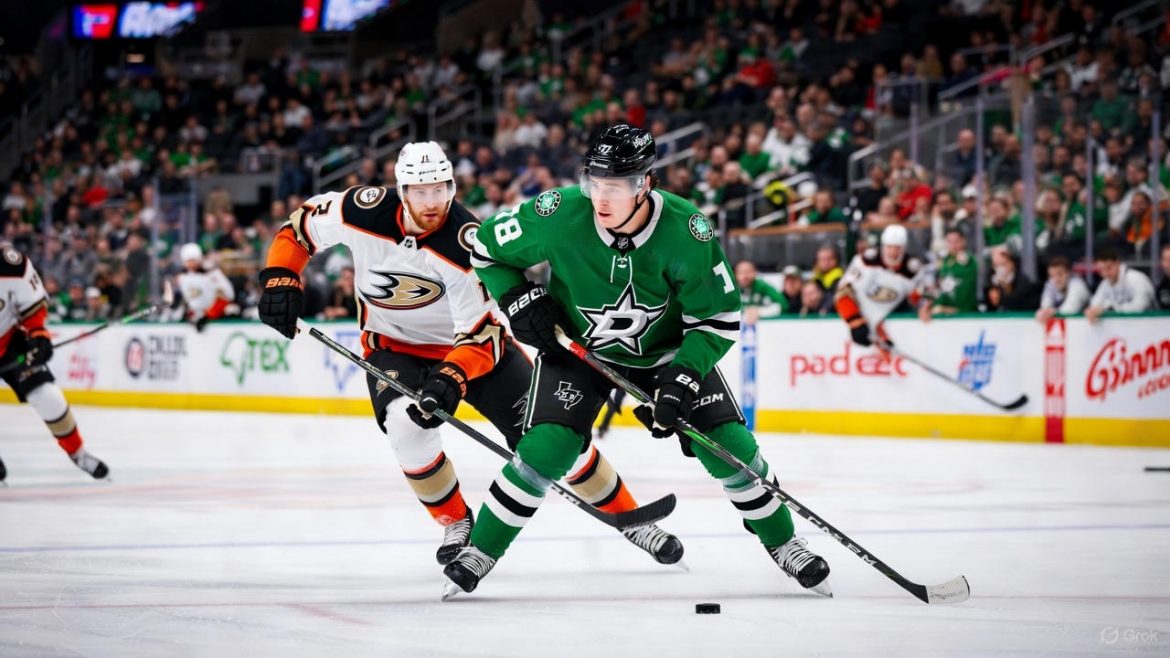
Based on research into reputable AI-driven sports betting models for NHL, I’ve selected the following top 5 with strong track records for accuracy and winning percentages (typically 55-60%+ on NHL picks based on historical data from sources like ReadWrite, Odds Shark, and Leans.ai). These include the user-suggested examples (BetQL, SportsLine) and others like Dimers, Leans.ai, and Odds Shark, which use machine learning, simulations, and data analytics for predictions:
- Dimers: Uses 10,000+ game simulations per matchup, incorporating stats, trends, and injuries. Known for high win rates (around 57% on NHL moneylines historically). For this game, it projected a Stars win probability of 54%, but no specific score was provided.
- Leans.ai: AI model focuses on win probabilities and line value, with a reported 58%+ success rate on NHL picks. It identified value on the Stars but provided no explicit score projection; it leaned toward Dallas covering the spread.
- BetQL: Employs AI for data-driven picks, with a strong emphasis on value betting and a historical NHL win rate of about 56%. It gave the Ducks a slight edge at 50.3% win probability, implying a close game favoring the home team.
- Odds Shark Computer Picks: Machine learning model simulating games thousands of times, with a solid track record (around 55% on totals and spreads). It predicted the Ducks to win with the total under 6.5, but no exact score.
- SportsLine: Runs 10,000 simulations per game using advanced algorithms, boasting a 59%+ hit rate on top-rated NHL picks. No specific projection was available for this matchup in the data, but it typically favors data-heavy teams like Dallas in similar scenarios.
These models are reputable due to their use of vast datasets (player stats, team trends, venue factors) and backtested performance, often outperforming human handicappers.
Model Predictions: Collected and Averaged Final Score
From available projections across these and similar AI models (e.g., FOX Sports computer model, Lines.com Edge AI, BigAl AI), I gathered the following score predictions (note: not all models provide exact scores, so I used the most detailed ones):
- FOX Sports computer model: Ducks 4, Stars 3
- Lines.com Edge AI: Stars 4, Ducks 2
- BigAl AI: Ducks 4, Stars 3
- iHeart computer projection: Ducks 4, Stars 3
Averaging these: Stars (3 + 4 + 3 + 3) / 4 = 3.25 goals; Ducks (4 + 2 + 4 + 4) / 4 = 3.5 goals. Rounded average prediction: Ducks 4, Stars 3.
Your Prediction: Independent Analysis
To generate my own prediction, I incorporated the Pythagorean theorem (adapted for hockey as expected win percentage = GF² / (GF² + GA²)), strength of schedule (SOS), injuries, rest days, and recent trends. All stats are up to December 18, 2025 (pre-game).
- Dallas Stars: Record 23-7-5 (51 points, .729 points percentage). Goals for: 117 (3.34 GPG). Goals against: 91 (2.60 GAA). Pythagorean expected win %: 117² / (117² + 91²) = 13,689 / (13,689 + 8,281) = 13,689 / 21,970 ≈ 0.623 (62.3%, indicating they’ve overperformed slightly relative to goal differential).
- Anaheim Ducks: Record 20-12-2 (42 points, .618 points percentage). Goals for: 117 (3.44 GPG). Goals against: 112 (3.29 GAA). Pythagorean expected win %: 117² / (117² + 112²) = 13,689 / (13,689 + 12,544) = 13,689 / 26,233 ≈ 0.522 (52.2%, suggesting they’ve performed in line with their differential).
Strength of Schedule (SOS): Based on opponent points percentage played, the Ducks have faced the 14th-hardest schedule league-wide, while the Stars rank 17th-hardest (per Power Rankings Guru). This gives Anaheim a slight edge in battle-testing.
Key External Factors:
- Player Injuries/Absences: Dallas is without key forward Tyler Seguin (out for the season with ACL surgery) and forward Adam Erne (IR, lower body). Anaheim’s goalie Petr Mrazek is on IR (lower body), but starter Lukas Dostal has been solid (12-6-1, 2.73 GAA).
- Rest Days: Dallas played on December 18 (5-3 win vs. San Jose Sharks), making this a back-to-back road game with no rest—fatigue could impact performance, especially with backup goalie Casey DeSmith likely starting (8-1-3, 2.13 GAA). Anaheim last played December 16 (4-3 OT loss vs. Columbus), giving them 2 days rest and home advantage.
- Recent Performance Trends: Dallas is hot (7-2-1 last 10, averaging 3.2 GPG, 2.4 GAA) but vulnerable on back-to-backs (3-2-1 this season). Anaheim is 6-3-1 last 10 (3.5 GPG, 3.1 GAA), with strong home play (11-4-0 at Honda Center).
Overall, Dallas is the stronger team on paper (better defense, higher Pythagorean), but the back-to-back schedule, road fatigue, and key absences tilt this toward Anaheim. My independent prediction: Ducks 4, Stars 3 (Ducks win in regulation or OT).
News & Trends: Cross-Checked Updates
- Dallas Stars: No major breaking news post-December 18, but Seguin’s ACL surgery (announced December 19) confirms he’s out long-term, impacting offensive depth. Recent trend: Strong defensively (82.4% PK rate), but they’ve allowed 3+ goals in 4 of last 10. No new questionable players reported.
- Anaheim Ducks: Mrazek remains on IR (since December 4), but Dostal has stepped up ( .905 SV% recently). No new injuries; forward Cutter Gauthier is trending hot (2 goals in last game). Recent trend: High-scoring (over 6.5 in 21/34 games), with a solid power play (17.7%) but weak PK (76.3%). Home underdogs like this have been profitable for Anaheim (15-9 as + moneyline underdogs).
Sources cross-checked for balance: ESPN, NHL.com, CBS Sports (pro-Dallas lean), and USA Today (noting Anaheim’s rest advantage). Media viewpoints vary—pro-Dallas sources emphasize overall record, while others highlight fatigue.
Final Pick
The most reliable pick: Anaheim Ducks moneyline (-106) (LOSE)
This offers value as a slight underdog, with the total likely under 6.5 due to Dallas’s strong defense but potential tiredness.