
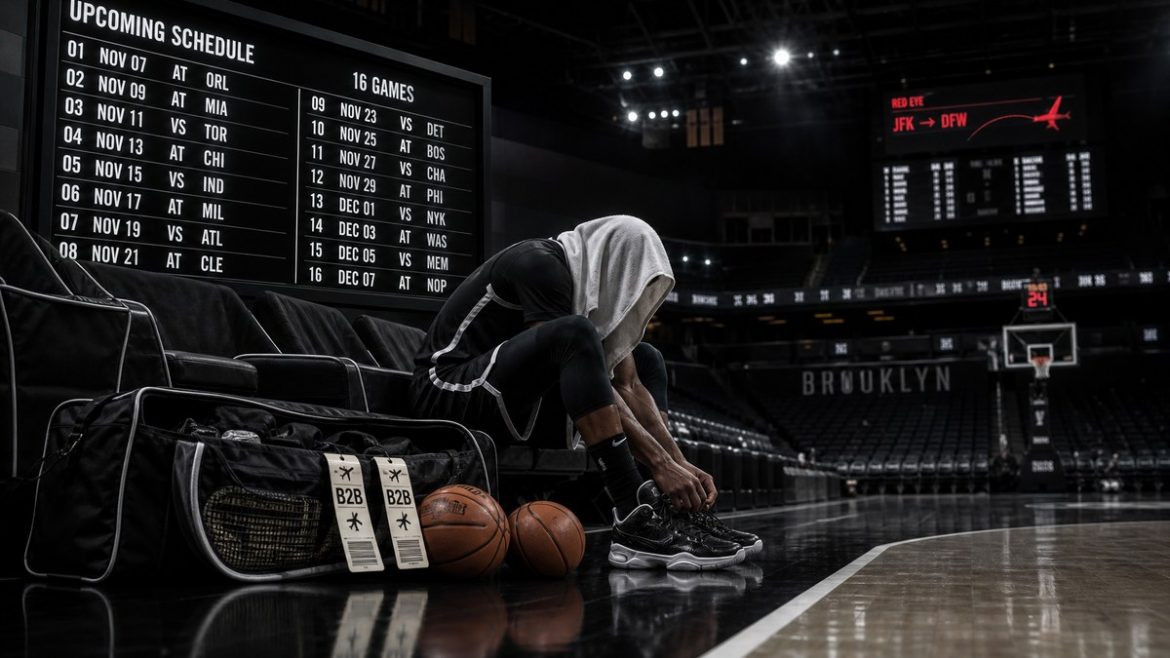
The Brooklyn Nets will reportedly play an NBA-high 16 back-to-back sets during the 2026-27 season, adding a significant workload challenge to a schedule that has also been described in reports as difficult at the start. The total matters because consecutive-day games test roster depth, recovery plans and lineup flexibility across the league’s 82-game regular season.
Brooklyn Nets face 16 reported back-to-back sets
The headline figure from the Nets’ schedule is the reported total of 16 back-to-backs. That means Brooklyn is scheduled to play on consecutive days 16 times, requiring the team to repeatedly move from one game directly into preparation for another without a full day between them. According to the reports, no NBA team has more such sets on its 2026-27 calendar.
Back-to-backs are a routine part of an NBA season, but their frequency and placement can shape how a team approaches the full schedule. The strain is not limited to the two games themselves. Travel, late finishes and reduced practice time can affect preparation before a set and recovery afterward. For Brooklyn, managing those compressed portions of the calendar will be an issue throughout the season rather than during one isolated stretch.
Difficult start adds to Brooklyn’s schedule concerns
Reports describing the Nets’ opening schedule as difficult add another layer to the 16 back-to-backs. An early run of demanding games can influence how quickly a team establishes its rotation, particularly when coaches are evaluating lineup combinations and defining roles. Early-season practices are also valuable because they allow teams to correct problems that appeared during training camp and the preseason.
A compressed schedule can reduce those opportunities. On consecutive-game days, the focus often shifts toward recovery, film work and limited on-court preparation. That does not determine results by itself, but it can narrow the margin for adjustment. The full effect of Brooklyn’s opening stretch will depend on the opponents, locations and travel sequence surrounding each game, not simply the number of back-to-backs.
NBA schedule demands put roster depth in focus
Brooklyn’s ability to handle the schedule will be tied closely to its usable depth. Back-to-backs can force coaches to reconsider minutes distribution, especially when players are returning from injuries or dealing with routine soreness. A reliable second unit can help prevent starters from carrying excessive workloads on the first night of a set and preserve lineup options for the following game.
The challenge extends beyond finding additional scorers. Teams need reserve ball-handlers who can organize the offense, defenders capable of matching up at multiple positions and frontcourt players who can absorb physically demanding minutes. When the schedule tightens, weaknesses at the end of a rotation can become more visible because there is less time to recover between performances.
Availability will remain the largest variable. A deep roster can withstand a demanding calendar when most players are healthy, while even a well-constructed rotation can be stretched by multiple absences. The Nets will have to make those decisions as the season develops, based on player health and performance rather than the schedule number alone.
Recovery and preparation become central issues
Consecutive-day games create different demands depending on where they fall. A home back-to-back generally presents a different logistical challenge from a set that includes travel between cities. The quality of the opponents also matters, as does whether the second game begins a longer trip or concludes a run of several games in a short period.
For the Nets’ coaching, performance and medical staffs, the schedule will require coordination. Minutes cannot be planned in a vacuum because game situations often force changes. Overtime, foul trouble or an injury can alter the intended workload on the first night and affect which players are best positioned to contribute one day later.
Practice planning also becomes important. NBA teams need time to install adjustments, work with developing players and address recurring mistakes. Back-to-backs replace potential practice dates with games and recovery sessions. Brooklyn therefore will need to use training camp, preseason work and less congested portions of the calendar efficiently.
Back-to-back total does not define the entire season
Although 16 is reportedly the league’s highest total, that statistic alone cannot fully measure schedule difficulty. A team’s calendar is also shaped by the strength and location of opponents, the length of road trips, the number of games in condensed spans and the distribution of rest days. Two teams with similar back-to-back totals can face substantially different overall circumstances.
The standard NBA regular season includes 82 games, split evenly between home and road dates. Within that framework, teams experience different patterns of travel and rest. Brooklyn’s reported back-to-back count is a clear indicator of repeated short-rest situations, but a complete assessment will require examining how those sets are arranged and what surrounds them.
Schedule difficulty can also change in practical terms once the season begins. Opponents may be missing key players, teams can improve or decline, and injuries can reshape matchups. What appears demanding in August does not always look the same several months later. For that reason, the Nets’ performance in the opening weeks will provide more useful evidence than the schedule’s initial description.
Nets must manage the calendar over all 82 games
The immediate takeaway is straightforward: Brooklyn reportedly has more back-to-backs than any other NBA team in 2026-27, and the Nets are expected to encounter a challenging opening portion of the schedule. That combination puts an early emphasis on health, rotation stability and the contributions of reserve players.
It also makes patience important when evaluating the team. A difficult first segment can expose weaknesses, but it can also provide information about which lineups function under pressure and which players can handle expanded responsibility. The broader judgment will come from how effectively Brooklyn responds over the entire season, including whether it can remain competitive when preparation and recovery time are limited.
Sources
- NewsWest9: Brooklyn Nets Face Difficult Start to 2026-27 Schedule, NBA-High 16 Back-to-Backs
- News Center Maine: Brooklyn Nets Face Difficult Start to 2026-27 Schedule, NBA-High 16 Back-to-Backs
- WFAA: Brooklyn Nets Face Difficult Start to 2026-27 Schedule, NBA-High 16 Back-to-Backs