
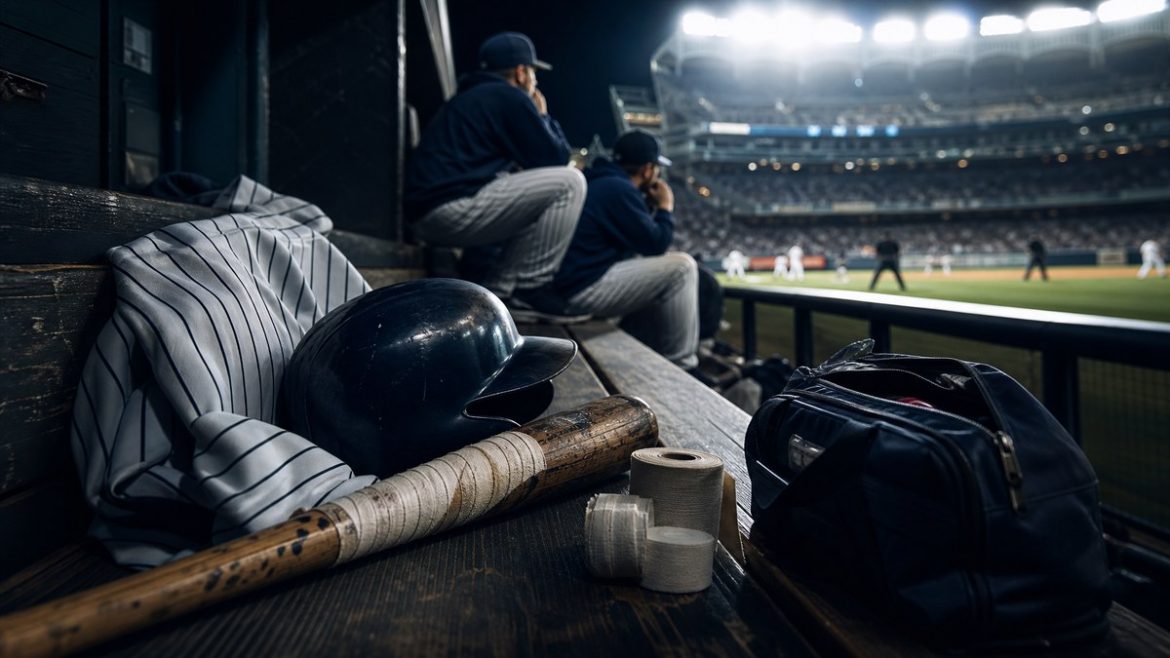
Aaron Judge has been placed on the injured list, leaving the New York Yankees without a firm timetable for their captain’s return as the regular season nears its conclusion. The immediate concern extends beyond the remaining games: According to CBS Sports, uncertainty surrounding the injury has placed Judge’s availability for the MLB playoffs in question.
Aaron Judge injury arrives at a critical point for the Yankees
Judge’s move to the injured list comes at one of the least forgiving stages of the baseball calendar. With the postseason approaching, the Yankees have limited time to evaluate his recovery, determine when he can resume baseball activities and assess whether he can return without exposing himself to a setback.
CBS Sports reported over the weekend of Sept. 19 that Judge had been placed on the IL and that his return timeline remained unclear. The absence of a defined target date is significant because late-season injuries compress every step of the recovery process. A player must not only improve medically, but also regain the timing and workload tolerance needed to face major-league pitching.
For the Yankees, there is no direct replacement for Judge’s overall influence. He occupies a central place in the batting order, changes how opposing pitchers approach the hitters around him and provides the type of power capable of altering a game with one swing. His status as team captain also makes his absence more prominent inside a clubhouse preparing for high-pressure games.
The injured-list transaction provides New York with an active-roster opening, allowing the club to bring in another available player while Judge is sidelined. That move can address the numerical shortage, but it cannot reproduce the same lineup presence. The Yankees instead must spread the available plate appearances and defensive responsibilities across several players while maintaining enough flexibility for Judge’s possible return.
Why the uncertain return timeline matters for the MLB playoffs
An injured-list placement does not by itself eliminate a player from postseason consideration. The more important questions are how quickly Judge responds to treatment, when he can safely resume activity and whether enough time remains for him to prepare for playoff competition. Those decisions will be driven by medical evaluations rather than the importance of any single game.
The timing also complicates the distinction between being medically cleared and being fully game-ready. Even after an injury has improved, a hitter must recover his rhythm against high-velocity pitching and breaking balls. That challenge can be greater after a period without regular at-bats, particularly when the next assignment could involve postseason pitching rather than a gradual return during the middle of the schedule.
New York must therefore prepare for more than one possibility. Judge could return before the regular season ends, become available at some point during the playoffs or remain sidelined longer than the club hopes. With no firm timetable reported, the Yankees cannot responsibly build their plans around only the most favorable outcome.
Yankees must adjust their lineup without Judge
The first baseball consequence is a reworked batting order. Judge normally commands considerable attention from opposing pitchers, and his presence affects pitch selection throughout the lineup. Without him, other Yankees hitters will be asked to take on larger run-producing roles rather than simply moving up one spot and attempting to imitate his approach.
Managerial decisions also become more fluid. The Yankees can use the opening to balance matchups, create opportunities for another outfielder or rotate players through the designated hitter role. The precise arrangement may change based on the opposing starter, defensive needs and the health of the rest of the roster.
That flexibility, however, comes with a trade-off. A stable lineup allows hitters to become comfortable with their responsibilities, while Judge’s uncertain status requires the club to remain ready for another major adjustment. If he returns, New York will have to decide how quickly to restore his normal workload. If he does not, the temporary configuration effectively becomes the postseason plan.
The Yankees also must resist allowing the uncertainty around one player, even one as important as Judge, to dominate each day. Their remaining games still carry immediate competitive consequences. The club’s position players and pitching staff must continue operating without knowing exactly when the captain will be back.
Judge’s recovery must take priority over the calendar
The shrinking schedule naturally creates urgency, but the Yankees cannot treat the calendar as the only factor in the decision. Bringing Judge back before he is prepared could compromise his performance or increase the possibility of aggravating the injury. Waiting longer may cost him games, but it could also improve the chances that he remains available once activated.
That balance is especially important in October, when recovery time between games is limited and every plate appearance carries additional weight. A postseason return would require confidence that Judge can handle the demands of hitting, running the bases and, depending on his role, playing defense. The Yankees may also have to consider whether a reduced or modified workload is practical.
Until the team or Judge provides a more specific timetable, any projection about a return date would be premature. The next meaningful developments will be medical updates and evidence that he has resumed baseball work. Those markers will offer more information than the original roster transaction alone.
New York prepares for multiple postseason scenarios
The Yankees’ broader challenge is to stay competitive while preserving options. They need enough coverage on the active roster to finish the regular season, but they also must consider how the group would look if Judge becomes available. Postseason planning usually involves defined roles and carefully arranged matchups; this injury leaves one of the most important roles unresolved.
If Judge returns, questions will remain about his readiness and how quickly he can resume a prominent place in the lineup. If his absence continues, New York will need collective production rather than expecting one hitter to replace him. Either scenario requires preparation before the club receives a definitive medical answer.
For now, the central fact is straightforward: Judge is on the injured list, the Yankees do not have a publicly established return timeline, and the playoffs are close enough for that uncertainty to matter. New York’s postseason outlook will depend partly on how its captain progresses and partly on how effectively the rest of the roster responds while he is unavailable.