
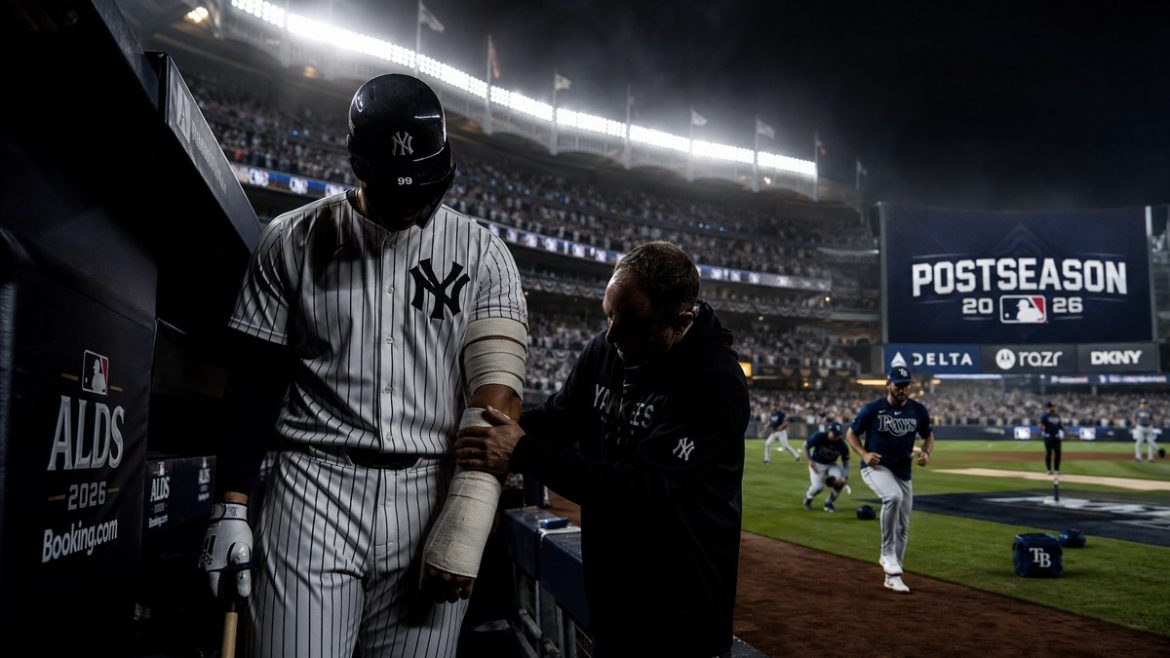
Aaron Judge’s injury status has become a central question for the New York Yankees as they prepare to face the Tampa Bay Rays in the 2026 MLB playoffs. A report published Saturday linked Judge to new rumors and an updated injury situation, but the available report summary did not provide a confirmed diagnosis, a recovery timetable or a definitive declaration about whether the Yankees captain will play.
Aaron Judge’s status remains the key Yankees question
The uncertainty is significant because Judge occupies a unique place in the Yankees’ lineup and clubhouse. He is the team’s captain, a middle-of-the-order hitter and an outfielder whose availability affects decisions on both sides of the ball. Any physical limitation involving Judge can force New York to reconsider its batting order, defensive alignment and bench construction during a postseason series.
The initial report, published by Bleacher Report on Oct. 3, described the development as an update on Judge’s injury status before the Yankees’ playoff matchup with Tampa Bay. However, the information supplied with the report did not identify the nature or severity of the issue. It also did not include an official roster move or a final game designation from the Yankees.
That distinction matters during the postseason, when speculation can move more quickly than confirmed medical information. Until the Yankees or Judge provides a specific update, claims about the exact injury, his ability to play or the possibility of a roster change should be treated as unconfirmed. The report establishes that his condition is being monitored, but it does not, on its own, settle his availability.
Yankees lineup decisions depend on Judge’s availability
If Judge is cleared without meaningful restrictions, the Yankees can build their lineup around their most prominent power hitter and maintain a more familiar structure. His presence influences how opposing pitchers navigate the surrounding hitters, particularly when runners are on base or when New York has an opportunity to create a multi-run inning.
If he is available only in a limited role, the Yankees would face a different set of decisions. Managerial options could include using Judge as the designated hitter, adjusting his defensive workload or selecting particular situations in which to deploy him. Those possibilities are roster-management considerations rather than indications of the team’s actual plan, which had not been confirmed in the source material.
A complete absence would have broader consequences. New York would need another player to assume Judge’s lineup position, while the rest of the batting order could shift to balance power, on-base ability and matchup considerations. The outfield alignment might also change depending on which reserve or regular takes on additional responsibility.
Postseason games often magnify the loss of a central hitter because clubs have fewer opportunities to absorb an unproductive offensive stretch. Managers also tend to use their best relievers more aggressively, making every difficult plate appearance more important. A healthy Judge gives New York another proven threat against that kind of concentrated pitching strategy.
Rays preparation could change with an official update
Tampa Bay’s planning will also be affected by the eventual decision. The Rays’ pitching approach with Judge in the lineup would naturally differ from a plan created for a Yankees order without him. His spot in the batting order can influence bullpen timing, intentional matchup choices and how carefully pitchers attack the hitters immediately ahead of and behind him.
The Rays, however, cannot base their preparation entirely on public speculation. Teams routinely account for multiple possible lineups when an opposing player’s status is unsettled. Tampa Bay’s staff can prepare one plan for a full-strength Judge, another for a limited designated-hitter role and a third for an order that does not include him.
That flexibility is especially relevant between American League East opponents. The Yankees and Rays are familiar with each other’s personnel and organizational tendencies, although postseason conditions can produce different decisions than a regular-season series. Shorter pitching hooks, more frequent bullpen matchups and increased use of bench players can alter even a familiar divisional contest.
Postseason roster rules raise the stakes of an injury
Injury management becomes more complicated once a postseason series begins. Clubs must weigh a player’s present ability against the possibility that his condition could improve or worsen over the course of the round. With a player as important as Judge, the Yankees must consider not only whether he can appear but whether he can perform effectively and avoid aggravating the issue.
Replacing an injured player on a postseason roster is not the same as making a routine substitution during the regular season. MLB has specific procedures governing injury replacements and a player’s eligibility for later rounds. Because no Judge transaction was identified in the available report information, there is no basis to conclude that New York has chosen that route.
The Yankees’ final decision could come through an official lineup, a roster announcement or a direct update from the club. Medical clearance is only one part of the process. The team must also assess Judge’s ability to run, swing, throw and handle the repeated demands of a playoff game. A player may be technically available while still requiring workload management.
Those evaluations can continue close to game time. Batting practice, pregame running and defensive work can provide information that is not available during an earlier media update. That is one reason clubs sometimes avoid making an immediate declaration when a prominent player is dealing with a physical issue.
Confirmed information should guide the Judge injury story
For now, the most important point is that Judge’s health is a live issue before the Yankees-Rays playoff matchup, while the precise medical details and his game status remain unclear in the information provided. No responsible conclusion can be reached about his role until the Yankees issue an update or submit a lineup and roster that clarify their plans.
The attention surrounding Judge is understandable. Few individual availability decisions have the potential to reshape New York’s lineup as substantially. But postseason urgency does not make unverified reports more reliable. A confirmed diagnosis, an official roster decision or a statement from the club would provide a firmer basis for assessing the competitive impact.
Until then, New York must prepare for several scenarios, and Tampa Bay must do the same. Whether Judge plays without restrictions, appears in a modified role or is held out will affect personnel choices throughout the matchup. His official status, rather than the surrounding rumors, will determine how much the Yankees need to alter their postseason plan.