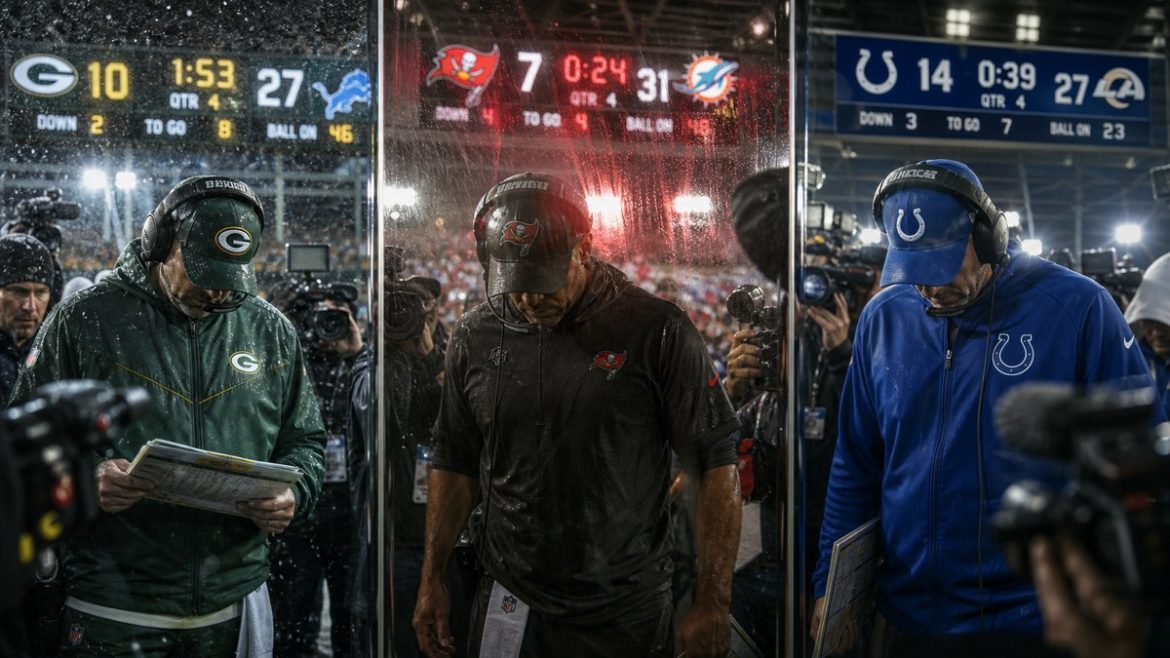
Matt LaFleur, Todd Bowles and Shane Steichen have emerged as three NFL head coaches facing heightened early-season scrutiny, according to reports published Friday. The circumstances differ in Green Bay, Tampa Bay and Indianapolis, but the common issue is whether each team is showing enough progress to support its current direction.
Matt LaFleur faces rising expectations with the Green Bay Packers
LaFleur’s inclusion is notable because his Green Bay tenure has included sustained regular-season success and multiple playoff appearances. He took over in 2019 and immediately led the Packers to three consecutive 13-win seasons, reaching the NFC championship game in each of his first two years.
Those early results established a high standard, but they also created a complicated measuring stick. Green Bay was unable to convert its strongest regular seasons into a Super Bowl appearance, and the franchise later entered a significant transition when longtime quarterback Aaron Rodgers was traded to the New York Jets in 2023.
LaFleur then had to reshape the offense around Jordan Love and a younger group of skill-position players. That transition brought encouraging stretches and demonstrated that the Packers could remain competitive after changing quarterbacks. It also shifted more responsibility toward the coaching staff’s development program, offensive design and week-to-week consistency.
The current scrutiny is therefore about more than a short run of results. Green Bay’s decision-makers must evaluate whether the team is progressing from a promising transition into a dependable contender. LaFleur’s offensive background and previous record give him a stronger résumé than many coaches commonly associated with job uncertainty, but past success does not permanently insulate an NFL coach from questions.
For LaFleur, the most important indicators will be whether the offense operates consistently, whether the Packers respond effectively to in-game adjustments and whether the roster’s younger players continue developing. Green Bay has historically emphasized stability, so any eventual coaching decision would carry significance beyond a normal early-season reaction.
Todd Bowles is judged on Tampa Bay’s ability to sustain success
Bowles occupies a different position with the Tampa Bay Buccaneers. He succeeded Bruce Arians as head coach in 2022 after serving as the team’s defensive coordinator, including during Tampa Bay’s championship season following the 2020 campaign.
His tenure began during the final season of Tom Brady’s playing career and continued through another major quarterback transition. That sequence required Bowles and the Buccaneers to manage changing expectations while trying to remain competitive in the NFC South.
Bowles also entered the Tampa Bay job with previous head-coaching experience. He coached the New York Jets from 2015 through 2018, giving him a broader résumé than a first-time head coach learning the position. His defensive expertise remains central to his identity, and Tampa Bay’s performance in that phase naturally carries added weight when his work is assessed.
The standard for Bowles is no longer simply keeping the Buccaneers functional after the Brady era. Division contention and postseason appearances raise expectations. Once a team demonstrates that it can compete for January football, the evaluation turns toward whether it can become more complete, avoid extended lapses and challenge stronger opponents outside its division.
That makes Tampa Bay’s overall balance particularly important. A defensive-minded head coach is still responsible for the entire operation, including offensive efficiency, game management, penalties and special teams. The Buccaneers’ response to difficult stretches will help determine whether the organization views its current structure as capable of producing further postseason progress.
Shane Steichen’s Indianapolis Colts tenure centers on development
Steichen’s situation in Indianapolis is shaped by his status as the least experienced head coach of the three. The Colts hired him in 2023 after he served as offensive coordinator for the Philadelphia Eagles, whose offense helped carry the team to Super Bowl LVII.
Indianapolis brought Steichen in to help build a sustainable offense and develop a long-term answer at quarterback. His first season showed immediate competitiveness: the Colts finished 9-8 and remained in playoff contention until the final week despite injuries and lineup changes.
The broader challenge has been turning flashes of offensive promise into stable progress. Quarterback development is rarely linear, particularly when injuries or availability disrupt practice time and game repetitions. Nevertheless, coaches hired for their offensive expertise are ultimately evaluated on whether their system makes the quarterback and surrounding personnel more effective.
Steichen’s evaluation also extends beyond play design. The Colts must show sound situational football, disciplined execution and improvement across the roster. Indianapolis has spent several seasons searching for lasting stability at the sport’s most important position, and that history adds urgency whenever the offense struggles to establish a clear identity.
Because Steichen is still relatively early in his head-coaching career, the Colts must weigh continuity against the need for tangible results. Development requires patience, but NFL timelines can contract quickly if losses accumulate or if recurring problems remain unresolved.
Early-season NFL coaching pressure requires context
The phrase “hot seat” is an informal description rather than an official designation. None of the cited reports represents an announcement from the Packers, Buccaneers or Colts about a coaching change. It instead reflects external scrutiny surrounding results, expectations and each franchise’s trajectory.
September evaluations can also be unstable. NFL seasons are long enough for teams to correct early weaknesses, but short enough that several poor performances can have lasting playoff consequences. Injuries, schedule strength and roster turnover can affect initial results, making it important to distinguish temporary problems from structural ones.
LaFleur, Bowles and Steichen are not facing identical standards. LaFleur is measured against the success he established in Green Bay and the expectation of building another championship-level team. Bowles must demonstrate that Tampa Bay can sustain and expand its post-Brady competitiveness. Steichen is responsible for turning Indianapolis’ developmental plan into consistent winning football.
The next phase of the season will provide more meaningful evidence than a label attached in September. Performance against quality opponents, player development, injury management and the ability to correct repeated mistakes will influence how all three coaches are viewed. Until their clubs or team officials indicate otherwise, the immediate story is increased pressure—not a confirmed change.