As the NBA postseason intensity reaches a fever pitch, the Western Conference finds itself at a fascinating crossroads in Phoenix. The Oklahoma City Thunder, the defending champions and current gold standard of the “small-ball” revolution, enter Monday night with a chance to break out the brooms. For the Phoenix Suns, this isn’t just about survival; it’s about preventing a narrative of decline after being swept in the first round for the second consecutive year.
The dynamics of a Game 4 “close-out” game are unique. You have a young, hungry Thunder squad looking to maximize rest before the second round, clashing with a veteran Suns core that is battered but still dangerous on their home floor. With the total set at a relatively modest 213.5, the betting market is bracing for a defensive grind, but the data suggests a different story might be unfolding.
The Thunder: A Symphony of Efficiency
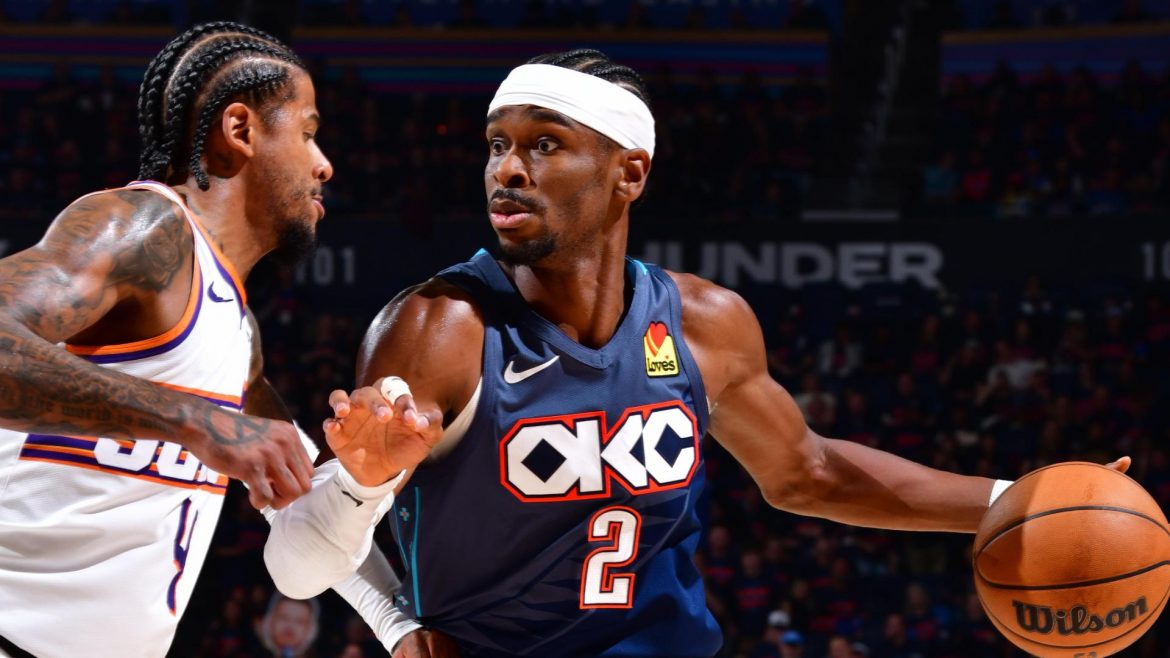
Oklahoma City is no longer the “team of the future”—they are the masters of the present. Their performance in Game 3 was a masterclass in offensive efficiency, spearheaded by reigning MVP Shai Gilgeous-Alexander. SGA’s 42-point masterpiece wasn’t just about volume; it was about surgical precision, hitting 15 of his 18 shots.
When analyzing the Thunder’s form, the most striking metric is their True Shooting Percentage (TS%), which has hovered near league-leading levels throughout the playoffs. Even without Jalen Williams, who is sidelined with a hamstring injury, OKC’s “Next Man Up” philosophy is bolstered by the veteran presence of Alex Caruso. Caruso’s defensive Rating (DefRTG) remains elite, but it is his ability to hit timely corner threes that keeps the spacing pristine for SGA’s drives.
The Thunder’s strength lies in their transition game. They currently rank in the 90th percentile for points per possession in transition. In Game 4, expect them to push the pace early to test the lateral mobility of Phoenix’s injured stars. If OKC can replicate their Game 3 performance of forcing 12+ turnovers, the game could get away from Phoenix quickly.
The Suns: Pride, Pain, and Perimeter Shooting
The Phoenix Suns are effectively a wounded animal. ESPN reports suggest that while Devin Booker and Grayson Allen will suit up, neither is playing at 100% capacity. Booker’s left ankle injury in the third quarter of Game 3 clearly hampered his explosive first step, limiting him to a series-low output.
However, there is a silver lining in the desert: Dillon Brooks. Often criticized for his shot selection, Brooks has found a rhythm, torching the Thunder for 63 points over the last two contests. His 43% clip from behind the arc in this series has been the only thing keeping the Suns’ offensive rating respectable.
For Phoenix to win—or even cover—they must dominate the “math game.” Without big man Mark Williams to provide rim protection and second-chance points, Phoenix is forced to live and die by the three. Their situational form at home is notably better than on the road, where they shoot 4% higher from the perimeter at the Footprint Center. The desperation of a 3-0 deficit often leads to a “nothing to lose” shooting mentality, which historically inflates scoring totals in elimination games.
Matchup Analysis: Tactical Edges
The chess match between Thunder coach Mark Daigneault and Suns interim leader Jordan Ott is reaching its endgame. Daigneault has successfully used a “drop coverage” scheme that dares Phoenix’s mid-range specialists to beat them from 20 feet out. Since Booker and Allen are dealing with lower-body injuries, their ability to elevate on those contested mid-range jumpers has diminished.
The key battle tonight is the Suns’ backcourt vs. OKC’s perimeter pressure. If Caruso and Lu Dort can navigate screens without fouling, they can turn Phoenix into a stagnant, isolation-heavy offense. On the flip side, if Phoenix can move the ball as they did in the second quarter of Game 3, they can exploit the gaps left by the absence of Jalen Williams.
According to NBA.com, the Thunder lead the playoffs in Deflection Rate. This suggests that even when they aren’t getting blocks, they are disrupting the rhythm of the opposing offense. For the Suns to stay alive, they need a “vintage” Booker game—one where he ignores the pain and hunts for 35+ points.
Betting Insights & Trend Analysis
The betting public is heavily leaning toward the Thunder to cover the small spread, but the real value lies in the Over/Under 213.5.
-
Trend Watch: In the last five instances where a defending champion held a 3-0 lead, the Over has hit four times in Game 4. Teams often relax defensively when they have a cushion, while the trailing team plays at a frantic, desperate pace.
-
Situational Angle: The Suns are allowing 118 points per game in this series. Even with a sluggish offense, their defensive lapses against SGA’s drives almost guarantee a high floor for OKC’s scoring.
-
The “Push” Factor: As noted in recent sports betting evaluations, bettors should remember that “pushes” are essentially non-events in bankroll management—but at 213.5, a hook (.5) ensures a decisive result.
Final Prediction: The “Over” is the Play
While the Thunder are the superior team and likely to complete the sweep, the 213.5 total feels reactionary to the Suns’ injury report. Even a hobbled Devin Booker and a streaky Dillon Brooks provide enough offensive gravity to push this game into the 110-110 range.
OKC is scoring at will. Shai Gilgeous-Alexander is in a zone where the rim looks like an ocean. Phoenix, facing the end of their season, will likely abandon their structured half-court sets for a more chaotic, high-volume shooting approach to try and catch lightning in a bottle.
The Pick: OVER 213.5