
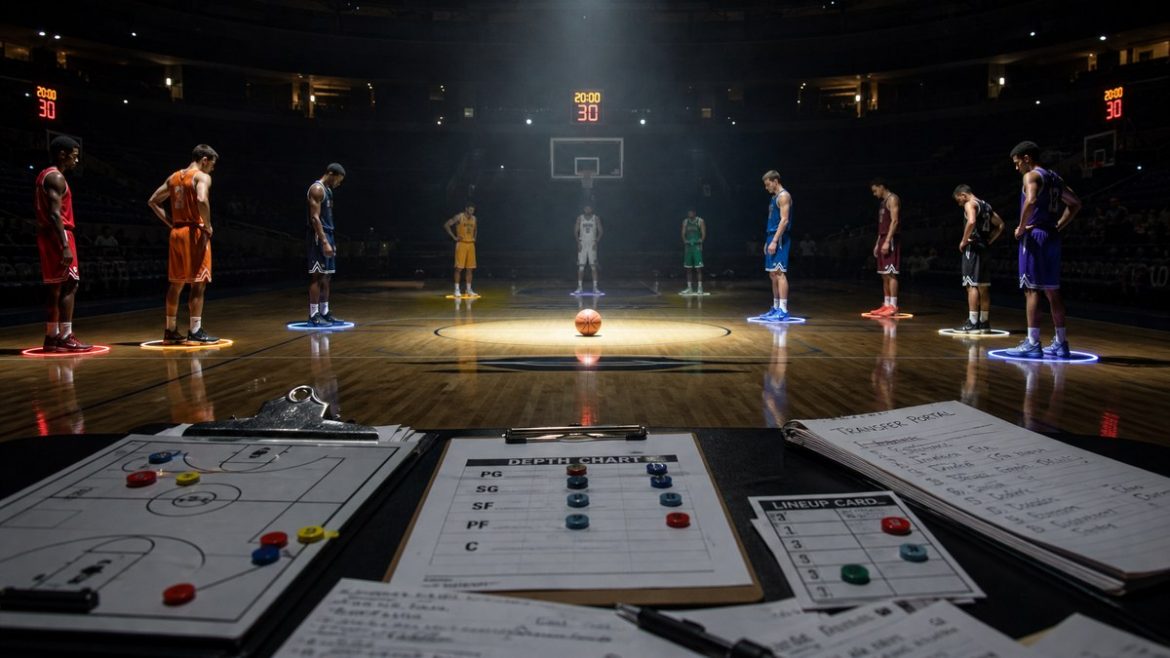
With the 2026-27 college basketball season approaching, 247Sports has published a report identifying 10 X-factors to monitor across the sport. The preseason exercise matters because team outlooks are increasingly tied not only to established stars, but also to roster integration, player development, health and the allocation of roles on teams rebuilt during the offseason.
College basketball preseason evaluation moves beyond roster names
The 247Sports report, published Tuesday, places the focus on variables that could influence the direction of the coming season. Rather than treating the preseason as a simple ranking of the most talented rosters, an X-factor approach examines the unresolved questions that often separate successful teams from those that fall short of expectations.
That distinction is significant in modern college basketball. A roster can look complete on paper and still enter the season with uncertainty about lineup combinations, defensive assignments, shooting distribution or late-game responsibilities. Conversely, a team without the same level of preseason recognition can improve quickly if returning players make developmental gains or newcomers settle into productive roles.
Preseason rankings and individual honors provide an early snapshot, but they cannot account for every change that occurs once practices and games begin. Coaches must determine which groups function effectively together, how much responsibility young players can handle and whether experienced additions can translate previous production into a new system. Those decisions can affect results well before conference play.
The report’s timing also reflects the transition from offseason roster construction to on-court evaluation. By late October, attention begins to shift from which players joined or left a program to how the assembled pieces will fit. The next stage is less about transactions and more about execution, chemistry and the ability to respond when initial plans require adjustment.
Roster continuity and newcomer integration remain central variables
College basketball teams now regularly combine returning players, transfers and first-year prospects. Each group arrives with a different level of familiarity. Returnees understand a program’s terminology and daily expectations, while newcomers may bring experience or talent without an established role in the new environment. How quickly those groups become a coherent rotation is one of the broad questions surrounding any season.
Continuity can provide a useful foundation, particularly in close games when communication and decision-making become more important. It does not guarantee success, however. Returning teams still need players to expand their games, accept changing responsibilities and address weaknesses exposed during the previous season. Experience is most valuable when it leads to better execution rather than simply a familiar lineup.
Transfers present a different evaluation challenge. Past statistics offer evidence of what a player has done, but role, competition, pace and surrounding personnel can change after a move. A high-usage scorer may be asked to distribute more often, while a former complementary player may receive additional offensive responsibility. Defensive fit can be just as important, especially for teams attempting to play a different style than a newcomer’s previous program.
Freshmen add another layer of uncertainty. Recruiting evaluations measure long-term potential, but immediate college production depends on physical readiness, defensive awareness and the ability to make decisions against older opponents. Some first-year players earn major assignments quickly. Others contribute in narrower roles while developing the consistency required for extended minutes.
Defined roles can determine how quickly contenders develop
One of the most important preseason tasks is establishing a workable hierarchy without limiting competition. Teams need clarity about primary ball-handlers, interior responsibilities and which players will be trusted in high-leverage possessions. Those roles are not always settled before opening night, and they can continue evolving as coaches gather evidence from nonconference games.
Backcourt organization is especially important because guards often control tempo and initiate offense. A team may have several capable scorers but still need a dependable decision-maker who can limit empty possessions and create quality attempts late in games. Frontcourt roles require similar definition, from rebounding and rim protection to screening, spacing and defending away from the basket.
Depth also becomes meaningful only when players can fill specific assignments. A long bench may appear to be an advantage, but coaches still must identify combinations that preserve offensive spacing and defensive balance. Rotation decisions can change because of performance, foul trouble, injuries or matchup demands, making adaptability an essential part of a team’s development.
Availability remains another unavoidable variable. Even short absences can alter a rotation during the early season, when teams are still building timing and identifying their preferred units. Programs with flexible personnel may be better positioned to redistribute minutes, but replacing a central playmaker, rebounder or defender often requires broader tactical changes rather than a direct substitution.
Nonconference games will provide the first evidence
The first weeks of the season will begin answering the questions raised by preseason X-factor discussions. Nonconference schedules give coaches a chance to test lineups and evaluate players in competitive settings, but the results also count toward a team’s overall body of work. That creates an immediate tension between experimentation and the need to win.
Early games can reveal whether projected strengths are translating to the floor. Shooting, rebounding and defensive performance can fluctuate over small samples, so one result rarely provides a complete judgment. Repeated patterns are more informative: persistent turnover issues, difficulty finishing defensive possessions or an inability to generate efficient offense against different coverages can point to problems requiring structural changes.
Conference play brings another level of familiarity. Opponents study tendencies, personnel and preferred actions, forcing teams to develop counters. An X-factor that appears promising in November may become less effective once scouting intensifies, while a player in a modest early role can emerge after demonstrating consistency in practice and games.
March outcomes often depend on questions answered during the season
The NCAA Tournament’s single-elimination format naturally draws attention to star performances, but postseason readiness is usually built over months. Teams must learn how to handle different styles, protect possessions and execute under pressure. Development in those areas can matter as much as a roster’s initial reputation.
That is why preseason X-factors offer a useful framework without serving as final conclusions. They identify uncertainty rather than eliminate it. The 2026-27 season will determine which players, lineup decisions and tactical adjustments become genuinely consequential, and which preseason concerns fade once games provide clearer evidence.
For now, the 247Sports report marks another step in the sport’s move toward opening night. Rosters have been assembled and expectations are taking shape, but the most important evaluations will come when teams begin revealing how effectively their personnel, experience and coaching plans work together.