
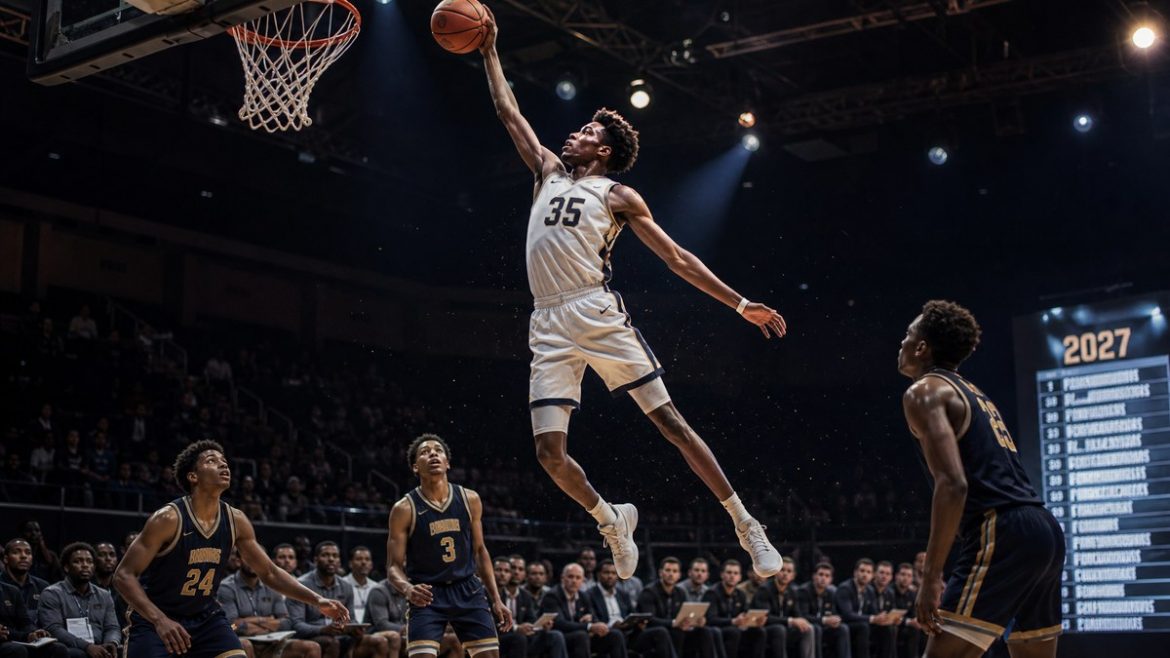
Arafan Diane has emerged as a name to monitor in early coverage of the 2027 NBA Draft, with a scouting feature distributed Thursday across several local news websites. The attention places Diane on the long-range prospect radar, but it should not be confused with a formal draft decision or an established projection this far from the event.
Arafan Diane enters the early 2027 NBA Draft conversation
The same scouting-report headline identifying Diane as a 2027 NBA Draft prospect appeared on the websites of KVUE, WGRZ, KAGS and KSDK on Oct. 15. Each item carried the same publication time, indicating that the coverage was distributed across multiple stations rather than produced as four independent evaluations.
That distinction matters when measuring the breadth of the attention. Diane has clearly become the subject of public draft discussion, but the cluster of matching reports should be treated as one piece of syndicated scouting coverage. It does not represent a consensus among NBA teams, independent evaluators or separate news organizations.
The available listings also do not establish that Diane has declared for the draft, received a formal evaluation from the NBA or made any binding decision about his future. The 2027 draft remains well ahead, leaving considerable time for his development, competitive role and eligibility circumstances to evolve.
For now, the most concrete development is simply that Diane’s name has entered the wider NBA prospect cycle. That is notable for a player being discussed on such a distant timeline, even if the substance of the evaluation will require far more evidence.
Why early NBA Draft scouting requires caution
Long-range draft coverage serves a useful purpose by identifying players who may possess tools worth following. It also comes with obvious limitations. Evaluators working years in advance must project how a player’s body, skill level, decision-making and role will change before he is eligible and ready to face NBA competition.
Those variables can move in different directions. A physically advanced player may attract attention before his offensive game or defensive awareness is fully developed. Another prospect may improve rapidly once given a larger role, better spacing or more demanding competition. Injuries, roster changes and coaching decisions can also reshape a player’s path.
That is why an early “prospect” designation is best understood as an invitation to continue evaluating rather than a prediction of where a player will be selected. NBA scouting departments build files over time, revisiting prospects through live viewings, video analysis, background work, interviews and medical information. A public report this early can identify a starting point, but it cannot reproduce that full process.
No reliable draft position for Diane is established by the supplied reports. There is also no basis in the source material to describe him as a likely lottery selection, first-round choice or certain draft entrant. Those conclusions would go beyond what has been reported.
Development will shape Diane’s eventual NBA outlook
The next stages of Diane’s career will provide the information needed for a more complete evaluation. Scouts generally look beyond size and athletic traits when studying frontcourt prospects, examining whether those physical advantages translate into repeatable production and winning decisions.
Offensively, future assessments will need to consider Diane’s efficiency near the basket, touch, screening, passing reads and ability to operate when defenses force him away from preferred areas. Ball security is another important measure for developing big men, especially when they catch in traffic or are asked to make quick decisions against double-teams.
Defensively, evaluators will study positioning, rim protection, rebounding technique and mobility in space. Modern NBA centers are frequently required to defend several actions within the same possession. They may begin near the basket, step toward a ball handler and then recover to a rolling player or rebounder. Physical dimensions can help, but timing and recognition often determine whether those tools are effective.
Consistency will be central to the process. A short run of strong performances can raise interest, but teams eventually want to see how a prospect responds to different opponents, changing assignments and increased expectations. They also evaluate effort away from the ball, communication and the ability to avoid unnecessary fouls.
The current reports do not supply enough verified performance data to reach firm conclusions in those areas. As a result, Diane’s standing should remain open rather than fixed. His eventual profile will depend on what he shows over an extended period, not solely on the early visibility created by one scouting feature.
The 2027 NBA Draft picture remains unsettled
Draft classes are rarely clear several years in advance. Some players identified early remain prominent throughout the cycle, while others need more development time or follow a different route. New candidates also emerge once they receive larger roles and face stronger competition.
Eligibility is another reason to avoid treating a future draft list as final. Prospects must meet NBA rules before entering, and individual timelines can vary according to age, education and playing background. Until a player formally enters the process, references to a particular draft year are generally projections based on an anticipated path.
The NBA’s own assessment will come much later. Teams do not publish their draft boards, and public rankings are produced independently of front offices. Even when outside evaluators agree that a player is talented, organizational priorities can differ based on roster construction, coaching systems and long-term development plans.
Diane’s appearance in 2027 coverage therefore represents an early marker, not a final judgment. It gives observers a reason to follow his progress and compare future performance with the traits that initially generated attention.
What comes next for Arafan Diane
The responsible approach is to track Diane’s development as more verified information becomes available. Future evaluations should be grounded in his actual role, level of competition, production and improvement rather than the scale of the headline attached to the initial report.
More detailed coverage may eventually clarify his strengths, developmental priorities and projected position. It may also provide the biographical and competitive context needed to understand where he stands relative to other players in the 2027 pool.
For now, Diane is an early name in a draft class that remains far from settled. The scouting attention is meaningful because it introduces him to a broader NBA audience. The larger conclusions—whether he will enter in 2027, how teams will evaluate him and where he might be selected—must wait for a much more substantial body of evidence.
Sources
- Arafan Diane is a GIANT 2027 NBA Draft Prospect | 2027 NBA Draft Scouting Report — KVUE
- Arafan Diane is a GIANT 2027 NBA Draft Prospect | 2027 NBA Draft Scouting Report — WGRZ
- Arafan Diane is a GIANT 2027 NBA Draft Prospect | 2027 NBA Draft Scouting Report — KAGS
- Arafan Diane is a GIANT 2027 NBA Draft Prospect | 2027 NBA Draft Scouting Report — KSDK