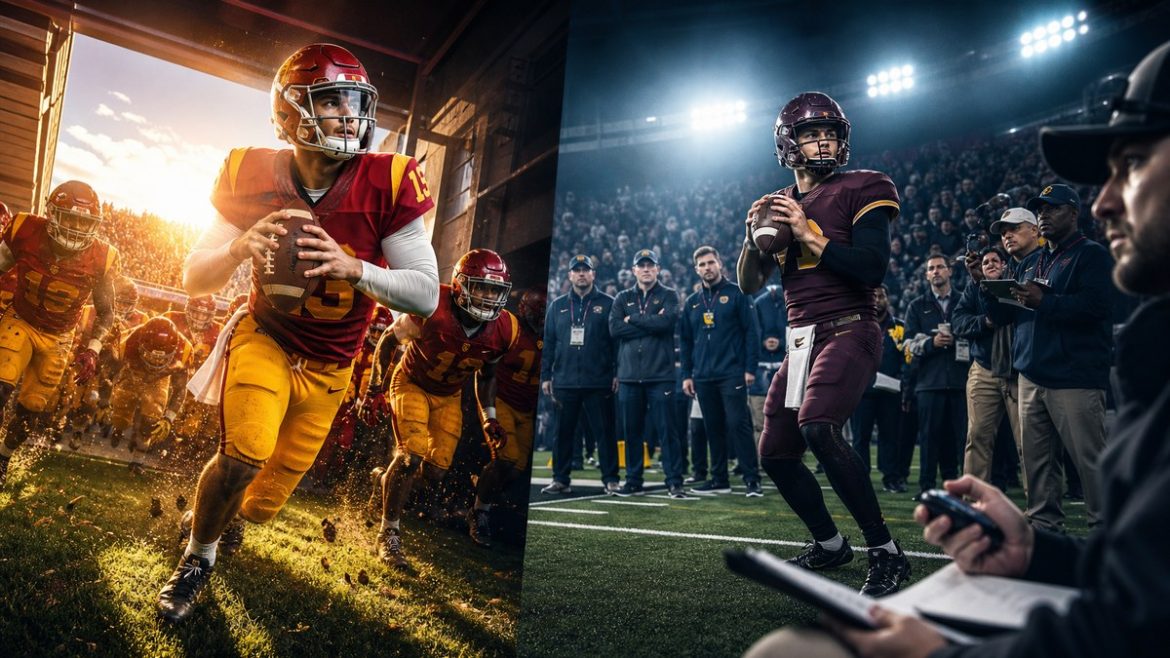
USC quarterback Jayden Maiava has emerged as a central figure in the Trojans’ strong start, while Minnesota quarterback Drake Lindsey is reportedly making an early impression on NFL Draft scouts. The developments matter because both players are entering the broader professional evaluation conversation, although the scouting process remains preliminary and neither an early-season run nor a favorable report represents a final NFL judgment.
Jayden Maiava puts USC offense in the NFL Draft spotlight
Maiava’s role in USC’s opening stretch has placed him among the college quarterbacks attracting increased attention. Reports published Wednesday identified him as the player headlining the Trojans’ hot start, adding another layer of interest to a program that is regularly examined by NFL evaluators.
The USC quarterback arrived in Los Angeles after beginning his college career at UNLV. That path has exposed him to different offensive environments and levels of competition, experience that can be useful when evaluators study how a player processes change. For scouts, a transfer history is not automatically positive or negative. It offers additional tape and raises questions about how quickly a quarterback can absorb terminology, adjust to personnel and operate within a new structure.
Maiava’s early results with USC are significant primarily because quarterback evaluation depends on sustained command. Scouts will study more than whether the Trojans continue winning. They will review his timing, decisions under pressure, accuracy to different areas of the field and ability to keep the offense functioning when the initial play breaks down.
USC also brings a level of visibility that can accelerate the discussion surrounding a quarterback. The Trojans play a high-profile schedule, and their games routinely receive close attention from professional personnel departments. That exposure does not guarantee a favorable evaluation, but it gives Maiava repeated opportunities to provide evidence against major competition.
Drake Lindsey begins to register with NFL evaluators
Lindsey’s inclusion in the same reports is notable for a different reason. The Minnesota quarterback is reportedly impressing NFL Draft scouts, an indication that his recent work has prompted evaluators to monitor his development more closely. The available reports do not establish a league-wide consensus, a formal draft grade or a decision about when Lindsey might pursue the NFL.
That distinction is important. NFL teams begin tracking quarterbacks well before those players formally enter a draft. Area scouts gather background information, evaluate practices and games, and compare notes with cross-checkers and senior personnel executives. A player can therefore attract professional interest without being viewed as an immediate draft candidate.
For Lindsey, the next phase is likely to be about consistency. Evaluators generally want to see whether a young quarterback can repeat sound decisions from week to week, respond after mistakes and remain efficient as opposing defenses build more detailed plans to stop him. Early success often leads defensive coordinators to change coverages, pressure patterns and pre-snap disguises. How a quarterback handles those adjustments can be more revealing than an isolated productive performance.
Minnesota’s offensive context will also be part of the study. Scouts separate a quarterback’s individual work from the design of the offense, accounting for protection, receiver play, route concepts and the difficulty of each throw. They will be interested in Lindsey’s responsibility before the snap, his progression work after it and his response when the structure around him is imperfect.
What NFL scouts will examine as the season develops
The reports surrounding Maiava and Lindsey represent the beginning of an evaluation process rather than its conclusion. Quarterbacks can rise into broader public view quickly, but NFL teams typically rely on a much larger body of evidence. Game film remains central, while live exposure, character research, medical information and interviews eventually contribute to a complete assessment.
Several areas will be particularly relevant as scouts continue their work:
- Decision-making: Evaluators will track how often each quarterback puts the ball in danger and whether he identifies favorable matchups before and after the snap.
- Accuracy and placement: Completion totals provide only part of the picture. Scouts examine whether passes allow receivers to maintain momentum and whether quarterbacks can throw accurately when moved from their preferred platform.
- Pressure response: NFL personnel departments want to know whether a passer remains composed against pressure, avoids unnecessary sacks and understands when to abandon a play.
- Offensive command: Communication, tempo management and the ability to make adjustments at the line help show how much responsibility a quarterback can handle.
- Weekly consistency: A full schedule tests whether promising traits remain visible against different opponents, schemes and game situations.
Those categories also explain why early reports should be viewed with perspective. A strong September can put a quarterback on more scouting lists, but it cannot answer every question. Opponents gain more current film as the season advances, forcing quarterbacks and coaching staffs to counter new approaches. The ability to adjust becomes part of the evaluation.
USC’s start gives Maiava a valuable evaluation window
Maiava currently has the more visible team storyline because USC’s start has created immediate national interest. If the Trojans remain successful, his handling of increasingly important games will receive close review. Scouts will be able to assess not only his physical tools but also his performance in high-leverage situations and his response to the week-to-week scrutiny attached to USC’s quarterback position.
The evaluation will not rest entirely on the team’s record. Quarterbacks can play well in losses and struggle in victories, which is why NFL evaluators grade individual decisions rather than relying solely on outcomes. Still, leading a successful offense can provide useful evidence of preparation, communication and control.
Lindsey’s situation offers a parallel test. Increased attention changes expectations, and future opponents will have more material with which to prepare. Maintaining his early impression will require continued growth rather than simply repeating what has already appeared on film.
Early NFL Draft attention is only a starting point
For now, the most supportable conclusion is that Maiava and Lindsey have given scouts reasons to keep watching. Reports characterize Maiava as a driving force behind USC’s opening run and Lindsey as a quarterback who has impressed professional evaluators. They do not provide a settled ranking between the two, and their different levels of experience make direct comparisons premature.
The coming weeks should provide a clearer view. More snaps will test their accuracy, judgment, durability and adaptability, while stronger opponent preparation will reveal how each responds when initial solutions no longer work. In quarterback scouting, that accumulation of evidence carries considerably more weight than any single game or early report.
Maiava has an opportunity to connect USC’s team success with a sustained individual case for NFL consideration. Lindsey, meanwhile, has entered the developmental conversation and can strengthen that position through consistent play. Both remain players to monitor, but their evaluations are still being written.
Sources
- WWLTV: Jayden Maiava headlines USC’s hot start, Drake Lindsey impresses NFL Draft scouts
- WFMY News 2: Maiava and Lindsey draw early attention
- WQAD: USC’s start and emerging NFL Draft quarterback evaluations