
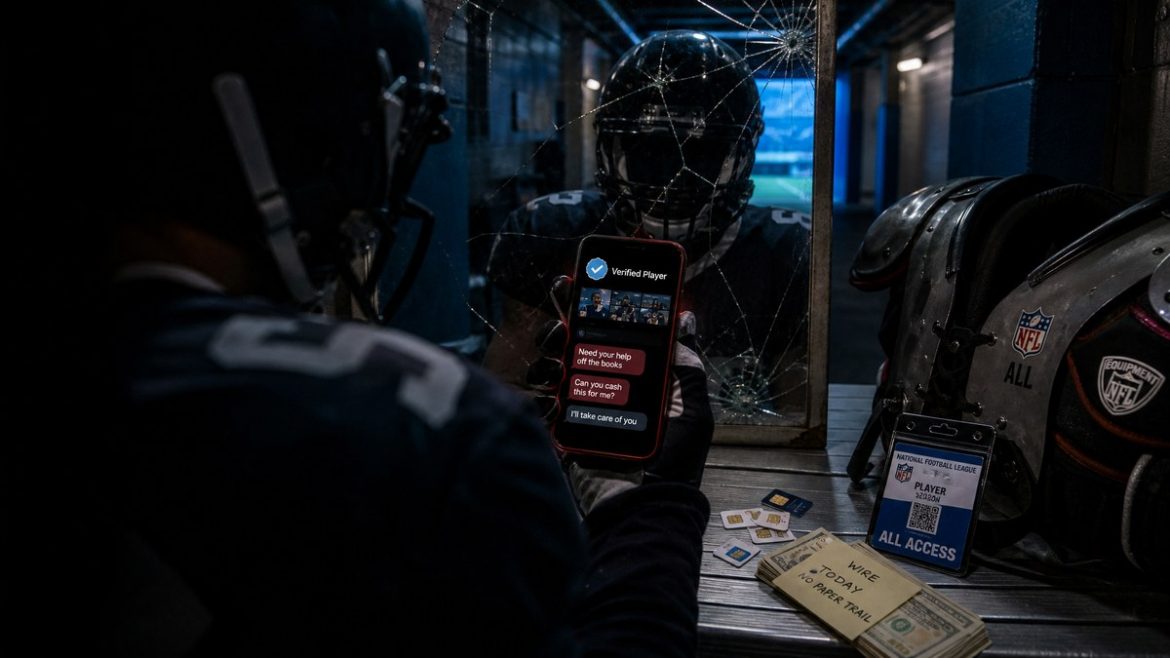
A syndicated consumer-news report published Monday, Sept. 7, highlighted a scheme involving someone presented as a fake NFL player, placing the case alongside warnings about student-loan schemes and deceptive “wrong number” text messages. The available reports do not identify a player, team or alleged impersonator, but the NFL connection matters because the league’s visibility gives fraudulent claims an immediate appearance of credibility.
Fake NFL player case appears in syndicated scam report
The report appeared across several local television news websites, including KREM, News Center Maine, WWL-TV, WUSA9, 12News and KCEN-TV. Each outlet published the same headline and brief description, indicating that the story was distributed as a broader consumer report rather than developed as separate coverage of an NFL team or player.
As presented in the available source material, the fake-player item was one part of a package covering several forms of deception. It was grouped with student-loan schemes and unsolicited messages that begin as supposed wrong-number texts. The summaries do not explain whether the person claimed to be an active player, a former player or a prospect, nor do they specify how the claimed NFL identity was used.
No team, player name, arrest, criminal charge or financial loss is identified in the supplied reports. There also is no listed response from the NFL, the NFL Players Association or a law-enforcement agency. Those omissions limit what can responsibly be concluded about the episode. At this stage, it should be described as a reported impersonation scheme involving a purported NFL player, not as misconduct by a real player or an official league disciplinary matter.
NFL identity can give an impersonation scheme credibility
The league’s public profile creates a recognizable framework that can be misused by an impersonator. NFL players routinely communicate through social platforms, make public appearances, participate in charitable events and interact with supporters. That legitimate accessibility can make a false identity seem plausible when a name, photograph, team reference or football biography is presented without independent confirmation.
Professional football also has a large and constantly changing player pool. Beyond established starters, NFL rosters include reserves, practice-squad players and offseason participants. Players move between teams, and many have brief professional tenures. For someone who does not closely follow roster activity, a claim involving a little-known or supposedly former player may be more difficult to assess than one involving a prominent star.
That does not mean an unfamiliar name is automatically suspicious. It does mean that a claimed league connection should be checked against reliable records. Official team rosters, NFL transaction notices, established player biographies and verified organizational accounts provide a clearer basis for confirmation than screenshots, direct messages or self-written social-media profiles.
Report does not connect a real NFL player to wrongdoing
The distinction between impersonation and player misconduct is important. Nothing in the published summaries indicates that an actual NFL player participated in the reported scheme. The central issue is the apparent use of an NFL identity, not an allegation against a named athlete.
That distinction protects both the public and the people whose identities may be borrowed. A false profile can harm a consumer while also damaging the reputation of a real player, team or league. Even when no specific athlete is named, the use of NFL branding or football credentials can create confusion about whether an approach is personal, commercial or officially connected to a club.
The available reports also do not establish whether the fake-player claim relied on a real athlete’s identity or a completely invented football biography. Those are materially different situations. One involves impersonating an identifiable person; the other involves constructing a fictional connection to the league. Further reporting or an official statement would be required to determine which description applies.
Verification remains central when NFL claims surface online
Public figures and sports organizations generally maintain more than one visible record of their identities. A genuine NFL connection can often be supported through a team roster, an official transaction history, accredited reporting or consistent links among verified accounts. A single profile or message, standing alone, does not establish that someone played in the league or currently represents a team.
Verification is especially important when a conversation moves quickly from a sports connection to a personal request. The source summaries do not disclose whether the reported fake-player case involved money, personal data, travel, merchandise, charitable contributions or another objective. It would therefore be inaccurate to assign a specific method to this report. The broader concern is that a claimed NFL identity can be used to lower skepticism before the purpose of the contact becomes clear.
Teams and the league operate through identifiable business channels for ticketing, community programs, media relations and commercial activity. Players may conduct personal business independently, but an unexpected approach should not be treated as official merely because it contains team imagery or football terminology. Logos, photographs and biographical details can be copied, while an authentic organizational connection should be independently traceable.
Syndicated publication expands the report’s audience
The appearance of the same report on stations in multiple markets gives the warning a national footprint, even though the underlying item concerns an NFL-related identity rather than league competition. KREM serves the Spokane area, while the other versions appeared through outlets in Maine, New Orleans, Washington, Arizona and Central Texas.
Because the headlines and summaries are substantially identical, the postings should be understood as versions of one syndicated report rather than six separate confirmations of the underlying case. Repetition across affiliate websites can increase visibility, but it does not add independent factual detail. The published material available through the news cluster remains limited to the report’s three stated subjects: student-loan schemes, a fake NFL player and wrong-number texts.
Further details needed on reported NFL impersonation
The next meaningful development would be identification of the alleged impersonator, the football identity used, the method of contact and any official investigation. Confirmation from a team, the league, a player representative or law enforcement would also clarify whether a real person’s name or likeness was involved.
Until such information is available, the report is best viewed as a consumer-safety story with an NFL connection. It does not concern a game result, roster move or disciplinary decision, and it should not be attributed to any real player. Its relevance to the league lies in how the status and familiarity associated with professional football can be invoked by people who have no verified relationship with the NFL.
Sources
- The Scam Report: Student loan schemes, fake NFL player, ‘wrong number’ texts — KREM
- The Scam Report: Student loan schemes, fake NFL player, ‘wrong number’ texts — News Center Maine
- The Scam Report: Student loan schemes, fake NFL player, ‘wrong number’ texts — WWL-TV
- The Scam Report: Student loan schemes, fake NFL player, ‘wrong number’ texts — WUSA9
- The Scam Report: Student loan schemes, fake NFL player, ‘wrong number’ texts — 12News
- The Scam Report: Student loan schemes, fake NFL player, ‘wrong number’ texts — KCEN-TV