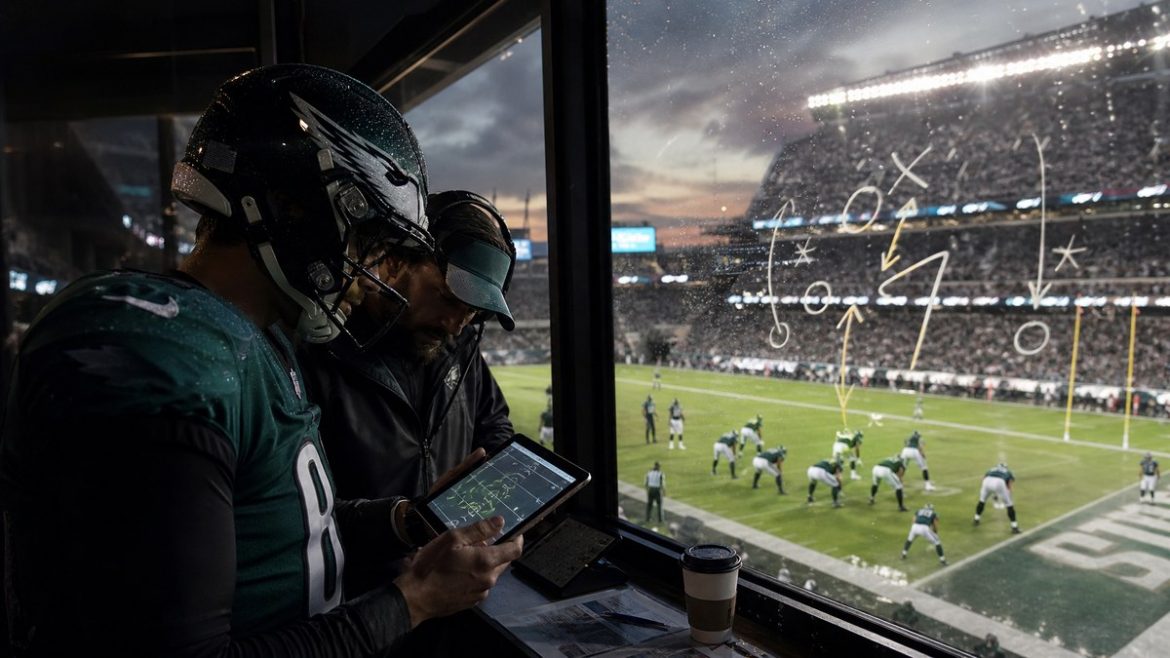
The Philadelphia Eagles are entering the 2026 NFL season with changes on offense and the expectation that those adjustments can help launch another Super Bowl run. Reports published Wednesday did not frame Philadelphia as a team starting over. Instead, the focus is on refining an offense that remains central to the franchise’s championship ambitions.
Philadelphia Eagles seek progress rather than a rebuild
The distinction between adjustment and reconstruction is important for the Eagles. Philadelphia has spent much of the past several seasons among the NFC’s leading contenders, reaching the Super Bowl twice in a three-year span and winning the championship to conclude the 2024 season. That recent history creates a different standard than the one facing a developing team.
For the Eagles, offensive changes will be measured by whether they improve consistency against the strongest opponents and hold up over a complete season. A productive September can establish confidence, but Philadelphia’s larger objective requires an attack capable of adapting as defensive coordinators accumulate film and identify tendencies.
The reports distributed Wednesday emphasize hope that the changes will produce another trip to the Super Bowl. They do not, however, provide enough detail in the available summaries to identify every alteration or assign responsibility for specific schematic decisions. The broad direction is clear: Philadelphia believes a modified offensive approach can help maximize a roster built to compete now.
Jalen Hurts remains central to the Eagles offense
Any discussion of Philadelphia’s offense begins with quarterback Jalen Hurts. His combination of passing, designed rushing ability and strength in short-yardage situations has shaped the Eagles’ identity during their recent run of success. It also gives the coaching staff options that are not available to every offense.
Hurts was named the most valuable player of Super Bowl LIX after Philadelphia defeated the Kansas City Chiefs 40-22 in February 2025. That performance reinforced his ability to deliver on the sport’s biggest stage, but it also raised the standard for every season that followed. The Eagles are no longer simply trying to determine whether Hurts can lead a championship offense. They are trying to build an attack that repeatedly places him in favorable situations.
Changes around a veteran quarterback can affect terminology, play sequencing, protection responsibilities and the way reads are presented. The most successful transitions generally preserve the concepts a quarterback handles well while addressing the areas where opponents have found answers. For Hurts and the Eagles, the practical test will be whether the revised offense operates efficiently without losing the physical character that has defined the unit.
Philadelphia’s championship blueprint offers a foundation
The Eagles’ most recent title team provided a clear model. Philadelphia combined a powerful running game with explosive skill-position talent and an offensive line capable of controlling games. Running back Saquon Barkley became the centerpiece of that ground attack in 2024, rushing for 2,005 yards during the regular season and finishing with 2,504 when the postseason was included.
That production gave the Eagles balance and reduced the need to ask Hurts to solve every difficult situation through the air. A dependable running game also helped Philadelphia control possession, create manageable third downs and use play-action opportunities. Those principles are likely to remain relevant even as the offense evolves.
Change does not necessarily require abandoning a successful identity. It can mean altering formations, disguising familiar concepts or finding different ways to involve key players. It can also involve improving responses to defensive pressure, tightening execution in the red zone and creating easier completions when an opponent limits deeper routes.
For Philadelphia, maintaining balance will be particularly significant. An offense built too heavily around one phase becomes easier to anticipate, especially during the postseason, when opponents have more time to prepare. The Eagles’ best teams have forced defenses to account for the quarterback run, the conventional ground game and downfield passing threats on the same series.
Nick Sirianni faces another test of offensive adaptability
Head coach Nick Sirianni has overseen one of the most successful periods in franchise history, but that success has brought repeated change to his coaching staff and offensive structure. Deep postseason runs often create opportunities for assistants elsewhere, making continuity difficult even for winning organizations.
Sirianni’s responsibility extends beyond choosing individual plays. He must ensure that the offense has a coherent identity, that communication remains clear and that changes serve the personnel rather than complicate their assignments. Early-season mistakes are common when terminology or responsibilities shift, but a contender cannot allow an adjustment period to become a prolonged source of inconsistency.
The Eagles also must determine which developments are meaningful and which are simply normal September volatility. One uneven game does not establish that a new approach has failed, just as one high-scoring performance does not guarantee long-term success. Philadelphia’s evaluation will continue throughout the season as opponents adjust and the Eagles respond.
NFC competition leaves little margin for offensive inconsistency
Philadelphia’s recent achievements guarantee respect, not passage through the NFC. The conference’s playoff race annually turns on health, divisional results and performance in close games. Offensive reliability can separate teams with similar talent, particularly late in the season when weather, injuries and detailed scouting can make explosive plays more difficult to produce.
That is why situational performance will provide an important measure of the Eagles’ changes. Third-down conversions, red-zone possessions, pass protection and late-game drives often determine whether a good regular-season team becomes a genuine championship threat. Philadelphia already knows it can reach the sport’s final game. The challenge is reproducing that standard while opponents continue to study the methods behind its success.
The Eagles’ history also illustrates how quickly expectations can shift. Philadelphia lost Super Bowl LVII to Kansas City after the 2022 season, then returned two years later and beat the Chiefs for the title. Those appearances showed both the difficulty of reaching the Super Bowl and the value of maintaining a competitive core through changes in personnel and coaching.
Eagles’ offensive changes will be judged over time
The immediate attention will fall on visible differences: formations, pace, personnel deployment and the distribution of touches. The more consequential evidence may be less dramatic. Cleaner protection calls, fewer stalled possessions and better answers against pressure can have a larger effect on a season than a handful of new plays.
Philadelphia enters 2026 with a clear objective and recent proof that its broader team-building approach can produce a championship. The offense does not need to erase its past identity. It needs to make that identity less predictable, more sustainable and better equipped for the challenges that develop over a long NFL season.
Whether those changes are sufficient will not be settled in the opening weeks. The meaningful judgment will come when the Eagles face high-level defenses, difficult road environments and the pressure of the postseason. For a franchise pursuing another Super Bowl appearance, that is the standard by which every offensive adjustment ultimately will be measured.