
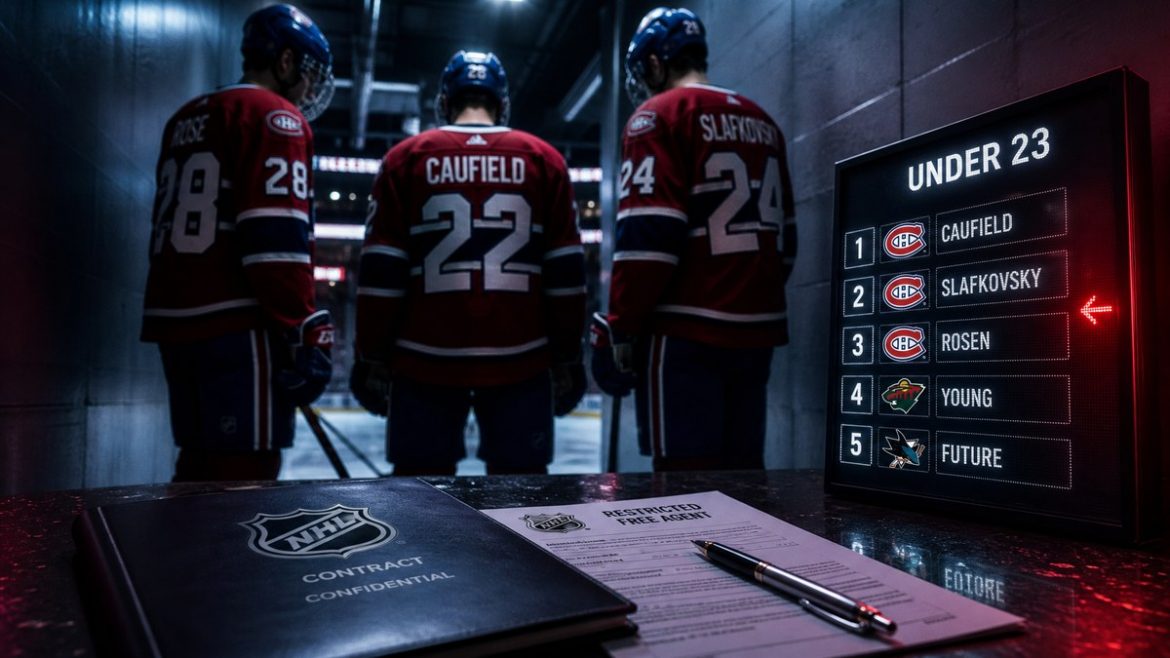
The Washington Capitals’ looming restricted free-agent decisions have moved into focus alongside a broader discussion about the NHL’s top players under age 23. The two subjects are closely connected: young talent is central to building a competitive roster, but teams must also determine how quickly to make long-term financial commitments to players who are still developing.
Washington Capitals face important RFA contract decisions
Reports published Thursday highlighted pending extension questions for Washington while also examining the debate surrounding a ranking of the league’s leading under-23 players. The reports did not announce a new Capitals contract or identify a completed transaction. Instead, they framed Washington’s restricted free-agent business as an approaching roster-management issue.
Restricted free agency gives an NHL club more control than unrestricted free agency, but it does not remove the need for difficult negotiations. Teams generally must decide whether to pursue a short-term agreement, which can preserve flexibility, or a longer contract that may provide cost certainty through important years of a player’s career.
That choice depends on more than a player’s most recent point total. Management must consider role, usage, health, development, comparable contracts and the club’s broader salary structure. The player’s arbitration eligibility and qualifying-offer requirements can also affect the process, depending on his age and professional experience.
For Washington, each RFA negotiation is part of a larger plan. A contract cannot be evaluated only by its immediate salary-cap charge. Its length and structure can influence future roster moves, determine when a player next reaches free agency and affect how much room remains for other extensions or additions.
NHL under-23 rankings generate a wider evaluation debate
The discussion also centers on The Athletic’s ranking of top NHL players under 23, according to the syndicated reports carried by multiple outlets. Such lists naturally invite disagreement because they require comparisons among players at significantly different stages of their careers.
An established NHL regular may offer a larger body of work than a recent draft pick, while a younger prospect may have greater projected upside. A high-scoring forward is also easier to compare statistically than a defenseman whose value comes from transition play, positioning or difficult assignments. Goaltenders present another challenge because their development timelines and year-to-year results can differ sharply from those of skaters.
Age-based rankings also depend heavily on methodology. Some evaluations emphasize current NHL performance. Others place more weight on long-term ceiling, positional value or the likelihood that a prospect reaches his projected role. A list can produce very different results depending on how those factors are balanced.
The age cutoff itself creates another important distinction. A 22-year-old with several professional seasons may be grouped with a teenager who has not yet played a full NHL schedule. Both qualify for the same category, but they carry different levels of certainty. One has already demonstrated how his game translates against NHL competition; the other may be evaluated largely on projection and performance at lower levels.
Young-player rankings and contracts answer different questions
Public rankings and NHL contract decisions overlap, but they are not the same exercise. A ranking asks where a player belongs relative to his peers. A contract negotiation asks what that player is worth to a specific team under a particular set of roster and salary-cap circumstances.
A player can rank highly in an under-23 evaluation without being positioned for an immediate long-term extension. His club may prefer a shorter agreement because his NHL role remains unsettled or because management needs financial flexibility. Conversely, a player who receives less attention in a league-wide ranking may be especially valuable to his team because he fills a scarce role or fits well within its system.
Contract leverage also differs from player to player. Restricted free agents do not all have identical rights, and their negotiating positions can be shaped by service time, arbitration eligibility and recent performance. That makes direct comparisons imperfect even when two players are close in age and production.
For the Capitals, the relevant question is therefore not simply where one of their young players might appear on an outside list. The more significant issue is how Washington projects that player’s role over the full term of a proposed contract and how much uncertainty the organization is prepared to accept.
Bridge contracts and long-term extensions carry different risks
A shorter bridge contract can give a team additional time to evaluate a young player before making a major commitment. It can also give the player an opportunity to earn a more lucrative deal by establishing a larger role. The trade-off for the club is that a strong performance during the bridge term may increase the price of the next contract.
A long-term extension offers a different calculation. If the player develops as expected, the agreement can become efficient relative to future production and rising market prices. If his growth stalls, the team may be left with less cap flexibility for several seasons.
Those competing risks help explain why RFA negotiations can continue even when both sides want the player to remain with the organization. The central disagreement may concern term, future potential or how much of the player’s projected improvement should be reflected in the present contract.
The decision is especially important for clubs trying to manage a transition between roster generations. Young players need opportunities, but management also has to preserve enough flexibility to address immediate needs. Locking in several developing players can create continuity; doing so at the wrong price can restrict future options.
Washington’s next steps will clarify its roster priorities
The syndicated reports did not establish a timetable for Washington’s RFA resolutions, and no outcome should be assumed until an agreement is announced by the club or confirmed by the parties involved. The Capitals can continue negotiating while assessing how each potential contract fits within the rest of their roster planning.
Qualifying offers, arbitration-related deadlines and the opening of training camp can create pressure points during an NHL offseason, although the circumstances vary for each player. Agreements may arrive quickly, or talks may extend as the sides work through term and salary.
Until Washington completes its pending business, the under-23 rankings debate provides useful context rather than a definitive answer. External evaluations can illustrate how young talent is viewed across the league, but the Capitals’ contract decisions will offer the clearer indication of how the organization values its own developing players.
Sources
- Top Under-23 NHL Players: Debating The Athletic’s Rankings + RFA Extensions Loom For Washington — WFMY News 2
- Top Under-23 NHL Players: Debating The Athletic’s Rankings + RFA Extensions Loom For Washington — My FOX Zone
- Top Under-23 NHL Players: Debating The Athletic’s Rankings + RFA Extensions Loom For Washington — KARE 11