
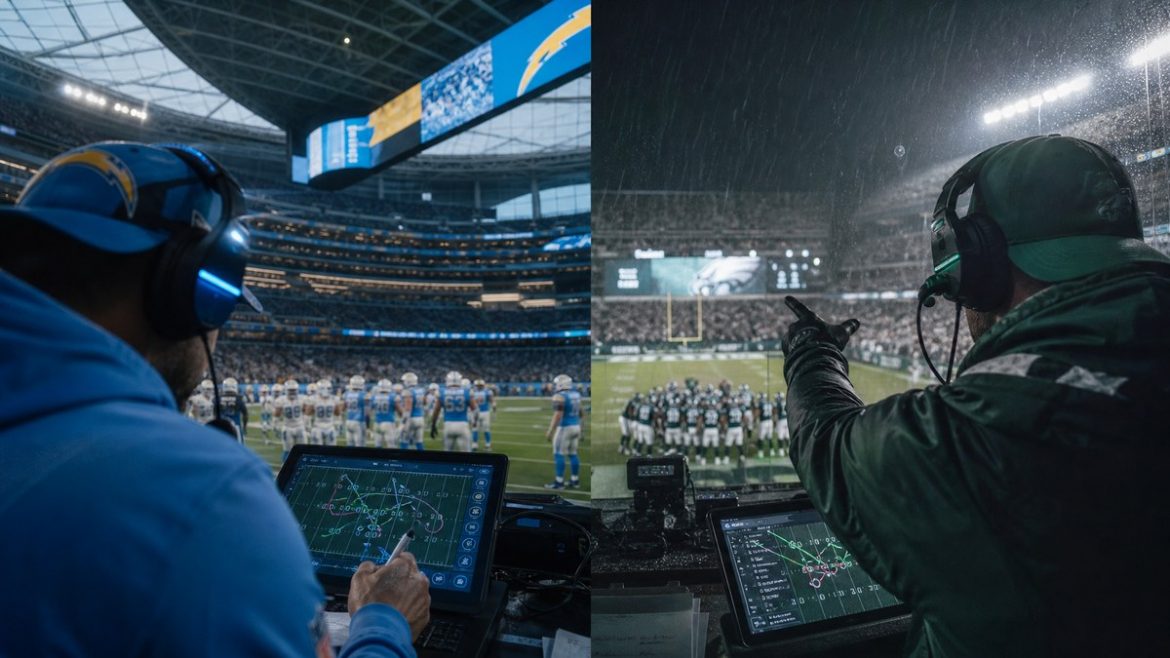
The Los Angeles Chargers and Philadelphia Eagles are entering the 2026 NFL season with new play-callers, according to published reports, giving two playoff teams a significant change to manage during the preseason. The decisions matter because changing the voice directing an offense can affect game planning, communication and situational choices even when much of the existing system and personnel remains intact.
Chargers and Eagles Make Changes After Playoff Appearances
The Chargers and Eagles are part of a group of recent playoff teams looking for improved results through changes in play-calling responsibilities. Reports published Monday identified both clubs among the postseason qualifiers hoping a different approach on game day can provide a lift in 2026.
The available reports characterize the changes broadly and do not establish that either team is undertaking a complete schematic overhaul. A new play-caller does not necessarily mean a new playbook. Teams frequently retain core concepts, terminology and personnel packages while changing the person responsible for sequencing calls and making adjustments during a game.
That distinction is important for teams coming off playoff seasons. Los Angeles and Philadelphia are not rebuilding from the ground up. Their postseason appearances indicate that each had a roster and overall structure capable of navigating the regular season successfully enough to qualify. The objective now is to preserve that foundation while finding more consistent or efficient ways to deploy it.
New NFL Play-Callers Face a Compressed Preparation Window
August provides the first sustained opportunity for a new play-caller to rehearse the full operation under game conditions. Training-camp practices can simulate down, distance and field position, but preseason games add the pressures of the play clock, headset communication, substitutions and an opposing staff making real-time adjustments.
The process involves more than selecting a play from a call sheet. The play-caller must receive information from coaches in the booth and on the sideline, consider personnel availability and communicate the decision to the quarterback with enough time left for the offense to reach the line and make any necessary checks. Delays at any point can limit the quarterback’s options or force the use of a timeout.
For the Chargers and Eagles, preseason work therefore serves two purposes. Coaches can evaluate players competing for roles, and the offensive operation can practice its communication chain. The final score of an exhibition game is less informative than whether the unit breaks the huddle cleanly, avoids procedural errors and reaches the line with time to assess the defense.
Play-Calling Changes Do Not Automatically Mean New Schemes
Any assessment of the two teams should separate play design from play selection. Design concerns how a concept is built: formations, routes, blocking assignments, motion and quarterback reads. Selection concerns when that concept is called and how it fits with the plays immediately before and after it.
A change in the second area can be meaningful without a dramatic change in the first. A new caller might use familiar concepts but arrange them differently, alter the frequency of certain personnel groups or place greater emphasis on favorable down-and-distance situations. The effect often becomes clearest in sequences rather than isolated plays.
That is why early preseason snapshots can be misleading. Teams generally do not reveal the full range of their regular-season plans in August, and established starters may receive limited work. The more useful indicators are organizational: substitutions completed on time, coherent sequencing and an ability to respond when the defense presents an unexpected look.
Situational Football Will Be an Early Test
The most visible scrutiny will come in high-leverage situations. Third downs, red-zone possessions, two-minute drives and short-yardage plays require the caller to balance preparation with immediate information. Those moments also produce the clearest public comparisons with the previous arrangement.
Still, a single decision rarely offers a complete evaluation. A call can be sound and fail because of protection trouble, a missed assignment or effective defense. Conversely, an imperfect decision can succeed because a player wins an individual matchup. Coaches will review whether the call created the intended opportunity, not merely whether the play gained yards.
Game management also enters the equation. The caller must know when the head coach wants to increase tempo, protect the clock or use a more conservative approach based on score and field position. Establishing that shared understanding before the regular season is especially important when responsibilities have changed.
Quarterback Communication Is Central to the Transition
No working relationship will draw more attention than the one between each new caller and his quarterback. The quarterback must understand not only the wording of a call but its purpose: where the anticipated matchup is, what defensive response might trigger a change and which option offers the safest answer under pressure.
Clear communication can give a quarterback more time and confidence at the line of scrimmage. It can also help coaches receive useful feedback between series. The quarterback may identify how defenders are handling motion, disguising coverage or attacking a protection. The caller then has to decide whether to revisit a concept, modify it or move to another part of the plan.
That exchange develops through repetition. Practice scripts offer controlled situations, while games introduce the uncertainty that tests how quickly the partnership functions. For playoff-caliber teams, the standard is not simply avoiding confusion. It is turning information into productive adjustments before an opponent can dictate the game.
Expectations Remain High for Two NFL Playoff Teams
Changing play-callers after reaching the postseason creates a particular kind of pressure. A team that missed the playoffs can present a new approach as part of a broader reset. Los Angeles and Philadelphia instead must show that the changes can improve specific aspects of performance without disrupting what already worked.
The early regular-season schedule will provide a more reliable measure than preseason results. Opponents will prepare detailed plans, starters will handle full workloads and coaches will begin building counters from one week to the next. Trends in efficiency, penalties, communication and situational execution will offer better evidence than any single opening-week performance.
There also will be an adjustment period. New play-callers need time to learn which concepts their players execute most consistently under pressure, while players must become comfortable with the caller’s rhythm and preferences. The challenge for teams with postseason expectations is allowing that relationship to develop without surrendering avoidable games.
Chargers and Eagles Seek Refinement Rather Than a Reset
The central storyline for both clubs is refinement. According to the reports, the Chargers and Eagles believe new play-calling leadership can help teams that already reached the playoffs take another step. Whether that happens will depend on more than creativity. Communication, preparation, sequencing and the ability to adjust during games will determine whether the changes produce a measurable return.
For now, the preseason offers a controlled introduction. The more consequential examination begins when regular-season opponents force both teams away from their preferred scripts and require the new callers to solve problems in real time.
Sources
- The Chargers and Eagles are among playoff teams hoping for boosts from new play-callers — LancasterOnline
- The Chargers and Eagles are among playoff teams hoping for boosts from new play-callers — The Killeen Daily Herald
- The Chargers and Eagles are among playoff teams hoping for boosts from new play-callers — Oskaloosa Herald