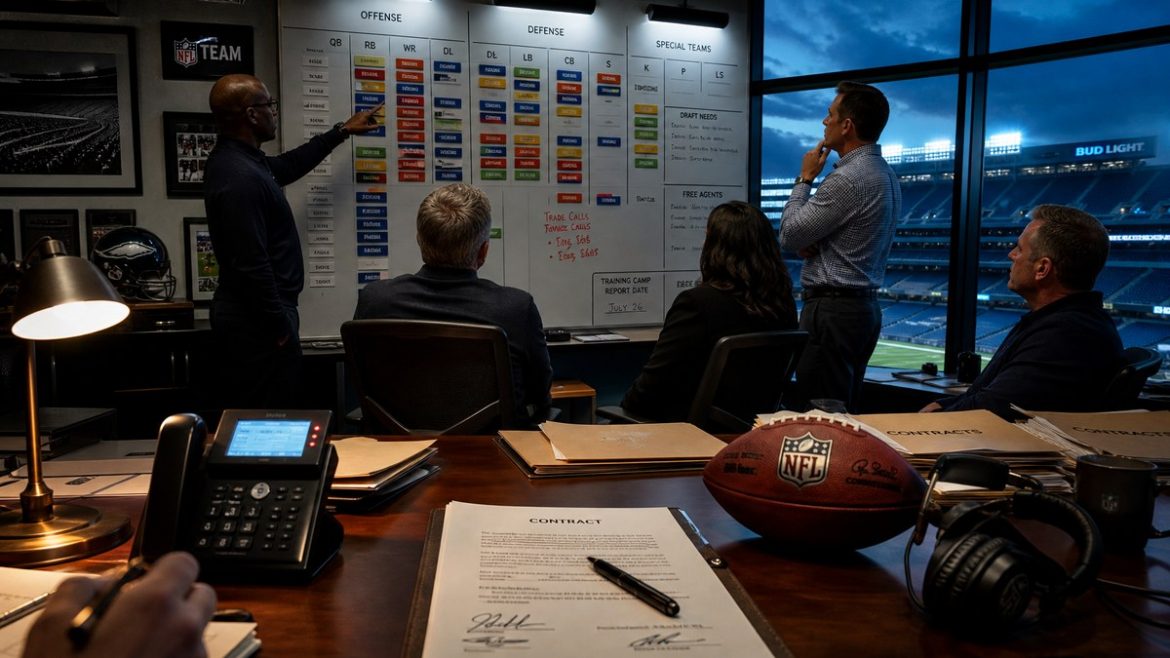
The final stretch of NFL offseason roster building is taking shape across the league, with teams making their last trades, signings and personnel adjustments before training camp opens. ESPN’s roundup of the 32 clubs’ offseason moves underscores a familiar reality in June: while most of the major transactions have already been completed, front offices are still working to sharpen depth charts, reinforce weak spots and create competition at key positions.
That late-offseason work matters because it often determines how complete a roster feels once organized team activities end and players shift toward full camp preparation. For some teams, the last wave of moves is about filling a clear need. For others, it is about protecting against injuries, adding experienced depth or giving coaches another option at a position where uncertainty still lingers.
Teams are still shaping rosters after the biggest moves
By this point on the NFL calendar, most high-profile free-agent signings and top draft decisions are in the books. But the league’s offseason never truly stops, and the moves that happen in June can still have real significance. ESPN’s overview of every team’s offseason activity reflects a leaguewide picture in which no roster is ever finished, even after the draft and the first round of free agency.
For some teams, the final moves are about rounding out special teams units, bolstering the offensive and defensive lines, or adding a veteran at a position group that lacks proven production. For others, the focus is on competition. A backup quarterback battle, a cornerback rotation or the search for a fourth receiver can all be influenced by these later additions.
That is one reason these late offseason transactions draw more attention than they might in another sport. In the NFL, where rosters are smaller and injuries can alter a season quickly, even a modest signing can influence how a team survives the fall and winter months. The difference between a roster that merely looks deep on paper and one that can withstand injuries is often found in these less glamorous transactions.
Why the final offseason moves matter for contenders and rebuilds
The implications vary widely depending on the team’s stage of development. Contenders typically use this part of the offseason to patch specific holes and preserve flexibility. If a team believes it has a playoff-caliber core, the goal is not to chase headlines. It is to avoid leaving any vulnerable spots exposed for September.
Rebuilding teams, meanwhile, may use their remaining offseason moves to add younger players, claim roster-fitting veterans, or bring in competition without sacrificing long-term plans. The emphasis is often less about immediate upside and more about whether a player fits the coaching staff’s vision. June signings can sometimes be overlooked at the time and then become meaningful if an unexpected injury forces the player into a bigger role later in the year.
The ESPN roundup also serves as a reminder that offseason grades are not fixed in one moment. Teams continue to evolve after the draft, and the decisions made now can alter how a roster is viewed once the season starts. A team that looked thin in April may appear much stronger by June. A club that seemed stable may still be one injury away from revisiting the same position in August.
How roster depth has become a bigger NFL story
The growing emphasis on depth is not new, but it has become more visible in recent seasons. The NFL schedule is demanding, and the line between a successful season and an injury-riddled one is narrow. That reality pushes teams to keep adding bodies even after the main wave of offseason business is complete.
This is especially true at premium positions such as quarterback, tackle, edge rusher and cornerback, where a single absence can affect an entire game plan. It is also true on the interior lines, where wear and tear can accumulate over time. Front offices know that a roster built only around its starters is rarely enough to get through a full season.
As a result, these final offseason moves can be viewed as an insurance policy. Teams may not know exactly which players will matter most in November, but they know the season will test the full roster. The clubs that prepare best now often benefit later, when attrition begins to reshape depth charts and practice squads.
Training camp will reveal which offseason moves hold up
The next major checkpoint comes when training camp begins and competition becomes more visible. Players who were added late in the offseason often get a clearer chance to prove they belong once pads come on and teams can evaluate them against live competition. Some will stick because of their experience. Others may flash enough in camp to earn a role that was not expected when they signed.
That is the practical value of these final offseason moves: they create options. A signing in June does not guarantee a roster spot in September, but it can improve the quality of the competition and give a team more answers if injuries or inconsistency surface later.
For coaches, the last roster decisions are also about continuity. The more stable a team can make its lineup before camp, the more it can spend the summer refining execution rather than searching for fixes. That does not mean every team gets everything right. It simply means the best-run organizations are usually the ones still working the margins while others have already moved on to the next phase of the calendar.
The broader NFL offseason picture
ESPN’s final offseason review of all 32 teams is useful because it places each club’s moves in context. The NFL is not built on one marquee acquisition alone. It is built on layers of decisions: draft picks, free-agent additions, contract extensions, trades and the late-summer depth moves that can help a roster survive the season.
That bigger picture matters because every organization enters camp with different priorities. Some are trying to complete a playoff push. Some are trying to support a young quarterback. Some are trying to identify which veterans still fit a changing roster. The offseason is the same leaguewide, but the meaning of each move is not.
What remains constant is the urgency. Even in June, every team is trying to leave as little unresolved as possible before the regular season approaches. ESPN’s leaguewide offseason summary shows that the work is not finished — it has only moved into a quieter, but still important, stage.
As training camp gets closer, these final moves may not dominate headlines for long. But they will shape the way teams look when the games begin, which is ultimately the point. In the NFL, offseason business is never just about the transaction itself. It is about building enough margin to survive the season ahead.
Sources
- Final NFL offseason moves for 32 teams: Trades, signings, more – ESPN India
- Final NFL offseason moves for 32 teams: Trades, signings, more – ESPN