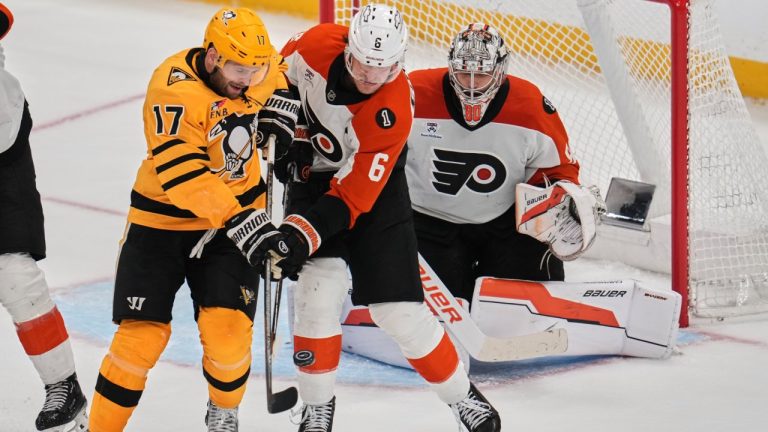
The state of Pennsylvania is currently the epicenter of the hockey world as the “Battle of Pennsylvania” returns to its most hostile environment. The Philadelphia Flyers have stunned the league—and certainly the Pittsburgh Penguins—by storming out to a 2-0 series lead. As the scene shifts to the Wells Fargo Center for Game 3, the narrative has flipped from “Can the veteran Penguins handle the pressure?” to “Can anyone stop the Flyers’ youth movement?”
This isn’t just a rivalry game; it’s a clash of eras. On one side, you have the legendary Sidney Crosby and Evgeni Malkin trying to claw back into a series that is quickly slipping away. On the other, a relentless, high-octane Philadelphia squad led by a 19-year-old phenom and a goaltender who has suddenly become an impenetrable wall.
The Philadelphia Flyers: Speed, Snarl, and “Vladdy”
The Flyers entered this series as a team many expected to provide a “good effort” but ultimately succumb to Pittsburgh’s postseason experience. Instead, they have dictated every facet of the game. The most glaring advantage for Philadelphia has been their depth and situational awareness.
Dan Vladar has been nothing short of spectacular. His 27-save shutout in Game 2 wasn’t just about the saves; it was about the control he exerted over the crease. According to ESPN’s NHL coverage, Vladar’s “GSAx” (Goals Saved Above Expected) has skyrocketed this postseason, signaling that he isn’t just lucky—he’s technically superior right now.
Furthermore, the emergence of Porter Martone has given the Flyers a weapon the Penguins haven’t found an answer for. Martone is scoring with the poise of a ten-year veteran, finding soft spots in Pittsburgh’s coverage and punishing them for every turnover. The Flyers’ transition game is operating at a high efficiency rating, turning blocked shots and defensive zone wins into odd-man rushes within seconds.
The Pittsburgh Penguins: A Power Play in Peril
For Pittsburgh, the alarm bells are ringing. You don’t often see a team featuring Sidney Crosby, Evgeni Malkin, and Erik Karlsson go 0-for-7 on the power play in a two-game span. The Penguins’ lack of production on the man-advantage has effectively neutered their biggest advantage.
The struggle is largely tactical. Philadelphia is playing an aggressive, diamond-style penalty kill that is taking away Karlsson’s passing lanes at the point. This has forced the Penguins into a “perimeter game,” where they cycle the puck along the boards but rarely penetrate the “high-danger” scoring areas.
Defensively, NHL.com statistical leaders show that while Stuart Skinner has actually played well (stopping 21 of 23 in Game 2 before the empty-netter), he is being hung out to dry by a defense that is struggling to handle Philly’s speed on the forecheck. Pittsburgh’s veterans are looking their age against a Flyers team that is playing “even-keel” hockey, as Owen Tippett described it.
Matchup Analysis: The Tactical Edge
The chess match between Rick Tocchet and Dan Muse has been one-sided thus far. Tocchet has successfully neutralized Sidney Crosby by utilizing a hard-match defensive rotation. By keeping his top defensive pairing on the ice every time Crosby hops over the boards, Tocchet has forced “The Next One” to work for every inch of ice, resulting in zero points for the Penguins’ captain through 120 minutes of play.
The key battle for Game 3 will be the first ten minutes. Philadelphia fans are going to make the Wells Fargo Center a cauldron of noise. If the Penguins can weather the initial storm and find a gritty, “dirty” goal, they might regain some confidence. However, if the Flyers strike first—especially if it’s another tally from the Martone-Tippett-Hathaway group—the Penguins may mentally check out.
Situational factors also heavily favor the home team. The Penguins have lost five straight games dating back to the regular season. This isn’t just a playoff slump; it’s a systemic failure to close out games. According to BBC Sport, momentum in a best-of-seven series is often dictated by the team that wins the “special teams battle,” and currently, Philadelphia is winning that battle by a landslide.
Betting Insights: Finding the Value
When looking at the odds for Game 3, the market is starting to price in the Flyers’ dominance, but there is still value to be found.
-
The Trend: The Penguins are 0-5 in their last 5 games overall. Conversely, the Flyers are playing with house money and a red-hot goaltender.
-
The Total: The “Under” has been the winning play in both games so far (3-2 and 3-0). Playoff hockey usually tightens up as the series progresses, and with Dan Vladar playing at a Vezina-caliber level, goals will be at a premium.
-
Risk vs. Reward: Taking the Flyers on the Moneyline at home is the “safe” play, but the real value lies in the Under 5.5 total goals. Both teams are prioritizing defensive structure over high-risk offensive plays.
Final Prediction: The “Wall” Stays Up
The Penguins are too proud a franchise to go down without a fight, and I expect Sidney Crosby to finally register a point in this game. However, a single point from a superstar isn’t enough to overcome the systemic issues Pittsburgh is facing. The Flyers are younger, faster, and currently getting elite-level goaltending that masks any minor mistakes they make.
The atmosphere in Philadelphia will be electric, and the Flyers have shown they feed off that energy. Expect a tight, physical game where every inch of ice is contested. Pittsburgh will finally break their power-play drought, but Philadelphia’s depth scoring will once again be the difference-maker.
FINAL PICK: Philadelphia Flyers Moneyline & Under 5.5 Total Goals
Betting on the Flyers right now isn’t just riding a “hot hand”—it’s backing a superior tactical system that has successfully solved the Penguins’ aging core. While the total is tempting, the Under is the smartest play given Vladar’s current form and Pittsburgh’s desperate need to play a perfect defensive game to stay alive.