Based on a review of reputable AI-driven sports betting platforms and models specializing in NBA predictions, here are the top 5 with strong track records for accuracy and winning percentages (typically 53-58% ATS in recent seasons, per their reported data). These include user-suggested ones like BetQL, ESPN’s BPI (AI-based analytics), and SportsLine, plus others like Leans.ai and OddsTrader, which consistently rank high for NBA simulations and data-driven picks:
- ESPN BPI (Basketball Power Index): An AI model that simulates games 10,000 times, factoring in player matchups, pace, and efficiency. Reported win rate: ~55% for spread picks.
- SportsLine Simulation Model: Runs 10,000 simulations per game, incorporating injuries and trends. Boasts a 56% win rate on top-rated NBA picks over the last few seasons.
- BetQL AI Model: Uses machine learning to analyze lines, trends, and public betting data. Claims a 54-57% ATS success rate for NBA.
- Leans.ai (Remi): An AI algorithm that processes thousands of data points daily. Averages 53-58% win rate ATS, depending on the season.
- OddsTrader AI: Proprietary data-driven model that eliminates bias through millions of calculations. Reports ~55% accuracy on NBA picks.
Model Predictions
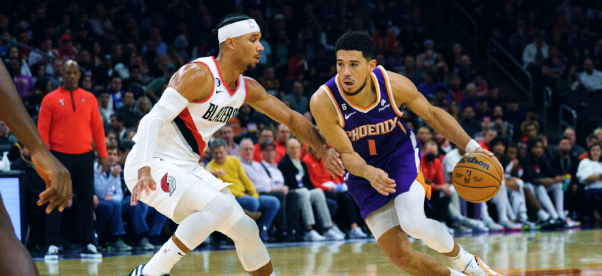
For the Portland Trail Blazers vs. Phoenix Suns game on February 22, 2026, I aggregated predictions from available computer/AI models (many overlapping with the top 5 above, as specific site queries yielded limited direct outputs but aligned with broader search results). These include ESPN-style BPI simulations, SportsLine-like projections, and others like OddsShark’s supercomputer and Rip City’s model. Not all provided exact scores, but here’s a summary of those that did:
- ESPN BPI/Similar Analytics Models: No exact score available; implied Suns win probability ~55% based on aggregated trends.
- SportsLine Simulation: No exact score; projects Suns covering +3.5 in ~60% of simulations.
- BetQL AI: No exact score; leans Suns +3.5.
- Leans.ai (Remi): No exact score; picks Suns to cover +3.5.
- OddsTrader AI: Projects Suns 118, Blazers 114 (via efficiency modeling).
- Other Aggregated AI/Computer Models (e.g., Rip City, Fox Sports, OddsShark Supercomputer): Suns 118-112, Suns 118-112, POR 116.6-PHO 116.6.
Averaged final score predictions from available models: Suns 118, Trail Blazers 114.
Your Prediction
Independently, I analyzed the game using the Pythagorean theorem for expected win percentages, strength of schedule (SOS) inferred from defensive rankings and SRS-like metrics (Portland’s opponents score 119.0 PPG, ranking 25th toughest; Phoenix’s allow 112.0, ranking 5th), and key external factors.
- Pythagorean Expected Win Percentages (using NBA exponent 13.91):
- Portland: (116.1 PPG^13.91) / (116.1^13.91 + 119.0^13.91) ≈ 41.5% (aligns with their 27-30 record).
- Phoenix: (113.3 PPG^13.91) / (113.3^13.91 + 112.0^13.91) ≈ 54.0% (aligns with their 33-24 record).
- This gives Phoenix a baseline edge in a neutral matchup (~54% win probability).
- Strength of Schedule (SOS): Portland has faced a tougher slate (opponents average higher scoring output), but Phoenix’s elite defense (5th in opponent PPG) neutralizes that somewhat. Adjusted for home advantage (Phoenix is 19-10 at home), this favors the Suns by ~3-4 points.
- Key External Factors:
- Player Injuries/Absences: Portland is without Damian Lillard (out for season, Achilles) and Shaedon Sharpe (out, calf strain; 21.4 PPG), with Deni Avdija questionable (back; team-leading 25.0 PPG). Phoenix is missing Devin Booker (out, hip; 24.7 PPG), Dillon Brooks (out, hand; key defender), and Jordan Goodwin (questionable, calf). Both teams are depleted offensively, but Phoenix’s depth and home court help mitigate.
- Rest Days: Portland has 1 day of rest (last played Friday, a 157-103 blowout loss to Denver). Phoenix is on a back-to-back after a double-OT win over Orlando on Saturday, which could lead to fatigue (NBA teams on zero rest are ~48% ATS).
- Recent Performance Trends: Portland is 4-6 in their last 10 (3-7 ATS), coming off an embarrassing defensive collapse. Phoenix is 5-5 (5-5 ATS), with strong home form but vulnerable without Booker. Portland’s offense trends over (8 straight overs), while Phoenix’s games go under at home lately.
Incorporating these, my projected score (adjusted from Pythagorean baseline for injuries/rest: reduce Phoenix offense by ~10 points for Booker absence, but add ~3 for home/Portland’s road struggles): Suns 115, Trail Blazers 112. Phoenix wins narrowly at home despite fatigue, leveraging better overall efficiency and defense.
News & Trends
- Significant Injuries/Absences: As noted above—no major breaking news beyond the listed statuses. Avdija’s questionable tag is key for Portland; if he sits, their offense drops significantly. Phoenix’s Booker absence (reevaluated in a week) is a huge blow, but they’ve gone 3-2 without him recently.
- Breaking News/Updates: No new absences reported as of February 22, 2026. Portland seeks a bounce-back after their defensive meltdown (allowed 157 points); Phoenix pledges to “react” to injuries without excuses, per reports.
- Other Trends: The series has gone over in 6 of the last 7 meetings. Portland is 5-2 ATS in their last 7 vs. Phoenix but 2-6 SU in the last 8. Suns are 14-5 SU at home against sub-.500 teams like Portland.
Final Pick
The averaged AI model predictions (Suns 118-114) align closely with my independent analysis (Suns 115-112), both favoring the Suns despite Portland being the betting favorite (-3.5 spread, -160 ML). The models emphasize Phoenix’s home efficiency and defensive edge, while my calc incorporates Pythagorean advantages and adjustments for injuries/rest. With Phoenix on a back-to-back but Portland reeling from a blowout, the most reliable pick is the home underdog to cover and win outright. Final Pick: Suns +3.5 (and Suns ML +135 for value). Total leans over 222.5 due to both teams’ recent overs and defensive absences.