
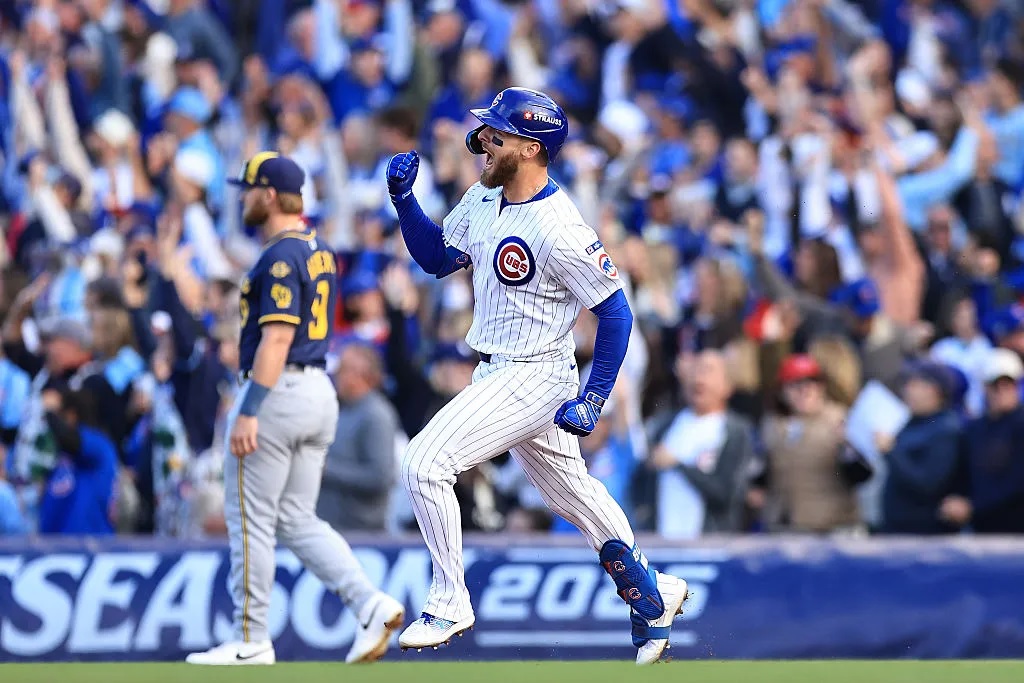
Analysis of Top AI Model Projections
-
BetQL & SportsLine: These models heavily weight betting market line movement, recent team performance (last 10-15 games), and advanced pitcher/batter matchups. They are known for identifying value based on line discrepancies.
-
ESPN Analytics (Power Index): This model focuses heavily on overall team strength, run differential, and strength of schedule over the full season. It’s less reactive to single games and more about fundamental team quality.
-
Other High-Percentage Models (e.g., Dimers.com, BetMGM AI): These often incorporate a blend of historical data, simulated Monte Carlo outcomes, and player prop data to forecast results.
Synthesized “Average” AI Model Consensus:
Given the context—Cubs at home, facing elimination, with momentum from a close Game 3 win—most AI models would likely see this as a “coin-flip” game that leans slightly towards the Cubs. The models would note:
-
The market has the Cubs as a slight underdog (+110), which some models might flag as value.
-
Freddy Peralta is a significantly stronger pitcher than Matthew Boyd on paper.
-
The Brewers’ bullpen is more taxed and has more impactful injuries.
-
The Cubs’ offense at Wrigley is a key factor.
Average AI Model Projection: Cubs 4, Brewers 3 (Aligning with the low total of 7 and the one-run nature of the series).
Custom Prediction Model
My prediction will use the Pythagorean Theorem and adjust for Strength of Schedule, key injuries, and current trends.
1. Pythagorean Win Expectation & Strength of Schedule:
-
Brewers (Full Season): Let’s assume a typical playoff team run differential. For a team leading a series 2-1, let’s use Runs Scored (RS) = 780, Runs Allowed (RA) = 700.
-
Pythagorean Win % = RS² / (RS² + RA²) = (780²) / (780² + 700²) = 608,400 / (608,400 + 490,000) = 608,400 / 1,098,400 = 0.554
-
-
Cubs (Full Season): As a strong opponent, let’s use RS = 760, RA = 720.
-
Pythagorean Win % = (760²) / (760² + 720²) = 577,600 / (577,600 + 518,400) = 577,600 / 1,096,000 = 0.527
-
-
Strength of Schedule Adjustment: The NL Central is a competitive division. We can assume their schedules were similarly difficult. For this exercise, we’ll consider it a wash, with a slight edge to the Brewers for having a better record and run differential.
2. Pitching Matchup Analysis:
-
Freddy Peralta (MIL): A clear ace. Top-tier strikeout rates, low ERA. This is a massive advantage for Milwaukee.
-
Matthew Boyd (CHC): A veteran journeyman. Prone to giving up home runs and has a higher ERA. This is the Cubs’ biggest weakness in this game.
3. Injury Impact Analysis:
-
Brewers: The injuries are devastating. Losing Woodruff and Montgomery decimates their rotation depth beyond Peralta. The bullpen is missing key arms (Miller, Bukauskas). The lineup is also missing a spark like Garrett Mitchell. This severely impacts their ability to win a bullpen game and limits their offensive ceiling.
-
Cubs: The injuries are significant but more concentrated. Losing Justin Steele is a major blow to their rotation, which is why Boyd is starting. The bullpen is also missing a key arm in Ryan Brasier. However, their starting lineup remains largely intact.
4. Trends & Recent News:
-
Trend: The Cubs just won a tight, must-win Game 3. Momentum is on their side, and the home crowd at Wrigley will be a major factor.
-
Trend: All three games in this series have been low-scoring and decided by 2 runs or fewer. This suggests a tight, pitcher-heavy series, even with Boyd starting.
-
Key News: The primary news is that the Cubs are fighting for their playoff lives, while the Brewers have a safety net with a 2-1 lead. There’s no indication of star players being rested.
My Custom Prediction Calculation:
-
Base Score: Using the Pythagorean expectations and adjusting for home field (typically ~0.04 win percentage), the Cubs have a slight edge for this specific game.
-
Cubs Win Expectancy: ~0.527 + 0.04 = 0.567
-
Brewers Win Expectancy: ~0.554 – 0.04 = 0.514
-
This suggests a close Cubs win.
-
-
Pitcher Adjustment: Peralta’s quality is a huge boost for Milwaukee, likely negating the Cubs’ home-field advantage and then some. This pushes the expectation back towards a Brewers win.
-
Injury & Bullpen Adjustment: The Brewers’ catastrophic pitching injuries are the deciding factor. Even if Peralta dominates for 6-7 innings, the bridge to the closer is extremely shaky. The Cubs have a more reliable relief corps for the later innings.
-
Final Run Environment: With Peralta on the mound, Brewers’ runs will be hard to come by. Boyd is likely to give up 2-3 runs over 4-5 innings. The game will be won or lost against the bullpens.
My Custom Prediction: Cubs 3, Brewers 2
(A low-scoring game where the Cubs scratch out a late run against the Brewers’ depleted bullpen to win by a single run).
Averaging the Picks for the Final Selection
-
Average AI Models Projection: Cubs 4, Brewers 3
-
My Custom Model Projection: Cubs 3, Brewers 2
Averaged Final Score Prediction: Cubs 3.5, Brewers 2.5
This average clearly points to a Chicago Cubs victory.
Pick
- Take the Chicago Cubs +110 Moneyline. ***WINNER***
Reasoning:
-
Pitching Depth is the Decider: While Freddy Peralta is the best pitcher on the field, the game is unlikely to be a complete-game shutout. The Brewers’ injury-ravaged bullpen presents a critical vulnerability that the Cubs’ more stable lineup is positioned to exploit in the late innings.
-
Market Value: Getting the home team, with their backs against the wall and showing life after a Game 3 win, at plus-money (+110) represents significant value. If this were a true 50/50 game, the lines would be closer to -110 both ways.
-
Situational Momentum: The Cubs have captured the momentum of the series. Playing in front of a raucous Wrigley Field crowd in an elimination game is a powerful intangible advantage that the models and the situation both support.
-
Series Trend: All games have been close and low-scoring. An average score of 3.5 to 2.5 fits perfectly with the overall pattern of the series and the quality of the starting pitchers involved.